
Homework Answers
(a)
Plugging in given values,
(i) Y = (5 + 5) x (64)1/2 x (64)1/2 = 10 x 8 x 8 = 640
(ii) Y/L = 640 / 64 = 10
(b)
Plugging in new values,
Y = (5 + 5) x (100)1/2 x (100)1/2 = 10 x 10 x 10 = 1000
Y/L = 1000 / 100 = 10
When both K and L are increased by (100/64) times, aggregate Y has increased by exactly (1000/640) = (100/64) times. Hence it exhibits constant returns to scale.
(c)
Plugging in new values,
Y = (5 + 5) x (64)1/2 x (100)1/2 = 10 x 8 x 10 = 800
Y/L = 800 / 100 = 8
(d)
Plugging in new values,
Y = (5 + 5) x (100)1/2 x (64)1/2 = 10 x 10 x 8 = 800
Y/L = 800 / 100 = 8
Add Answer to:
A6-9. Imagine an economy with an average level of human capital (H) equal to 5, an...
15. Consider an economy, with a production function given by Y-AK03L07. This economy's annual GDP growth...
 15. Consider an economy, with a production function given by Y-AK03L07. This economy's annual GDP growth rate is 5%. Also assume that L and Kare both growing at annual rates of 2%. Calculate the growth rate of total factor productivity for this economy. a. 2.0% b. 3.0% 4.0% c. d. 5.0% 16. Suppose output is determined by a Cobb-Douglas production function Y=AK L1 Where 0ca<1. If total factor productivity (A) remains constant, but labour (L) and capital (K) inputs both...
Question#1: Based on the aggregate production function: GDP = FT (L, K, H) a. Imagine that...
Question#1: Based on the aggregate production function: GDP = FT (L, K, H) a. Imagine that the amount of capital K increases by 10% (from 50 to 55 units) while labour and technology stay the same. How much does total GDP and GDP per worker change by? (A specific percentage is not needed, just ‘more than’ / ‘less than’ 10%.) b. Imagine that capital increases by 5 units again, from 55 to 60. How big is the resulting change in...
Consider a closed (no trade) economy "I" with a fixed labor force equal to 1000 and...
Consider a closed (no trade) economy "I" with a fixed labor force equal to 1000 and a fixed capital stock equal to 100 (L=1000, K=100). There is a representative firm with a Cobb-Douglas production function that rents capital and hires labor to produce. ASsume that TFP parameter equals one (A=1) , we have Y=K^1/3 L^2/3. Markets are competitive. 1. Solve for the equilibrium in this economy using the production function. You should get numbers for (Y,K,L,w,r). 2. Solve for the...
Suppose an economy (Home) produces only two goods- Magnets and Neckties. Both goods require both capital...
Suppose an economy (Home) produces only two goods- Magnets and Neckties. Both goods require both capital and labour to produce. Assume capital and labour cannot be substituted for one another in the production process. The economy has 600 units of capital and 800 units of labour available. It takes 4 units of labour and 2 units of capital to make each Magnet and 2 units of labour and 6 units of capital to make each Necktie Problem 2 Now suppose...
MALTHUS AND SOLOW GROWTH MODEL
Malthusian Model of Growth Notation: Yt Aggregate output; Nt Population size; L¯ Land (fixed); ct Per capita consumption Production: Aggregate production function is Yt = F(Nt , Lt) = zN2/3 t L 1/3 t Population Dynamics: Nt+1 = g(ct)Nt Population growth function: g(ct) = (3ct) 1/3 Parameter Values: Land: L¯ = 1000 for all t. Productivity parameter: z = 1 ...
Consider a closed (no trade) economy "I" with a fixed labor force equal to 1000 and...
Consider a closed (no trade) economy "I" with a fixed labor force equal to 1000 and a fixed capital stock equal to 100 (L=1000, K=100). There is a representative firm with a Cobb-Douglas production function that rents capital and hires labor to produce. Assume that TFP parameter equals one (A=1) , we have Y=K^1/3 L^2/3. Markets are competitive. 1. graph the following: plot output per capita on the Y axis and capital per capita on the x axis. and show...
Consider an economy that is characterized by the Solow Model. The (aggregate) production function is given...
Consider an economy that is characterized by the Solow Model. The (aggregate) production function is given by: Y = 6K1/3L2/3 In this economy, workers consume 80% of income and save the rest. The labour force is growing at 2% per year while the annual rate of capital depreciation is 5.5%. a) Solve for the steady state capital-labour ratio and consumption per worker. The economy is in its steady state as described in part (a). Suppose both the stock of capital...
MALTHUSIAN MODEL
 Notation: Yt Aggregate output; Nt Population size; L¯ Land (fixed); ct Per capita consumptionAggregate production function is Yt = F(Nt
, Lt) = zN2/3
t L
1/3
t
Population Dynamics: Nt+1 = g(ct)Nt
Population growth function: g(ct) = (3ct)
1/3
Parameter Values: Land: L¯ = 1000 for all t. Productivity parameter: z = 1
(a) Solve for the steady state of this economy (Steady state: Nt+1 = Nt). Report steady
state values for c and N.
(b) Suppose the economy...
Notation: Yt Aggregate output; Nt Population size; L¯ Land (fixed); ct Per capita consumptionAggregate production function is Yt = F(Nt
, Lt) = zN2/3
t L
1/3
t
Population Dynamics: Nt+1 = g(ct)Nt
Population growth function: g(ct) = (3ct)
1/3
Parameter Values: Land: L¯ = 1000 for all t. Productivity parameter: z = 1
(a) Solve for the steady state of this economy (Steady state: Nt+1 = Nt). Report steady
state values for c and N.
(b) Suppose the economy...
Consider the Solow growth model that we developed in class. Output at time t is given...
 Consider the Solow growth model that we developed in class. Output at time t is given by the production function Y AK Lt, where A is total factor productivity, Kt is total capital at timet and L is the labour force. Total factor productivity A and labour force L are constant over time. There is no government or foreign trade and Y, + 1, where Ct is consumption and I is investment at tim. Every agent saves s share of...
5. Suppose that an economy has a fixed amount L* of homogeneous labour, and a fixed amount K*of h...
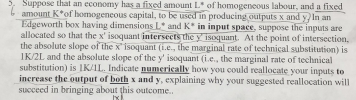 5. Suppose that an economy has a fixed amount L* of homogeneous labour, and a fixed amount K*of homogeneous capital, to be used in producing outputs x and y) In an Edgeworth box having dimensions L and K* in input space, suppose the inputs are the absolute slope of the x isoquant (i.e., the marginal rate of technical substitution) is 1K/2L and the absolute slope of the y' isoquant (i.e., the marginal rate of technical substitution) İs l K/L indicate...
 15. Consider an economy, with a production function given by Y-AK03L07. This economy's annual GDP growth rate is 5%. Also assume that L and Kare both growing at annual rates of 2%. Calculate the growth rate of total factor productivity for this economy. a. 2.0% b. 3.0% 4.0% c. d. 5.0% 16. Suppose output is determined by a Cobb-Douglas production function Y=AK L1 Where 0ca<1. If total factor productivity (A) remains constant, but labour (L) and capital (K) inputs both...
 Consider the Solow growth model that we developed in class. Output at time t is given by the production function Y AK Lt, where A is total factor productivity, Kt is total capital at timet and L is the labour force. Total factor productivity A and labour force L are constant over time. There is no government or foreign trade and Y, + 1, where Ct is consumption and I is investment at tim. Every agent saves s share of...
 5. Suppose that an economy has a fixed amount L* of homogeneous labour, and a fixed amount K*of homogeneous capital, to be used in producing outputs x and y) In an Edgeworth box having dimensions L and K* in input space, suppose the inputs are the absolute slope of the x isoquant (i.e., the marginal rate of technical substitution) is 1K/2L and the absolute slope of the y' isoquant (i.e., the marginal rate of technical substitution) İs l K/L indicate...
Most questions answered within 3 hours.
-
Where is the error in this code sequence?
String s1 = "Hello";
String s2 = "ello";...
asked 11 months ago -
Financial data for Joel de Paris, Inc., for last year
follow:
Joel de Paris, Inc.
Balance...
asked 11 months ago -
Consider this reaction:
Al2(SO4)3 (aq)+ BaCl3
(aq) Al2Cl6 (aq)- +
3BaSO4(s) . What is the...
asked 11 months ago -
Suppose that Savneet is considering increasing her
recent random sample from 20 car rentals to 40...
asked 11 months ago -
Trucks arrive at an unloading terminal at an average rate of 120
per hour.
Trucks arrive...
asked 11 months ago -
Why are methanol and ethanol completely soluble in water while
octanol is not very little soluble....
asked 11 months ago -
A facilities manager at a university reads in a research report
that the mean amount of...
asked 11 months ago -
When the CuSO4 is rehydrated by adding water to the anhydrous
compound, is this an endothermic...
asked 11 months ago -
A ray of sunlight is passing from diamond into crown glass; the
angle of incidence is...
asked 11 months ago -
A block of mass 0.249 kg is placed on top of a light, vertical
spring of...
asked 11 months ago -
how do the kidneys compensate in the presences of acidosis
a) trigger hyperventilate
b) reserve acid...
asked 11 months ago -
Question 501 pts
The rental rate of capital to the firm increases. Which of the
following...
asked 11 months ago