
Homework Answers

Problem 4 (4 points each). Let S = R {0}. (a) Let f: S R be...
 Problem 4 (4 points each). Let S = R {0}. (a) Let f: S R be f(x) = cos(1/x). Show that lim-0 f(x) does not exist. (b) For any fixed a > 0, let f: S+R be f(x) = rºcos(1/x). Show that lim -- f(x) = 0. (c) Find a value be R for which the function f: R+R given by f(x) = { 2" cos(1/x) if r +0, if x = 0, is continuous at 0. Is this b...
7. Let S = [0, 1] × [0, 1] and f : S → R be defined by f(x, y) = ( x + y, if x 2 ≤ y ≤ 2x 2 , 0, elsewhere. Show that f is integrable over S and calculate R S f(z)dz.
7. Let S = [0, 1] × [0, 1] and f : S → R be defined by f(x, y) = ( x + y, if x 2 ≤ y ≤ 2x 2 , 0, elsewhere. Show that f is integrable over S and calculate R S f(z)dz.
(7 pts.) Let f(x, y, z) = "y and let R be the region {(x, y,...
 (7 pts.) Let f(x, y, z) = "y and let R be the region {(x, y, z) |2 < x < 4,0 Sy < 3,15 zse}. 2 Evaluate | $180,0,.2) av. R
ULUM turu Problem 1. Assume that f:R R is continuous and satisfies f(x) - f(y) =...
 ULUM turu Problem 1. Assume that f:R R is continuous and satisfies f(x) - f(y) = (x - y)?, for all x, y ER. Show that f is constant.
the answer should be 4/3 x u Lipulation of X given Y =y? 10. Let X...
 the answer should be 4/3 x
u Lipulation of X given Y =y? 10. Let X and Y have joint density (2xy for 0 Sy < 2x < 2 f(x, y) = { otherwise. What is the conditional expectation of Y given X = r?
the answer should be 4/3 x
u Lipulation of X given Y =y? 10. Let X and Y have joint density (2xy for 0 Sy < 2x < 2 f(x, y) = { otherwise. What is the conditional expectation of Y given X = r?
·J (I) < 0 for all such y. (Hint: let g(x)--f(x) and use part (a)) 3....
 ·J (I) < 0 for all such y. (Hint: let g(x)--f(x) and use part (a)) 3. In this problem, we prove the Intermedinte Value Theorem. Let Intermediate Value Theorem. Let f : [a → R be continuous, and suppose f(a) < 0 and f(b) >0. Define S = {t E [a, b] : f(z) < 0 for allェE [a,t)) (a) Prove that s is nonempty and bounded above. Deduce that c= sup S exists, and that astst (b) Use Problem...
3. Let f: R+R be a function. (a) Assume that f is Riemann integrable on [a,...
 3. Let f: R+R be a function. (a) Assume that f is Riemann integrable on [a, b] by some a < b in R. Does there always exist a differentiable function F:RR such that F' = f? Provide either a counterexample or a proof. (b) Assume that f is differentiable, f'(x) > 1 for every x ER, f(0) = 0. Show that f(x) > x for every x > 0. (c) Assume that f(x) = 2:13 + x. Show that...
12. Let g(x), h(y) and p(z) be functions and define f(x, y, z) = g(x)h(y)p(2). Let...
 12. Let g(x), h(y) and p(z) be functions and define f(x, y, z) = g(x)h(y)p(2). Let R= = {(x, y, z) E R3: a < x <b,c sy <d, eszsf} where a, b, c, d, e and f are constants. Prove the following result SS1, 5100,2)AV = L*()dx ["Mwdy ['Plzdz.
Problem 5. Let f and g be R + R defined as f(x) = 2x +1...
 Problem 5. Let f and g be R + R defined as f(x) = 2x +1 and g(x) = x3 – 2x + 1 Find go f and determine if it is bijective. If it is bijective find its inverse. (20 pts)
Let f be the function defined below on the given region R, and let P be...
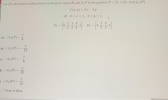 Let f be the function defined below on the given region R, and let P be the partition P = P x P. Find L(P). f (x, y) = 2x – 2y R:03 51, 0 Sy 31 1 P = - [#. - ( a) OL(P) = b) OL(P) = 1 -0) OL(P) = 1 1 1 1) O L;(P) = 12 ) OL(P) 7 12 None of these.
 Problem 4 (4 points each). Let S = R {0}. (a) Let f: S R be f(x) = cos(1/x). Show that lim-0 f(x) does not exist. (b) For any fixed a > 0, let f: S+R be f(x) = rºcos(1/x). Show that lim -- f(x) = 0. (c) Find a value be R for which the function f: R+R given by f(x) = { 2" cos(1/x) if r +0, if x = 0, is continuous at 0. Is this b...
 (7 pts.) Let f(x, y, z) = "y and let R be the region {(x, y, z) |2 < x < 4,0 Sy < 3,15 zse}. 2 Evaluate | $180,0,.2) av. R
 ULUM turu Problem 1. Assume that f:R R is continuous and satisfies f(x) - f(y) = (x - y)?, for all x, y ER. Show that f is constant.
 the answer should be 4/3 x
u Lipulation of X given Y =y? 10. Let X and Y have joint density (2xy for 0 Sy < 2x < 2 f(x, y) = { otherwise. What is the conditional expectation of Y given X = r?
the answer should be 4/3 x
u Lipulation of X given Y =y? 10. Let X and Y have joint density (2xy for 0 Sy < 2x < 2 f(x, y) = { otherwise. What is the conditional expectation of Y given X = r?
 ·J (I) < 0 for all such y. (Hint: let g(x)--f(x) and use part (a)) 3. In this problem, we prove the Intermedinte Value Theorem. Let Intermediate Value Theorem. Let f : [a → R be continuous, and suppose f(a) < 0 and f(b) >0. Define S = {t E [a, b] : f(z) < 0 for allェE [a,t)) (a) Prove that s is nonempty and bounded above. Deduce that c= sup S exists, and that astst (b) Use Problem...
 3. Let f: R+R be a function. (a) Assume that f is Riemann integrable on [a, b] by some a < b in R. Does there always exist a differentiable function F:RR such that F' = f? Provide either a counterexample or a proof. (b) Assume that f is differentiable, f'(x) > 1 for every x ER, f(0) = 0. Show that f(x) > x for every x > 0. (c) Assume that f(x) = 2:13 + x. Show that...
 12. Let g(x), h(y) and p(z) be functions and define f(x, y, z) = g(x)h(y)p(2). Let R= = {(x, y, z) E R3: a < x <b,c sy <d, eszsf} where a, b, c, d, e and f are constants. Prove the following result SS1, 5100,2)AV = L*()dx ["Mwdy ['Plzdz.
 Problem 5. Let f and g be R + R defined as f(x) = 2x +1 and g(x) = x3 – 2x + 1 Find go f and determine if it is bijective. If it is bijective find its inverse. (20 pts)
 Let f be the function defined below on the given region R, and let P be the partition P = P x P. Find L(P). f (x, y) = 2x – 2y R:03 51, 0 Sy 31 1 P = - [#. - ( a) OL(P) = b) OL(P) = 1 -0) OL(P) = 1 1 1 1) O L;(P) = 12 ) OL(P) 7 12 None of these.
Most questions answered within 3 hours.
-
Where is the error in this code sequence?
String s1 = "Hello";
String s2 = "ello";...
asked 10 months ago -
Financial data for Joel de Paris, Inc., for last year
follow:
Joel de Paris, Inc.
Balance...
asked 10 months ago -
Consider this reaction:
Al2(SO4)3 (aq)+ BaCl3
(aq) Al2Cl6 (aq)- +
3BaSO4(s) . What is the...
asked 10 months ago -
Suppose that Savneet is considering increasing her
recent random sample from 20 car rentals to 40...
asked 10 months ago -
Trucks arrive at an unloading terminal at an average rate of 120
per hour.
Trucks arrive...
asked 10 months ago -
Why are methanol and ethanol completely soluble in water while
octanol is not very little soluble....
asked 10 months ago -
A facilities manager at a university reads in a research report
that the mean amount of...
asked 10 months ago -
When the CuSO4 is rehydrated by adding water to the anhydrous
compound, is this an endothermic...
asked 10 months ago -
A ray of sunlight is passing from diamond into crown glass; the
angle of incidence is...
asked 10 months ago -
A block of mass 0.249 kg is placed on top of a light, vertical
spring of...
asked 10 months ago -
how do the kidneys compensate in the presences of acidosis
a) trigger hyperventilate
b) reserve acid...
asked 10 months ago -
Question 501 pts
The rental rate of capital to the firm increases. Which of the
following...
asked 10 months ago