
Homework Answers
Ans. #8. Follow this simplified approach that eliminates any chances of confusion
#I. Identify the oxidation and reduction half reactions. Write them separately.
#II. The standard redox table gives “REDUCTION potential”. So, the numeric sign of reduction-half reaction remains the same as in the table.
#III. Change the numeric sign of “OXIDATION” half reaction.
#IV. ADD the two E0 values of oxidation and reduction half reactions without any further change in the numeric sign.
# Solution:
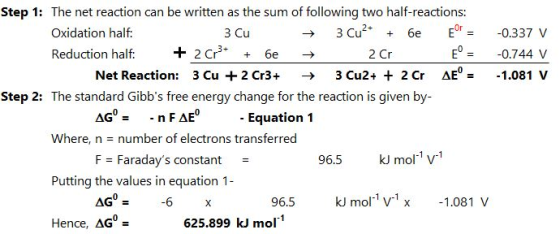
# Correct option- a. 623 kJ (closest value)
If the cathode and anode values have the e- on the standard (left) side of the half cell equations subtract:
Cr3+(aq) + 3e- ==> Cr(s) (Cathode) Eo = -0.744 v
Cu2+(aq) + 2e- ==> Cu(s) (Anode) Eo = +0.34 v
Eocell = Eocathode - Eoanode
Eocell = -0.744 v - 0.34 v
Eocell = -1.084 v
If the cathode and anode values have the e- on the properly represented side of the equations add:
Cr3+(aq) + 3e- ==> Cr(s) (Cathode) Eo = -0.744 v
Cu(s) ==> Cu2+(aq) + 2e- (Anode) Eo = -0.34 v
Eocell = Eocathode + Eoanode
Eocell = -0.744 v + (-0.34) v
Eocell = -1.084 v
Keep in mind the standard form for half cell data is typically presented with the oxidized substance (lost e-) on the left and the reduced substance (gained e-) on the right side of the half cell equation. Because of this, the first equation is generally the one you want to use because by subtracting the two you are already accounting for the sign change that would occur if you used the second method (+0.34 changed to -0.34 when the equation flipped)
Add Answer to:
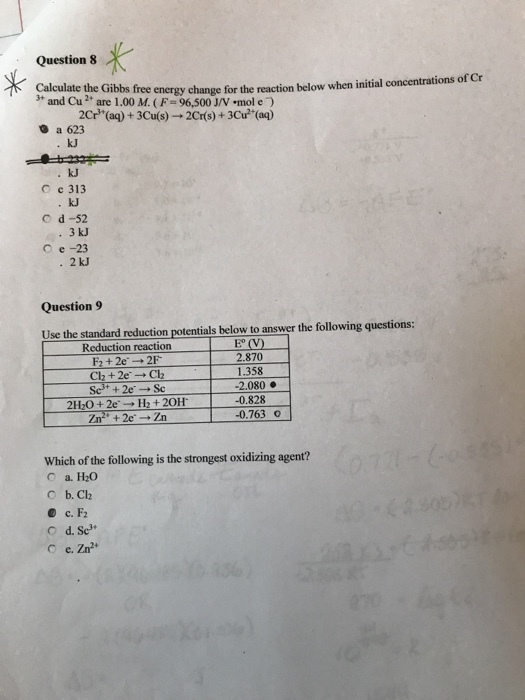
Calculate the Gibbs Free Energy change for reaction below when
initial concentrations of Cr 3+ and...
help please asap 3 Question 44 (1 point) What is the standard Gibbs free energy change...
 help please asap
3 Question 44 (1 point) What is the standard Gibbs free energy change for the reaction below? 2 Au + 3 Mn2+ - 2 Au3+ + 3 Mn % reaction Ered (V) AU3+ + 30 - Au +1.50 Mn2+ + 2e -- Mn -1.18 +185 kJ 0-517 kJ 0-185 kJ -1.55 x 10³ kJ +517 kJ none of these +1.55 x 10³ kJ Question 43 (1 point) Which of the following statements are TRUE about an electrochemical...
help please asap
3 Question 44 (1 point) What is the standard Gibbs free energy change for the reaction below? 2 Au + 3 Mn2+ - 2 Au3+ + 3 Mn % reaction Ered (V) AU3+ + 30 - Au +1.50 Mn2+ + 2e -- Mn -1.18 +185 kJ 0-517 kJ 0-185 kJ -1.55 x 10³ kJ +517 kJ none of these +1.55 x 10³ kJ Question 43 (1 point) Which of the following statements are TRUE about an electrochemical...
mong E'cell, Keq, and Gibbs Free Energy Review I Constants I Periodic Table Constant Value between...
 mong E'cell, Keq, and Gibbs Free Energy Review I Constants I Periodic Table Constant Value between two the standard an be used to 0cour dentified using Pell E and of the reaction. 0.337 V E 0.440 V 8.314 J-mol.K 96,485 C/mol s how Ell 298 K T Part A In the activity, click on the E and K quantities to observe how they are related. Use this relation to calculate K for the following redax reaction that occurs in an...
post lab queations help A voltaic cell consists of a Sn/Sn? half-cell and a Cr/Cr half-cell...
 post lab queations help
A voltaic cell consists of a Sn/Sn? half-cell and a Cr/Cr half-cell at 25 °C. The initial concentrations of Snow and Creare 0.10 M and 0.30 M respectively. Standard reduction potentials are as follows: Sn + 2e → Sn, E = -0.14 V; C* + 3e → Cr, E = -0.76 V 1. Which is the anode, which is the cathode? 2. What is the value of E'cell? 3. What is the value of Q, the...
post lab queations help
A voltaic cell consists of a Sn/Sn? half-cell and a Cr/Cr half-cell at 25 °C. The initial concentrations of Snow and Creare 0.10 M and 0.30 M respectively. Standard reduction potentials are as follows: Sn + 2e → Sn, E = -0.14 V; C* + 3e → Cr, E = -0.76 V 1. Which is the anode, which is the cathode? 2. What is the value of E'cell? 3. What is the value of Q, the...
Answer the following questions for this cell run at 25.0°C and 1.00 M concentrations: Al(s) ǀ...
Answer the following questions for this cell run at 25.0°C and 1.00 M concentrations: Al(s) ǀ Al3+ ǁ Cu2+ ǀ Cu(s) A) Write the equation for the half-reaction that occurs at the anode. Is this an oxidation or reduction? B) Write the equation for the half-reaction that occurs at the cathode. Is this an oxidation or reduction? C) Write the overall balanced net ionic equation for the cell. D) How many moles of electrons are transferred in the reaction? E)What...
Calculate the standard change in Gibbs free energy for the reaction at 25 °C. Standard Gibbs...
 Calculate the standard change in Gibbs free energy for the reaction at 25 °C. Standard Gibbs free energy of formation values can be found in this table. 3H2(g) + Fe,0,($) 2Fe(s) + 3 H,0 () AGran kJ/mol
Calculate the standard change in Gibbs free energy for the reaction at 25 °C. Refer to...
 Calculate the standard change in Gibbs free energy for the reaction at 25 °C. Refer to the AGⓇ values. 3 H2(g) + Fe, 0,(s) 2 Fe(s) + 3 H2O(g) AG" Calculate the standard change in Gibbs free energy for the reaction at 25 °C. Standard Gibbs free energy of formation values can be found in this table. C,H,(8) +4 C1,() 2 CCI, (1) + H2(g) AGE. kJ/mol
+ Calculate the change in the standard free energy for the following reaction: Zn + Cu?+...
 + Calculate the change in the standard free energy for the following reaction: Zn + Cu?+ Zn²+ (aq) + Cu (3) Standard Reduction Potentials (5) (aq) + 2e → = -0.763 V (aq) + 2e → Cu (s) Ered = 0.337 V (aq) → → Zn (5) Ered Zn2+ Cu2+ A. - 212 kJ/mol B. 175 kJ/mol C. 81.0 kJ /mol OD. - 106 kJ / mol
Calculate the standard change in Gibbs free energy, ΔG'm, for the following reaction at 25.0 ℃...
 Calculate the standard change in Gibbs free energy, ΔG'm, for the following reaction at 25.0 ℃ Standard Gibbs free energy of formation values can be found here. NH,CI(s) 근 NH, (aq) + Cl (aq) Number k.J/mol Then, determine the concentration of NH4 (aq) if the change in Gibbs free energy, AGrxn, for the reaction is-9.53 kJ/mol. Number
Calculate the standard change in Gibbs free energy for the reaction at 25 °C. Standard Gibbs...
 Calculate the standard change in Gibbs free energy for the reaction at 25 °C. Standard Gibbs free energy of formation values can be found in this table. 6 C1,() +2 Fe,0,(s) 4 FeC1, (s) + 30,() AGE kJ/mol
Calculate the standard change in Gibbs free energy, AGixn , for the given reaction at 25.0...
 Calculate the standard change in Gibbs free energy, AGixn , for the given reaction at 25.0 °C. Consult the table of thermodynamic properties for standard Gibbs free energy of formation values. NH,CI() = NH(aq) + Cl(aq) AGxn = -7.7 kJ/mol Determine the concentration of NH(aq) if the change in Gibbs free energy, AGrxn , for the reaction is –9.53 kJ/mol. [NH] = 0.72 Consider a general reaction enzyme A(aq) = B(aq) The AG® of the reaction is -4.880 kJ mol-....
 help please asap
3 Question 44 (1 point) What is the standard Gibbs free energy change for the reaction below? 2 Au + 3 Mn2+ - 2 Au3+ + 3 Mn % reaction Ered (V) AU3+ + 30 - Au +1.50 Mn2+ + 2e -- Mn -1.18 +185 kJ 0-517 kJ 0-185 kJ -1.55 x 10³ kJ +517 kJ none of these +1.55 x 10³ kJ Question 43 (1 point) Which of the following statements are TRUE about an electrochemical...
help please asap
3 Question 44 (1 point) What is the standard Gibbs free energy change for the reaction below? 2 Au + 3 Mn2+ - 2 Au3+ + 3 Mn % reaction Ered (V) AU3+ + 30 - Au +1.50 Mn2+ + 2e -- Mn -1.18 +185 kJ 0-517 kJ 0-185 kJ -1.55 x 10³ kJ +517 kJ none of these +1.55 x 10³ kJ Question 43 (1 point) Which of the following statements are TRUE about an electrochemical...
 mong E'cell, Keq, and Gibbs Free Energy Review I Constants I Periodic Table Constant Value between two the standard an be used to 0cour dentified using Pell E and of the reaction. 0.337 V E 0.440 V 8.314 J-mol.K 96,485 C/mol s how Ell 298 K T Part A In the activity, click on the E and K quantities to observe how they are related. Use this relation to calculate K for the following redax reaction that occurs in an...
 post lab queations help
A voltaic cell consists of a Sn/Sn? half-cell and a Cr/Cr half-cell at 25 °C. The initial concentrations of Snow and Creare 0.10 M and 0.30 M respectively. Standard reduction potentials are as follows: Sn + 2e → Sn, E = -0.14 V; C* + 3e → Cr, E = -0.76 V 1. Which is the anode, which is the cathode? 2. What is the value of E'cell? 3. What is the value of Q, the...
post lab queations help
A voltaic cell consists of a Sn/Sn? half-cell and a Cr/Cr half-cell at 25 °C. The initial concentrations of Snow and Creare 0.10 M and 0.30 M respectively. Standard reduction potentials are as follows: Sn + 2e → Sn, E = -0.14 V; C* + 3e → Cr, E = -0.76 V 1. Which is the anode, which is the cathode? 2. What is the value of E'cell? 3. What is the value of Q, the...
 Calculate the standard change in Gibbs free energy for the reaction at 25 °C. Standard Gibbs free energy of formation values can be found in this table. 3H2(g) + Fe,0,($) 2Fe(s) + 3 H,0 () AGran kJ/mol
 Calculate the standard change in Gibbs free energy for the reaction at 25 °C. Refer to the AGⓇ values. 3 H2(g) + Fe, 0,(s) 2 Fe(s) + 3 H2O(g) AG" Calculate the standard change in Gibbs free energy for the reaction at 25 °C. Standard Gibbs free energy of formation values can be found in this table. C,H,(8) +4 C1,() 2 CCI, (1) + H2(g) AGE. kJ/mol
 + Calculate the change in the standard free energy for the following reaction: Zn + Cu?+ Zn²+ (aq) + Cu (3) Standard Reduction Potentials (5) (aq) + 2e → = -0.763 V (aq) + 2e → Cu (s) Ered = 0.337 V (aq) → → Zn (5) Ered Zn2+ Cu2+ A. - 212 kJ/mol B. 175 kJ/mol C. 81.0 kJ /mol OD. - 106 kJ / mol
 Calculate the standard change in Gibbs free energy, ΔG'm, for the following reaction at 25.0 ℃ Standard Gibbs free energy of formation values can be found here. NH,CI(s) 근 NH, (aq) + Cl (aq) Number k.J/mol Then, determine the concentration of NH4 (aq) if the change in Gibbs free energy, AGrxn, for the reaction is-9.53 kJ/mol. Number
 Calculate the standard change in Gibbs free energy for the reaction at 25 °C. Standard Gibbs free energy of formation values can be found in this table. 6 C1,() +2 Fe,0,(s) 4 FeC1, (s) + 30,() AGE kJ/mol
 Calculate the standard change in Gibbs free energy, AGixn , for the given reaction at 25.0 °C. Consult the table of thermodynamic properties for standard Gibbs free energy of formation values. NH,CI() = NH(aq) + Cl(aq) AGxn = -7.7 kJ/mol Determine the concentration of NH(aq) if the change in Gibbs free energy, AGrxn , for the reaction is –9.53 kJ/mol. [NH] = 0.72 Consider a general reaction enzyme A(aq) = B(aq) The AG® of the reaction is -4.880 kJ mol-....
Most questions answered within 3 hours.
-
Where is the error in this code sequence?
String s1 = "Hello";
String s2 = "ello";...
asked 11 months ago -
Financial data for Joel de Paris, Inc., for last year
follow:
Joel de Paris, Inc.
Balance...
asked 11 months ago -
Consider this reaction:
Al2(SO4)3 (aq)+ BaCl3
(aq) Al2Cl6 (aq)- +
3BaSO4(s) . What is the...
asked 11 months ago -
Suppose that Savneet is considering increasing her
recent random sample from 20 car rentals to 40...
asked 11 months ago -
Trucks arrive at an unloading terminal at an average rate of 120
per hour.
Trucks arrive...
asked 11 months ago -
Why are methanol and ethanol completely soluble in water while
octanol is not very little soluble....
asked 11 months ago -
A facilities manager at a university reads in a research report
that the mean amount of...
asked 11 months ago -
When the CuSO4 is rehydrated by adding water to the anhydrous
compound, is this an endothermic...
asked 11 months ago -
A ray of sunlight is passing from diamond into crown glass; the
angle of incidence is...
asked 11 months ago -
A block of mass 0.249 kg is placed on top of a light, vertical
spring of...
asked 11 months ago -
how do the kidneys compensate in the presences of acidosis
a) trigger hyperventilate
b) reserve acid...
asked 11 months ago -
Question 501 pts
The rental rate of capital to the firm increases. Which of the
following...
asked 11 months ago