
Homework Answers

Add Answer to:
Chapter 02, Problem 46 GO Concept Simulation 2.3 provides some background for this problem. A ball...
A ball is thrown vertically upward, which is the positive direction. A little later it returns...
A ball is thrown vertically upward, which is the positive direction. A little later it returns to its point of release. The ball is in the air for a total time of 13.2 s. What is its initial velocity? Neglect air resistance.
A ball is thrown vertically upward, which is the positive direction. A little later it returns...
A ball is thrown vertically upward, which is the positive direction. A little later it returns to its point of release. The ball is in the air for a total time of 7.5 s. What is its initial velocity? Neglect air resistance. (Indicate the direction with the sign of your answer.)
A ball is thrown vertically upward, which is the positive direction. A little later it returns...
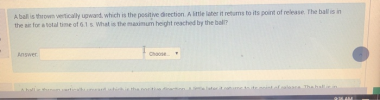 A ball is thrown vertically upward, which is the positive direction. A little later it returns to its point of release. The ball is in the air for a total time of 6.1 s. What is the maximum height reached by the ball? Answer: Choose hallic thrown ortically in which is the native direction to storitratumet tenint of relance The hallic in 0:26 AM
1. Concept Simulation 2.3 offers a useful review of the concepts central to this problem. An...
1. Concept Simulation 2.3 offers a useful review of the concepts central to this problem. An astronaut on a distant planet wants to determine its acceleration due to gravity. The astronaut throws a rock straight up with a velocity of +21.4 m/s and measures a time of 22.0 s before the rock returns to his hand. What is the acceleration (magnitude and direction) due to gravity on this planet? (positive = up, negative = down) 2. A golf ball is...
Please show complete work with necessary unit for full credit. Problem 1: A ball is thrown...
 Please show complete work with necessary unit for full credit. Problem 1: A ball is thrown up vertically from the top of a building of height-100 m with an initial speed of 30 m's. It then goes up for a certain period of time and then comes down to the ground. Neglect the air resistance for calculation (a) How high from the ground will the ball go? (b) How long will it take for the ball to reach to the...
Chapter 20, Problem 106 Your answer is partially correct. Try again. Concept Simulation 20.4 provides background...
 Chapter 20, Problem 106 Your answer is partially correct. Try again. Concept Simulation 20.4 provides background for this problem and gives you the opportunity to verify your answer graphically. How many time constants (a decimal number) must elapse before a capacitor in a series RC circuit is charged to 70.0% of its equilibrium charge? Nu UnitSTNo units the toierance is +/-296 LINK TO TEXT Question Attemptsi Unlimited SAVE FOR LATER SUBHIT ANSWER SUBMIT ANSWER
4. A soccer ball is kicked vertically upward. If it returns to its point of release...
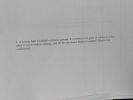 4. A soccer ball is kicked vertically upward. If it returns to its point of release in 4.00s, what is (a) its initial velocity, and (b) the maximum height it reached? (Neglect air resistance)
2/13 A ball is thrown vertically upward with an initial speed of 80 ft/sec from the...
 2/13 A ball is thrown vertically upward with an initial speed of 80 ft/sec from the base A of a 50-ft cliff. Determine the distance h by which the ball clears the top of the cliff and the time t after release for the ball to land at B. Also, calculate the impact velocity UB. Neglect air resistance and the small horizontal motion of the ball. 50 Uo Problem 2/13
Concept Simulation 2.3 offers a useful review of the concepts central to this problem. An astronaut...
 Concept Simulation 2.3 offers a useful review of the concepts central to this problem. An astronaut on a distant planet wants to determine its acceleration due to gravity. The astronaut throws a rock straight up with a velocity of +15.0 m/s and measures a time of 15.1 s before the rock returns to his hand. What is the acceleration (magnitude and direction) due to gravity on this planet? (positive-up, negative-down) Number Units the tolerance is +/-5%
(Problem 2/10 from Meriam and Kraige Dynamics) 60 m A ball is thrown vertically up with a velocity of 36 m/s at the edge of a 60 m cliffa. Neglect air resistance and take the downward acceleration to...
 (Problem 2/10 from Meriam and Kraige Dynamics) 60 m A ball is thrown vertically up with a velocity of 36 m/s at the edge of a 60 m cliffa. Neglect air resistance and take the downward acceleration to be 9.81 m/s2, calculate: (a) the height h to which the ball rises; hNumber (b) the total time t after release for the ball to reach the bottom of the clioff tNumber
(Problem 2/10 from Meriam and Kraige Dynamics) 60 m A...
(Problem 2/10 from Meriam and Kraige Dynamics) 60 m A ball is thrown vertically up with a velocity of 36 m/s at the edge of a 60 m cliffa. Neglect air resistance and take the downward acceleration to be 9.81 m/s2, calculate: (a) the height h to which the ball rises; hNumber (b) the total time t after release for the ball to reach the bottom of the clioff tNumber
(Problem 2/10 from Meriam and Kraige Dynamics) 60 m A...
 A ball is thrown vertically upward, which is the positive direction. A little later it returns to its point of release. The ball is in the air for a total time of 6.1 s. What is the maximum height reached by the ball? Answer: Choose hallic thrown ortically in which is the native direction to storitratumet tenint of relance The hallic in 0:26 AM
 Please show complete work with necessary unit for full credit. Problem 1: A ball is thrown up vertically from the top of a building of height-100 m with an initial speed of 30 m's. It then goes up for a certain period of time and then comes down to the ground. Neglect the air resistance for calculation (a) How high from the ground will the ball go? (b) How long will it take for the ball to reach to the...
 Chapter 20, Problem 106 Your answer is partially correct. Try again. Concept Simulation 20.4 provides background for this problem and gives you the opportunity to verify your answer graphically. How many time constants (a decimal number) must elapse before a capacitor in a series RC circuit is charged to 70.0% of its equilibrium charge? Nu UnitSTNo units the toierance is +/-296 LINK TO TEXT Question Attemptsi Unlimited SAVE FOR LATER SUBHIT ANSWER SUBMIT ANSWER
 4. A soccer ball is kicked vertically upward. If it returns to its point of release in 4.00s, what is (a) its initial velocity, and (b) the maximum height it reached? (Neglect air resistance)
 2/13 A ball is thrown vertically upward with an initial speed of 80 ft/sec from the base A of a 50-ft cliff. Determine the distance h by which the ball clears the top of the cliff and the time t after release for the ball to land at B. Also, calculate the impact velocity UB. Neglect air resistance and the small horizontal motion of the ball. 50 Uo Problem 2/13
 Concept Simulation 2.3 offers a useful review of the concepts central to this problem. An astronaut on a distant planet wants to determine its acceleration due to gravity. The astronaut throws a rock straight up with a velocity of +15.0 m/s and measures a time of 15.1 s before the rock returns to his hand. What is the acceleration (magnitude and direction) due to gravity on this planet? (positive-up, negative-down) Number Units the tolerance is +/-5%
 (Problem 2/10 from Meriam and Kraige Dynamics) 60 m A ball is thrown vertically up with a velocity of 36 m/s at the edge of a 60 m cliffa. Neglect air resistance and take the downward acceleration to be 9.81 m/s2, calculate: (a) the height h to which the ball rises; hNumber (b) the total time t after release for the ball to reach the bottom of the clioff tNumber
(Problem 2/10 from Meriam and Kraige Dynamics) 60 m A...
(Problem 2/10 from Meriam and Kraige Dynamics) 60 m A ball is thrown vertically up with a velocity of 36 m/s at the edge of a 60 m cliffa. Neglect air resistance and take the downward acceleration to be 9.81 m/s2, calculate: (a) the height h to which the ball rises; hNumber (b) the total time t after release for the ball to reach the bottom of the clioff tNumber
(Problem 2/10 from Meriam and Kraige Dynamics) 60 m A...
Most questions answered within 3 hours.
-
Where is the error in this code sequence?
String s1 = "Hello";
String s2 = "ello";...
asked 10 months ago -
Financial data for Joel de Paris, Inc., for last year
follow:
Joel de Paris, Inc.
Balance...
asked 10 months ago -
Consider this reaction:
Al2(SO4)3 (aq)+ BaCl3
(aq) Al2Cl6 (aq)- +
3BaSO4(s) . What is the...
asked 10 months ago -
Suppose that Savneet is considering increasing her
recent random sample from 20 car rentals to 40...
asked 10 months ago -
Trucks arrive at an unloading terminal at an average rate of 120
per hour.
Trucks arrive...
asked 10 months ago -
Why are methanol and ethanol completely soluble in water while
octanol is not very little soluble....
asked 10 months ago -
A facilities manager at a university reads in a research report
that the mean amount of...
asked 10 months ago -
When the CuSO4 is rehydrated by adding water to the anhydrous
compound, is this an endothermic...
asked 10 months ago -
A ray of sunlight is passing from diamond into crown glass; the
angle of incidence is...
asked 10 months ago -
A block of mass 0.249 kg is placed on top of a light, vertical
spring of...
asked 10 months ago -
how do the kidneys compensate in the presences of acidosis
a) trigger hyperventilate
b) reserve acid...
asked 10 months ago -
Question 501 pts
The rental rate of capital to the firm increases. Which of the
following...
asked 10 months ago