Using the rest mass of the electron, show that the energies of the two c-rays produced...
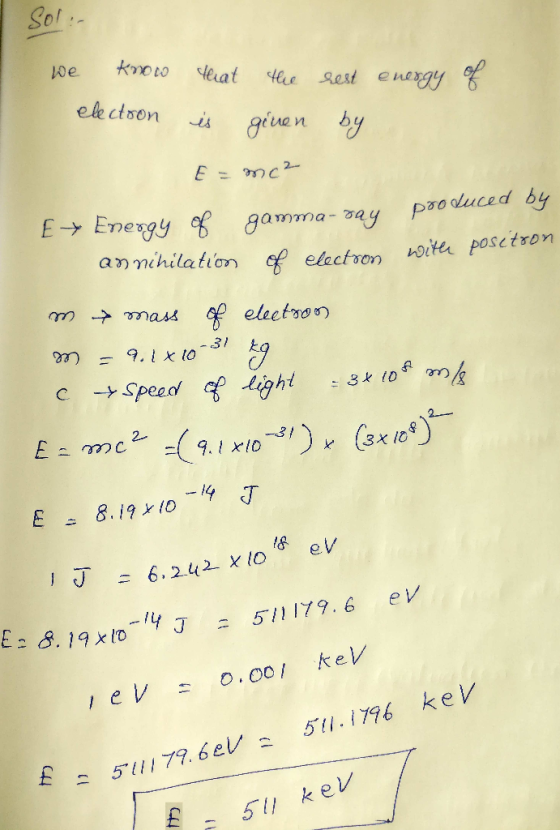
Using the rest mass of the electron, show that the energies of the two c-rays produced by the annihilation of an electron with a positron are 511 keV.
Homework Answers
Add Answer to:
Using the rest mass of the electron, show that the energies of
the two c-rays produced...
2. Electron-positron annihilation A positron with kinetic energy equal to twice its rest mass energy is incident on an...
 2. Electron-positron annihilation A positron with kinetic energy equal to twice its rest mass energy is incident on an electron at rest The positron and electron annihilate creating two photons. One photon goes off at an angle of 30 with respect to the incident positron. Compute the energies of the two photons and find the direction in which the second photon travels
2. Electron-positron annihilation A positron with kinetic energy equal to twice its rest mass energy is incident on...
2. Electron-positron annihilation A positron with kinetic energy equal to twice its rest mass energy is incident on an electron at rest The positron and electron annihilate creating two photons. One photon goes off at an angle of 30 with respect to the incident positron. Compute the energies of the two photons and find the direction in which the second photon travels
2. Electron-positron annihilation A positron with kinetic energy equal to twice its rest mass energy is incident on...
An electron (rest mass me) of energy E makes a head-on collision with a positron (positron...
 An electron (rest mass me) of
energy E makes a head-on collision with a positron (positron is
electron’s antiparticle, it has the same mass as electron, but
opposite charge) In collision the two particles annihilate each
other and are replaces by two photons (γ rays) of equal energy,
each traveling at equal angles θ with electron’s direction of
motion. Find 1. The energy of each photon. 2. The momentum p of
each photon. 3. The angle θ.
Problem 3. Electron-positron...
An electron (rest mass me) of
energy E makes a head-on collision with a positron (positron is
electron’s antiparticle, it has the same mass as electron, but
opposite charge) In collision the two particles annihilate each
other and are replaces by two photons (γ rays) of equal energy,
each traveling at equal angles θ with electron’s direction of
motion. Find 1. The energy of each photon. 2. The momentum p of
each photon. 3. The angle θ.
Problem 3. Electron-positron...
8-14 positron-electron annihilation A positron et of mass m and kinetic energy K is annihilated on...
 8-14 positron-electron annihilation A positron et of mass m and kinetic energy K is annihilated on a target containing electrons e(same mass m) practically at rest in the laboratory frame: et(fast) +e-(at rest) → radiation a By considering the collision in the center-of- momentum frame (the frame of reference in which the total momentum of the initial particles is equal to zero), show that it is necessary for at least two gamma rays (rather than one) co result from the...
Show your solution 5. An electron and a positron (antielectron), both nearly at rest, collide. What...
 Show your solution
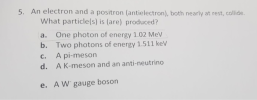
5. An electron and a positron (antielectron), both nearly at rest, collide. What particle(s) is (are) produced? a. One photon of energy 1.02 Mev b. Two photons of energy 1.511 keV c. A pi-meson d. A K-meson and an anti-neutrino e. A W gauge boson
Show your solution
5. An electron and a positron (antielectron), both nearly at rest, collide. What particle(s) is (are) produced? a. One photon of energy 1.02 Mev b. Two photons of energy 1.511 keV c. A pi-meson d. A K-meson and an anti-neutrino e. A W gauge boson
4 The correct value of the Compton wavelength is: A: 2.426E-12 m B: 5.013E-19 eV C:...
4 The correct value of the Compton wavelength is: A: 2.426E-12 m B: 5.013E-19 eV C: 511 keV D: 242.6 fm 5 The Compton wavelength corresponds to the wavelength-shift of a photon scattered at the angle of: A: 0 deg B: 90 deg C: 180 deg D: 360 deg 6 One alpha particle compared to two deuterons (i.e. two atoms of 2H) is: A: Heavier? B: Lighter? C: Has the same mass. D: Comparison is not possible. 7 The mass-difference...
An electron-positron pair (positron is electron’s antiparticle, it has the same mass as electron, but opposite...
 An electron-positron pair
(positron is electron’s antiparticle, it has the same mass as
electron, but opposite charge) can be produced what two photon are
collided. Two photons of frequency ω are collided head-on. What
will be the electron’s momentum? Electron’s rest mass is me
Problem 4. Electron-positron production An electron-positron pair (positron is electron's antiparticle, it has the same mass as electron, but opposite charge) can be produced what two photon are collided. Two photons of frequency w are collided...
An electron-positron pair
(positron is electron’s antiparticle, it has the same mass as
electron, but opposite charge) can be produced what two photon are
collided. Two photons of frequency ω are collided head-on. What
will be the electron’s momentum? Electron’s rest mass is me
Problem 4. Electron-positron production An electron-positron pair (positron is electron's antiparticle, it has the same mass as electron, but opposite charge) can be produced what two photon are collided. Two photons of frequency w are collided...
Problem 4. Electron-positron production An electron-positron pair (positron is electron’s antiparticle, it has the same mass...
Problem 4. Electron-positron production An electron-positron pair (positron is electron’s antiparticle, it has the same mass as electron, but opposite charge) can be produced what two photon are collided. Two photons of frequency ω are collided head-on. What will be the electron’s momentum? Electron’s rest mass is me.
11 The energy of an annihilation photon (511 keV) corresponds to the: A: Speed of light...
11 The energy of an annihilation photon (511 keV) corresponds to the: A: Speed of light in vacuum B: Rest-mass energy equivalent of 1 electron C: Binding energy of a PET-isotope D: Total sum of the electron and positron rest mass 12 An annihilation photon has the frequency: A: 511 MHz B: 1.235E+20 Hz C: 1.235E+17 Hz D: 7.712E+38 Hz 13 An annihilation photon has the wave-length: A: 1.522E-12 m B: 1.235E-12 m C: 2.427E-12 m D: 0.102E-10 m 14...
An electron-positron pair is produced by a 2.30 MeV photon. What is the kinetic energy of...
An electron-positron pair is produced by a 2.30 MeV photon. What is the kinetic energy of the positron if the kinetic energy of the electron is 0.958 MeV? Use the following Joules-to-electron-Volts conversion 1eV = 1.602 × 10⁻¹⁹ J. The rest mass of an electron is 9.11 × 10⁻³¹ kg
An electron-positron pair is produced by a 2.85 MeV photon. What is the kinetic energy of...
An electron-positron pair is produced by a 2.85 MeV photon. What is the kinetic energy of the positron if the kinetic energy of the electron is 1.219 MeV? Use the following Joules-to-electron-Volts conversion 1eV = 1.602 × 10⁻¹⁹ J. The rest mass of an electron is 9.11 × 10⁻³¹ kg Please answer in MeV
 2. Electron-positron annihilation A positron with kinetic energy equal to twice its rest mass energy is incident on an electron at rest The positron and electron annihilate creating two photons. One photon goes off at an angle of 30 with respect to the incident positron. Compute the energies of the two photons and find the direction in which the second photon travels
2. Electron-positron annihilation A positron with kinetic energy equal to twice its rest mass energy is incident on...
2. Electron-positron annihilation A positron with kinetic energy equal to twice its rest mass energy is incident on an electron at rest The positron and electron annihilate creating two photons. One photon goes off at an angle of 30 with respect to the incident positron. Compute the energies of the two photons and find the direction in which the second photon travels
2. Electron-positron annihilation A positron with kinetic energy equal to twice its rest mass energy is incident on...
 An electron (rest mass me) of
energy E makes a head-on collision with a positron (positron is
electron’s antiparticle, it has the same mass as electron, but
opposite charge) In collision the two particles annihilate each
other and are replaces by two photons (γ rays) of equal energy,
each traveling at equal angles θ with electron’s direction of
motion. Find 1. The energy of each photon. 2. The momentum p of
each photon. 3. The angle θ.
Problem 3. Electron-positron...
An electron (rest mass me) of
energy E makes a head-on collision with a positron (positron is
electron’s antiparticle, it has the same mass as electron, but
opposite charge) In collision the two particles annihilate each
other and are replaces by two photons (γ rays) of equal energy,
each traveling at equal angles θ with electron’s direction of
motion. Find 1. The energy of each photon. 2. The momentum p of
each photon. 3. The angle θ.
Problem 3. Electron-positron...
 8-14 positron-electron annihilation A positron et of mass m and kinetic energy K is annihilated on a target containing electrons e(same mass m) practically at rest in the laboratory frame: et(fast) +e-(at rest) → radiation a By considering the collision in the center-of- momentum frame (the frame of reference in which the total momentum of the initial particles is equal to zero), show that it is necessary for at least two gamma rays (rather than one) co result from the...
 Show your solution
5. An electron and a positron (antielectron), both nearly at rest, collide. What particle(s) is (are) produced? a. One photon of energy 1.02 Mev b. Two photons of energy 1.511 keV c. A pi-meson d. A K-meson and an anti-neutrino e. A W gauge boson
Show your solution
5. An electron and a positron (antielectron), both nearly at rest, collide. What particle(s) is (are) produced? a. One photon of energy 1.02 Mev b. Two photons of energy 1.511 keV c. A pi-meson d. A K-meson and an anti-neutrino e. A W gauge boson
 An electron-positron pair
(positron is electron’s antiparticle, it has the same mass as
electron, but opposite charge) can be produced what two photon are
collided. Two photons of frequency ω are collided head-on. What
will be the electron’s momentum? Electron’s rest mass is me
Problem 4. Electron-positron production An electron-positron pair (positron is electron's antiparticle, it has the same mass as electron, but opposite charge) can be produced what two photon are collided. Two photons of frequency w are collided...
An electron-positron pair
(positron is electron’s antiparticle, it has the same mass as
electron, but opposite charge) can be produced what two photon are
collided. Two photons of frequency ω are collided head-on. What
will be the electron’s momentum? Electron’s rest mass is me
Problem 4. Electron-positron production An electron-positron pair (positron is electron's antiparticle, it has the same mass as electron, but opposite charge) can be produced what two photon are collided. Two photons of frequency w are collided...
Most questions answered within 3 hours.
-
Where is the error in this code sequence?
String s1 = "Hello";
String s2 = "ello";...
asked 11 months ago -
Financial data for Joel de Paris, Inc., for last year
follow:
Joel de Paris, Inc.
Balance...
asked 11 months ago -
Consider this reaction:
Al2(SO4)3 (aq)+ BaCl3
(aq) Al2Cl6 (aq)- +
3BaSO4(s) . What is the...
asked 11 months ago -
Suppose that Savneet is considering increasing her
recent random sample from 20 car rentals to 40...
asked 11 months ago -
Trucks arrive at an unloading terminal at an average rate of 120
per hour.
Trucks arrive...
asked 11 months ago -
Why are methanol and ethanol completely soluble in water while
octanol is not very little soluble....
asked 11 months ago -
A facilities manager at a university reads in a research report
that the mean amount of...
asked 11 months ago -
When the CuSO4 is rehydrated by adding water to the anhydrous
compound, is this an endothermic...
asked 11 months ago -
A ray of sunlight is passing from diamond into crown glass; the
angle of incidence is...
asked 11 months ago -
A block of mass 0.249 kg is placed on top of a light, vertical
spring of...
asked 11 months ago -
how do the kidneys compensate in the presences of acidosis
a) trigger hyperventilate
b) reserve acid...
asked 11 months ago -
Question 501 pts
The rental rate of capital to the firm increases. Which of the
following...
asked 11 months ago