Let us assume we are using CRC to detect error.
Let us assume we are using CRC to detect error. The following are given to us
P(X)=X3+X+1
T = 1011011000
Was there an error in transmission? Show your work please.
Homework Answers

assume we want to transmit the message 10001111 and protect it from errors using the CRC...
assume we want to transmit the message 10001111 and protect it from errors using the CRC polynomial x3 + 1 Use polynomial long division to determine the message that should be transmitted. Suppose the leftmost bit of the message is inverted due to noise on the transmission link. What is the result of the receiver’s CRC calculation? How does the receiver know that an error has occurred?
Given below sequence of bitstream and CRC generator value: 1001, how to generate the CRC code?...
 Given below sequence of bitstream and CRC generator value: 1001, how to generate the CRC code? After recelved, how to use CRC method to detect if no error (case1) or the bit shown below underlined is flipped (case 2)2 Show your work on the answersheet. Original data:11100110 Caset: received data without error: 11100110 Case2: Received data with error: 11100100
In this problem, we explore some of the properties of the CRC. For the generator G...
 In this problem, we explore some of the properties of the CRC. For the generator G (-1001) given in Section 6.2.3, answer the following questions. a. Why can it detect any single bit error in data D? b. Can the above G detect any odd number of bit errors? Why?
The CRC is calculated using the following generator polynomial: x8+x2+x+1 a- Find the CRC bits fo...
The CRC is calculated using the following generator polynomial: x8+x2+x+1 a- Find the CRC bits for the following information bits 1111 0000 0000 0000 b- Can this code detect single errors, double errors, and triple errors? Explain why. c. Draw the shift register division circuit for this generator polynomial.
Consider a message D 110100111011001110111. Calculate the CRC code R for that message using a generator-polynomial...
Consider a message D 110100111011001110111. Calculate the CRC code R for that message using a generator-polynomial x4+x+1 (CRC-4-ITU) . Represent in binary code the message to be sent (D and R). Generate 2-bit burst error (erasure error) and show the checking procedure.
decide Tthe problern is easy? Problem 2 (The "Weather frog") Let us assume that a "weather...
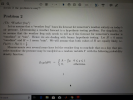 decide Tthe problern is easy? Problem 2 (The "Weather frog") Let us assume that a "weather frog" bases his forecast for tomorrow's weather entirely on today's air pressure. Determining a weather forecast is a hypothesis testing problem. For simplicity, let us assume that the weather frog only needs to tell us if the forecast for tomorrow's weather is "sunshine" or "rain". Hence we are dealing with binary hypothesis testing. Let H 0 mean "sunshine" and H 1 mean "rain". We...
Let us consider a binary symmetric channel, as shown in Figure 1, where the probabilities of the input X are Pr(X-0] =...
 Let us consider a binary symmetric channel, as shown in Figure 1, where the probabilities of the input X are Pr(X-0] = m and Pr(X-1-1-m, and the error probability during the transmission from X and Y is p. 0 1-p Figure 1: A typical binary symmetric channel, where the input is X and the output is Y. a) Given that p-1/3 and m-3/4, find H(X), H (Y), H (YİX), and 1(X:Y). (8 marks) b) Still given p = 1 /3....
Gradient descent weight update rule for a tanh unit. (2 pts) Assume throughout this exercise that we are using gradien...
 Gradient descent weight update rule for a tanh unit. (2 pts) Assume throughout this exercise that we are using gradient descent to minimize the error as defined in formula (4.2) on p.89 in the textbook: td -od Recall that the corresponding weight update rule for a sigmoid unit like the one in Figure 4.6 on p.96 in the textbook is: td - od) od (1-od) i,d ded Let us replace the sigmoid function σ in Figure 4.6 by the function...
Problem 2.2 n and let X ε Rnxp be a full-rank matrix, and Assume p Note that H is a square n × n ...
 Please show all work in READ-ABLE way. Thank you so much in
advance.
Problem 2.2 n and let X ε Rnxp be a full-rank matrix, and Assume p Note that H is a square n × n matrix. This problem is devoted to understanding the properties H Any matrix that satisfies conditions in (a) is an orthogonal projection matriz. In this problem, we will verify this directly for the H given in (1). Let V - Im(X). (b) Show that...
Please show all work in READ-ABLE way. Thank you so much in
advance.
Problem 2.2 n and let X ε Rnxp be a full-rank matrix, and Assume p Note that H is a square n × n matrix. This problem is devoted to understanding the properties H Any matrix that satisfies conditions in (a) is an orthogonal projection matriz. In this problem, we will verify this directly for the H given in (1). Let V - Im(X). (b) Show that...
and Y ~ Geometric - 4 Let X ~ Geometric We assume that the random variables X and Y are statistically independent. Answer the following questions: a (3 marks) For all x E 10,1,2,...^, show that 2+1 P...
 and Y ~ Geometric - 4 Let X ~ Geometric We assume that the random variables X and Y are statistically independent. Answer the following questions: a (3 marks) For all x E 10,1,2,...^, show that 2+1 P(X>x) P(x (3 = Similarly, for all y [0,1,2,...^, show that Show your working only for one of the two identities that are pre- sented above. Hint: You may use the following identity without proving it. For any non-negative integer (, we have:...
 Given below sequence of bitstream and CRC generator value: 1001, how to generate the CRC code? After recelved, how to use CRC method to detect if no error (case1) or the bit shown below underlined is flipped (case 2)2 Show your work on the answersheet. Original data:11100110 Caset: received data without error: 11100110 Case2: Received data with error: 11100100
 In this problem, we explore some of the properties of the CRC. For the generator G (-1001) given in Section 6.2.3, answer the following questions. a. Why can it detect any single bit error in data D? b. Can the above G detect any odd number of bit errors? Why?
 decide Tthe problern is easy? Problem 2 (The "Weather frog") Let us assume that a "weather frog" bases his forecast for tomorrow's weather entirely on today's air pressure. Determining a weather forecast is a hypothesis testing problem. For simplicity, let us assume that the weather frog only needs to tell us if the forecast for tomorrow's weather is "sunshine" or "rain". Hence we are dealing with binary hypothesis testing. Let H 0 mean "sunshine" and H 1 mean "rain". We...
 Let us consider a binary symmetric channel, as shown in Figure 1, where the probabilities of the input X are Pr(X-0] = m and Pr(X-1-1-m, and the error probability during the transmission from X and Y is p. 0 1-p Figure 1: A typical binary symmetric channel, where the input is X and the output is Y. a) Given that p-1/3 and m-3/4, find H(X), H (Y), H (YİX), and 1(X:Y). (8 marks) b) Still given p = 1 /3....
 Gradient descent weight update rule for a tanh unit. (2 pts) Assume throughout this exercise that we are using gradient descent to minimize the error as defined in formula (4.2) on p.89 in the textbook: td -od Recall that the corresponding weight update rule for a sigmoid unit like the one in Figure 4.6 on p.96 in the textbook is: td - od) od (1-od) i,d ded Let us replace the sigmoid function σ in Figure 4.6 by the function...
 Please show all work in READ-ABLE way. Thank you so much in
advance.
Problem 2.2 n and let X ε Rnxp be a full-rank matrix, and Assume p Note that H is a square n × n matrix. This problem is devoted to understanding the properties H Any matrix that satisfies conditions in (a) is an orthogonal projection matriz. In this problem, we will verify this directly for the H given in (1). Let V - Im(X). (b) Show that...
Please show all work in READ-ABLE way. Thank you so much in
advance.
Problem 2.2 n and let X ε Rnxp be a full-rank matrix, and Assume p Note that H is a square n × n matrix. This problem is devoted to understanding the properties H Any matrix that satisfies conditions in (a) is an orthogonal projection matriz. In this problem, we will verify this directly for the H given in (1). Let V - Im(X). (b) Show that...
 and Y ~ Geometric - 4 Let X ~ Geometric We assume that the random variables X and Y are statistically independent. Answer the following questions: a (3 marks) For all x E 10,1,2,...^, show that 2+1 P(X>x) P(x (3 = Similarly, for all y [0,1,2,...^, show that Show your working only for one of the two identities that are pre- sented above. Hint: You may use the following identity without proving it. For any non-negative integer (, we have:...
Most questions answered within 3 hours.
-
Where is the error in this code sequence?
String s1 = "Hello";
String s2 = "ello";...
asked 10 months ago -
Financial data for Joel de Paris, Inc., for last year
follow:
Joel de Paris, Inc.
Balance...
asked 10 months ago -
Consider this reaction:
Al2(SO4)3 (aq)+ BaCl3
(aq) Al2Cl6 (aq)- +
3BaSO4(s) . What is the...
asked 10 months ago -
Suppose that Savneet is considering increasing her
recent random sample from 20 car rentals to 40...
asked 10 months ago -
Trucks arrive at an unloading terminal at an average rate of 120
per hour.
Trucks arrive...
asked 10 months ago -
Why are methanol and ethanol completely soluble in water while
octanol is not very little soluble....
asked 10 months ago -
A facilities manager at a university reads in a research report
that the mean amount of...
asked 10 months ago -
When the CuSO4 is rehydrated by adding water to the anhydrous
compound, is this an endothermic...
asked 10 months ago -
A ray of sunlight is passing from diamond into crown glass; the
angle of incidence is...
asked 10 months ago -
A block of mass 0.249 kg is placed on top of a light, vertical
spring of...
asked 10 months ago -
how do the kidneys compensate in the presences of acidosis
a) trigger hyperventilate
b) reserve acid...
asked 10 months ago -
Question 501 pts
The rental rate of capital to the firm increases. Which of the
following...
asked 10 months ago