
Homework Answers
Add Answer to:
1. Determine the resultant of the following three vector displacements by using the polygon method: (1)...
using the head to tail method of vector addition, sketch the vector c given by c=3A-0.5B...
using the head to tail method of vector addition, sketch the vector c given by c=3A-0.5B where A= 15lb due north B=40lb @35 degrees south of east.... Determine the magnitude and direction of C using the law of sines and the law of cosines
1) Palos de la Frontera (Spain) to Canary Islands: 1400 km; Southwest (50 deg south of...
1) Palos de la Frontera (Spain) to Canary Islands: 1400 km; Southwest (50 deg south of west) 2) Canary Islands to San Salvadore (Bahamas): 7600 km; West 3) San Salvadore (Bahamas) to Cuba: 900 km; Southwest (45 deg south of west) 4) Cuba to Hispaniola & La Navidad: (Current Haiti/Dominican Republic island) 700 Km; Southeast (30 deg below east) 5) Hispaniola/La Navidad to Palos de la Frontera (Portugal): 6530 km; Northeast (40 deg north of east) Answer next 4 questions...
Summary of Christopher Columbus’ first voyage in 1492. The voyage is simplified into the following displacement...
Summary of Christopher Columbus’ first voyage in 1492. The voyage is simplified into the following displacement segments. Round to whole number as you work through the problems. 1) Palos de la Frontera (Spain) to Canary Islands: 1400 km; Southwest (50 deg south of west) 2) Canary Islands to San Salvadore (Bahamas): 7600 km; West 3) San Salvadore (Bahamas) to Cuba: 900 km; Southwest (45 deg south of west) 4) Cuba to Hispaniola & La Navidad: (Current Haiti/Dominican Republic island) 700...
Displacement vector A points due east and has a magnitude of 2.98 km. Displacement vector B...
 Displacement vector A points due east and has a magnitude of 2.98 km. Displacement vector B points due north and has a magnitude of 1.54 km. Displacement vector C boints due west and has a magnitude of 1 km. Displacement vector D points due south and has a magnitude of 1.4 km. Find the magnitude and direction (relative to due east) of the resultant vector A +B+C+D. magnitude direction km ocounterdlockwise from due east Additional Materials section 1 8
Part B Constants Find the magnitude of the resultant displacement, using the method of components. A...
 Part B Constants Find the magnitude of the resultant displacement, using the method of components. A disoriented physics professor drives 3.30 km north, then 2.80 km west, and then 1.60 km south. Express your answer with the appropriate units R- 1 Value Units Submit Part C Find the direction of the resultant displacement measured west of north. west of north Submit Answer Part D Show that the resultant displacement found from your diagram is in qualitative agreement with the result...
Displacement vector A with arrow points due east and has a magnitude of 2.44 km. Displacement...
Displacement vector A with arrow points due east and has a magnitude of 2.44 km. Displacement vector B with arrow points due north and has a magnitude of 2.8 km. Displacement vector C with arrow points due west and has a magnitude of 1.8 km. Displacement vector Darrowbold points due south and has a magnitude of 1 km. Find the magnitude and direction (relative to due east) of the resultant vector A with arrow + B with arrow + C...
1) A point particle makes three successive displacements in a plane: 4.80 m southeast, 6.50 m...
1) A point particle makes three successive displacements in a plane: 4.80 m southeast, 6.50 m east, 7.10 m in a direction 56 degree north of east. Choose the x-axis to point towards the east, and the y-axis to point towards the north. A) Find the x and y components of each displacement and B) the x and y components of the resultant displacement C) Find the single displacement that would be required to bring the particle back to the...
The route followed by a hiker consists of three displacement vectors , , and . Vector...
The route followed by a hiker consists of three displacement vectors , , and . Vector is along a measured trail and is 1710 m in a direction 40.0 ° north of east. Vector is not along a measured trail, but the hiker uses a compass and knows that the direction is 24.0 ° east of south. Similarly, the direction of vector is 43.0 ° north of west. The hiker ends up back where she started, so the resultant displacement...
The route followed by a hiker consists of three displacement vectors A, B, and C. Vector...
The route followed by a hiker consists of three displacement vectors A, B, and C. Vector A is along a measured trail and is 1550 m in a direction 25.0° north of east. Vector B is not along a measured trail, but the hiker uses a compass and knows that the direction is 41.0° east of south. Similarly, the direction of vector C is 35.0° north of west. The hiker ends up back where she started. Therefore, it follows that...
While exploring a cave, a spelunker starts at the entrance and moves the following distances: 75.0...
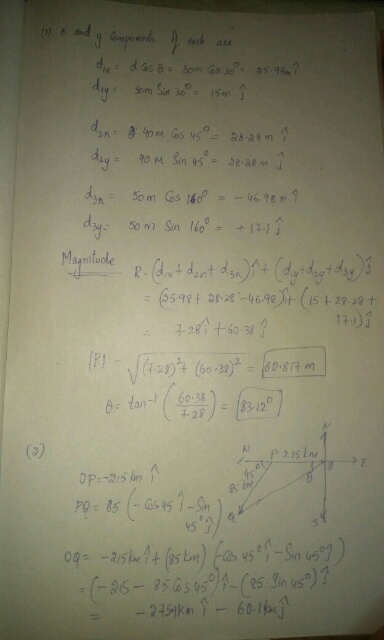
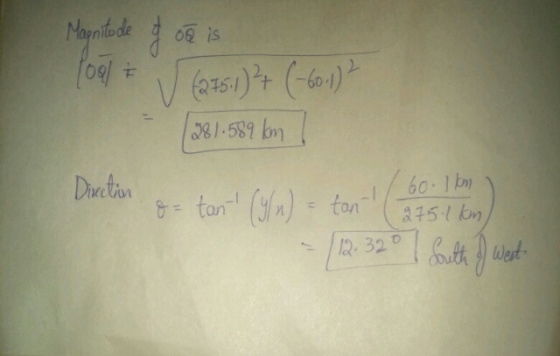
 While exploring a cave, a spelunker starts at the entrance and moves the following distances: 75.0 m north, 215 m east, 215 m at an angle 30.05 the resultant displacement from the cave entrance ㄈㄧ north of east, and 150 m south Find m at e north of east Need Help? .-41 points SerCPS 3 AE 03 -10 A commuter airplane starts from an airport and takes the route shown in the figure below. The plane first flies to city...
 Displacement vector A points due east and has a magnitude of 2.98 km. Displacement vector B points due north and has a magnitude of 1.54 km. Displacement vector C boints due west and has a magnitude of 1 km. Displacement vector D points due south and has a magnitude of 1.4 km. Find the magnitude and direction (relative to due east) of the resultant vector A +B+C+D. magnitude direction km ocounterdlockwise from due east Additional Materials section 1 8
 Part B Constants Find the magnitude of the resultant displacement, using the method of components. A disoriented physics professor drives 3.30 km north, then 2.80 km west, and then 1.60 km south. Express your answer with the appropriate units R- 1 Value Units Submit Part C Find the direction of the resultant displacement measured west of north. west of north Submit Answer Part D Show that the resultant displacement found from your diagram is in qualitative agreement with the result...
 While exploring a cave, a spelunker starts at the entrance and moves the following distances: 75.0 m north, 215 m east, 215 m at an angle 30.05 the resultant displacement from the cave entrance ㄈㄧ north of east, and 150 m south Find m at e north of east Need Help? .-41 points SerCPS 3 AE 03 -10 A commuter airplane starts from an airport and takes the route shown in the figure below. The plane first flies to city...
Most questions answered within 3 hours.
-
Where is the error in this code sequence?
String s1 = "Hello";
String s2 = "ello";...
asked 11 months ago -
Financial data for Joel de Paris, Inc., for last year
follow:
Joel de Paris, Inc.
Balance...
asked 11 months ago -
Consider this reaction:
Al2(SO4)3 (aq)+ BaCl3
(aq) Al2Cl6 (aq)- +
3BaSO4(s) . What is the...
asked 11 months ago -
Suppose that Savneet is considering increasing her
recent random sample from 20 car rentals to 40...
asked 11 months ago -
Trucks arrive at an unloading terminal at an average rate of 120
per hour.
Trucks arrive...
asked 11 months ago -
Why are methanol and ethanol completely soluble in water while
octanol is not very little soluble....
asked 11 months ago -
A facilities manager at a university reads in a research report
that the mean amount of...
asked 11 months ago -
When the CuSO4 is rehydrated by adding water to the anhydrous
compound, is this an endothermic...
asked 11 months ago -
A ray of sunlight is passing from diamond into crown glass; the
angle of incidence is...
asked 11 months ago -
A block of mass 0.249 kg is placed on top of a light, vertical
spring of...
asked 11 months ago -
how do the kidneys compensate in the presences of acidosis
a) trigger hyperventilate
b) reserve acid...
asked 11 months ago -
Question 501 pts
The rental rate of capital to the firm increases. Which of the
following...
asked 11 months ago