
Homework Answers
As per HOMEWORKLIB POLICY, we are mandated to solve only one question. Here is the solution to your first question.
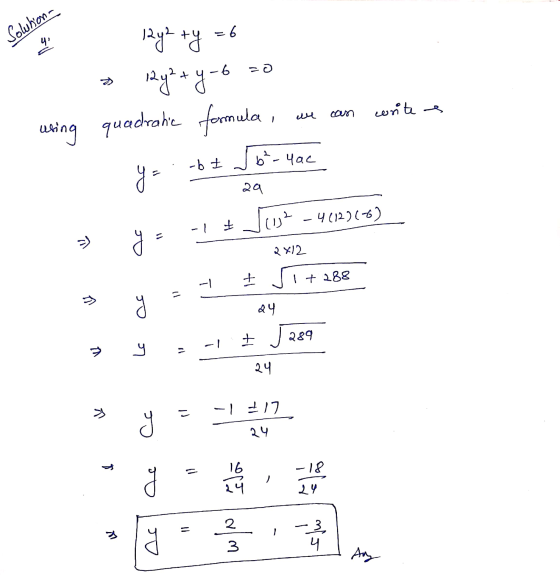
Please give it a thumbs up if you like the answer. Comment if any problem in solution. :)
12y2 for 0 <y sxs1 f(x,y) = 0 0. W. 4x3 for 0 SX S1 (12y2(1...
 12y2 for 0 <y sxs1 f(x,y) = 0 0. W. 4x3 for 0 SX S1 (12y2(1 - y) for 0 sys1 fx(x) = -2230 {*. and fr(y) = 0.w. 0. W. 1 25 2 Also, Var(X) 75 and Var(Y) (a) Find E(XY). (b) Find Cov(X,Y). (c) Find Var(X-Y).
Use the quadratic formula to solve the following equation. This 5y = 7y2 - 2
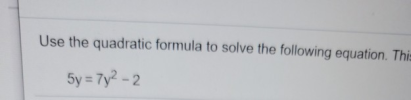 Use the quadratic formula to solve the following equation. This 5y = 7y2 - 2
Find the derivative of each one. a. y = (tan(x2 + 1))4 + 5 In Vx b. с. У-(sin x)cos x a. y = (tan(x2 + 1))4 + 5 In Vx b. с. У-(sin x)cos x
 Find the derivative of each
one.
a. y = (tan(x2 + 1))4 + 5 In Vx b. с. У-(sin x)cos x
a. y = (tan(x2 + 1))4 + 5 In Vx b. с. У-(sin x)cos x
Find the derivative of each
one.
a. y = (tan(x2 + 1))4 + 5 In Vx b. с. У-(sin x)cos x
a. y = (tan(x2 + 1))4 + 5 In Vx b. с. У-(sin x)cos x
(i) Find the area of the region bounded by the curves x = y 5y+6 and...
 (i) Find the area of the region bounded by the curves x = y
5y+6 and x =-y +y+6
Q.2 A. (1) Find the area of the region bounded by the curves x = y2 - 5y +6 and x=-y+y+6 (2 Marks) In(tan x) (ii) Evaluate lim (3 Marks) sinx-cosx B. (1) Evaluate |fxsin(xy dydx (3 Marks) X- (1) Evaluate lim * (11) Evaluate tan lim- (2 Marks) 2 Marks) - tan
(i) Find the area of the region bounded by the curves x = y
5y+6 and x =-y +y+6
Q.2 A. (1) Find the area of the region bounded by the curves x = y2 - 5y +6 and x=-y+y+6 (2 Marks) In(tan x) (ii) Evaluate lim (3 Marks) sinx-cosx B. (1) Evaluate |fxsin(xy dydx (3 Marks) X- (1) Evaluate lim * (11) Evaluate tan lim- (2 Marks) 2 Marks) - tan
Quadratic approximation: Cubic approximation: 2 near the origin Use Taylor's formula for f(x,y) at the origin...
 Quadratic approximation:
Cubic approximation:
2 near the origin Use Taylor's formula for f(x,y) at the origin to find quadratic and cubic approximations of f(x,y) = 7- x-V The quadratic approximation for f(x,y) is
2 near the origin Use Taylor's formula for f(x,y) at the origin to find quadratic and cubic approximations of f(x,y) = 7- x-V The quadratic approximation for f(x,y) is
Quadratic approximation:
Cubic approximation:
2 near the origin Use Taylor's formula for f(x,y) at the origin to find quadratic and cubic approximations of f(x,y) = 7- x-V The quadratic approximation for f(x,y) is
2 near the origin Use Taylor's formula for f(x,y) at the origin to find quadratic and cubic approximations of f(x,y) = 7- x-V The quadratic approximation for f(x,y) is
estion 7 of 16> The quadratic formula is used to solve for x in equations taking...
 estion 7 of 16> The quadratic formula is used to solve for x in equations taking the frm of a quadratic cquation, ar' + br + e-O quadratic formula: x Solve for x in the expression using the quadratic formula 2x2 + 29x-8. Use at least three significant figures in each answer. and x = 5 6 8 9
#5 4) Suppose total benefits and total costs are given by B(Y)= 600Y-12Y2 and C(Y) =...
 #5
4) Suppose total benefits and total costs are given by B(Y)= 600Y-12Y2 and C(Y) = 20Y2. What level of Y will yield the maximum net benefits? A) 300/64 B) 600/32 C) 300/8 D) 600/64 5) At what level of output does marginal cost equal marginal revenue? Total Revenue Total costs No. units produced 0 100 4 380 C) 3 B) 4 D) 2 A) 1 the interest rate is 3 percent, the present value of $900 received at the...
#5
4) Suppose total benefits and total costs are given by B(Y)= 600Y-12Y2 and C(Y) = 20Y2. What level of Y will yield the maximum net benefits? A) 300/64 B) 600/32 C) 300/8 D) 600/64 5) At what level of output does marginal cost equal marginal revenue? Total Revenue Total costs No. units produced 0 100 4 380 C) 3 B) 4 D) 2 A) 1 the interest rate is 3 percent, the present value of $900 received at the...
In the formula Y = F + VX, X refers to the a.dependent variable. b.independent variable....
In the formula Y = F + VX, X refers to the a.dependent variable. b.independent variable. c.slope. d.intercept.
3. Sketch the graph of the curve y vx' -5x + 6 = x (x-2)(x-3).
 3. Sketch the graph of the curve y vx' -5x + 6 = x (x-2)(x-3).
#9,11 ple 4 Graph each inequality. 9. f(x) > VX +4 10. f(x) < Vx -...
 #9,11
ple 4 Graph each inequality. 9. f(x) > VX +4 10. f(x) < Vx - 6+2 12. f(x) > V2x - 1 - 3 11. f(x) < –2Vx+ 3
#9,11
ple 4 Graph each inequality. 9. f(x) > VX +4 10. f(x) < Vx - 6+2 12. f(x) > V2x - 1 - 3 11. f(x) < –2Vx+ 3
 12y2 for 0 <y sxs1 f(x,y) = 0 0. W. 4x3 for 0 SX S1 (12y2(1 - y) for 0 sys1 fx(x) = -2230 {*. and fr(y) = 0.w. 0. W. 1 25 2 Also, Var(X) 75 and Var(Y) (a) Find E(XY). (b) Find Cov(X,Y). (c) Find Var(X-Y).
 Use the quadratic formula to solve the following equation. This 5y = 7y2 - 2
 Find the derivative of each
one.
a. y = (tan(x2 + 1))4 + 5 In Vx b. с. У-(sin x)cos x
a. y = (tan(x2 + 1))4 + 5 In Vx b. с. У-(sin x)cos x
Find the derivative of each
one.
a. y = (tan(x2 + 1))4 + 5 In Vx b. с. У-(sin x)cos x
a. y = (tan(x2 + 1))4 + 5 In Vx b. с. У-(sin x)cos x
 (i) Find the area of the region bounded by the curves x = y
5y+6 and x =-y +y+6
Q.2 A. (1) Find the area of the region bounded by the curves x = y2 - 5y +6 and x=-y+y+6 (2 Marks) In(tan x) (ii) Evaluate lim (3 Marks) sinx-cosx B. (1) Evaluate |fxsin(xy dydx (3 Marks) X- (1) Evaluate lim * (11) Evaluate tan lim- (2 Marks) 2 Marks) - tan
(i) Find the area of the region bounded by the curves x = y
5y+6 and x =-y +y+6
Q.2 A. (1) Find the area of the region bounded by the curves x = y2 - 5y +6 and x=-y+y+6 (2 Marks) In(tan x) (ii) Evaluate lim (3 Marks) sinx-cosx B. (1) Evaluate |fxsin(xy dydx (3 Marks) X- (1) Evaluate lim * (11) Evaluate tan lim- (2 Marks) 2 Marks) - tan
 Quadratic approximation:
Cubic approximation:
2 near the origin Use Taylor's formula for f(x,y) at the origin to find quadratic and cubic approximations of f(x,y) = 7- x-V The quadratic approximation for f(x,y) is
2 near the origin Use Taylor's formula for f(x,y) at the origin to find quadratic and cubic approximations of f(x,y) = 7- x-V The quadratic approximation for f(x,y) is
Quadratic approximation:
Cubic approximation:
2 near the origin Use Taylor's formula for f(x,y) at the origin to find quadratic and cubic approximations of f(x,y) = 7- x-V The quadratic approximation for f(x,y) is
2 near the origin Use Taylor's formula for f(x,y) at the origin to find quadratic and cubic approximations of f(x,y) = 7- x-V The quadratic approximation for f(x,y) is
 estion 7 of 16> The quadratic formula is used to solve for x in equations taking the frm of a quadratic cquation, ar' + br + e-O quadratic formula: x Solve for x in the expression using the quadratic formula 2x2 + 29x-8. Use at least three significant figures in each answer. and x = 5 6 8 9
 #5
4) Suppose total benefits and total costs are given by B(Y)= 600Y-12Y2 and C(Y) = 20Y2. What level of Y will yield the maximum net benefits? A) 300/64 B) 600/32 C) 300/8 D) 600/64 5) At what level of output does marginal cost equal marginal revenue? Total Revenue Total costs No. units produced 0 100 4 380 C) 3 B) 4 D) 2 A) 1 the interest rate is 3 percent, the present value of $900 received at the...
#5
4) Suppose total benefits and total costs are given by B(Y)= 600Y-12Y2 and C(Y) = 20Y2. What level of Y will yield the maximum net benefits? A) 300/64 B) 600/32 C) 300/8 D) 600/64 5) At what level of output does marginal cost equal marginal revenue? Total Revenue Total costs No. units produced 0 100 4 380 C) 3 B) 4 D) 2 A) 1 the interest rate is 3 percent, the present value of $900 received at the...
 3. Sketch the graph of the curve y vx' -5x + 6 = x (x-2)(x-3).
 #9,11
ple 4 Graph each inequality. 9. f(x) > VX +4 10. f(x) < Vx - 6+2 12. f(x) > V2x - 1 - 3 11. f(x) < –2Vx+ 3
#9,11
ple 4 Graph each inequality. 9. f(x) > VX +4 10. f(x) < Vx - 6+2 12. f(x) > V2x - 1 - 3 11. f(x) < –2Vx+ 3
Most questions answered within 3 hours.
-
Where is the error in this code sequence?
String s1 = "Hello";
String s2 = "ello";...
asked 11 months ago -
Financial data for Joel de Paris, Inc., for last year
follow:
Joel de Paris, Inc.
Balance...
asked 11 months ago -
Consider this reaction:
Al2(SO4)3 (aq)+ BaCl3
(aq) Al2Cl6 (aq)- +
3BaSO4(s) . What is the...
asked 11 months ago -
Suppose that Savneet is considering increasing her
recent random sample from 20 car rentals to 40...
asked 11 months ago -
Trucks arrive at an unloading terminal at an average rate of 120
per hour.
Trucks arrive...
asked 11 months ago -
Why are methanol and ethanol completely soluble in water while
octanol is not very little soluble....
asked 11 months ago -
A facilities manager at a university reads in a research report
that the mean amount of...
asked 11 months ago -
When the CuSO4 is rehydrated by adding water to the anhydrous
compound, is this an endothermic...
asked 11 months ago -
A ray of sunlight is passing from diamond into crown glass; the
angle of incidence is...
asked 11 months ago -
A block of mass 0.249 kg is placed on top of a light, vertical
spring of...
asked 11 months ago -
how do the kidneys compensate in the presences of acidosis
a) trigger hyperventilate
b) reserve acid...
asked 11 months ago -
Question 501 pts
The rental rate of capital to the firm increases. Which of the
following...
asked 11 months ago