


Homework Answers
Add Answer to:
5.43 (Do this)
Reference:
M 6 x 1024 kg 5.43 Consider the satellite model from P5.41...
Consider a 495 kg satellite in a circular orbit at a distance of 3.02 x 10⁴...
 Consider a 495 kg satellite in a circular orbit at a distance of 3.02 x 10⁴ km above the Earth's surface. What is the minimum amount of work W the satellite's thrusters must do to raise the satellite to a geosynchronous orbit? Geosynchronous orbits occur at approximately 3.60 x 10⁴ km above the Earth's surface. The radius of the Earth and the mass of the Earth are RE = 6.37 x 10³ km and Me = 5.97 x 1024 kg,...
Consider a 475 kg satellite in a circular orbit at a distance of 3.06 x 10⁴...
 Consider a 475 kg satellite in a circular orbit at a distance of 3.06 x 10⁴ km above the Earth's surface. What is the minimum amount of work W the satellite's thrusters must do to raise the satellite to a geosynchronous orbit? Geosynchronous orbits occur at approximately 3.60 x 10⁴ km above the Earth's surface. The radius of the Earth and the mass of the Earth are RE = 6.37 x 10⁹ km and Me = 5.97 x 1024 kg,...
Consider a 455 kg satellite in a circular orbit at a distance of 3.02 x 10⁴...
 Consider a 455 kg satellite in a circular orbit at a distance of 3.02 x 10⁴ km above the Earth's surface. What is the minimum amount of work W the satellite's thrusters must do to raise the satellite to a geosynchronous orbit? Geosynchronous orbits occur at approximately 3.60 x 10⁴ km above the Earth's surface. The radius of the Earth and the mass of the Earth are Re = 6.37 % 10% km and Me = 5.97 x 1024 kg,...
Consider a 455 kg satellite in a circular orbit at a distance of 3.02 x 10⁴...
 Consider a 455 kg satellite in a circular orbit at a distance of 3.02 x 10⁴ km above the Earth's surface. What is the minimum amount of work W the satellite's thrusters must do to raise the satellite to a geosynchronous orbit? Geosynchronous orbits occur at approximately 3.60 x 10⁷ km above the Earth's surface. The radius of the Earth and the mass of the Earth are RE = 6.37 x 10⁹ km and Me = 5.97 x 1024 kg,...
6. [2pt] A satellite is in a circular orbit around the Earth. The period of the...
 6. [2pt] A satellite is in a circular orbit around the Earth. The period of the satellite is 26.7 hr. Calculate the radius of the satellite's orbit. Data: ME=5.98 x 1024 kg, G = 6.67 x 10⁻¹¹ Nm²/kg2. Answer: Submit Al Answers 7. [2pt] What is the speed of the satellite in the previous problem? Answer: (Submit All Answers)
In a futuristic scenario, you are assigned the mission of making inoperative an enemy satellite that...
 In a futuristic scenario, you are assigned the mission of making inoperative an enemy satellite that is in a circular orbit around Earth. You know you cannot destroy the satellite, as it is well protected against attack. But you can try to knock it out of its orbit so it will fly away and never return. What is the minimum amount of work applied to the satellite that is required to accomplish that? The satellite's mass and altitude are 9.63...
In a futuristic scenario, you are assigned the mission of making an enemy satellite that is...
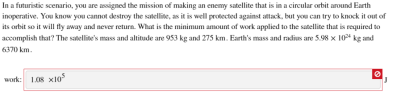 In a futuristic scenario, you are assigned the mission of making an enemy satellite that is in a circular orbit around Earth inoperative. You know you cannot destroy the satellite, as it is well protected against attack, but you can try to knock it out of its orbit so it will fly away and never return. What is the minimum amount of work applied to the satellite that is required to accomplish that? The satellite's mass and altitude are 953...
Consider a 455 kg satellite in a circular orbit at a distance of 3.06 x 10...
 Consider a 455 kg satellite in a circular orbit at a distance of 3.06 x 10 km above the Earth's surface. What is the minimum amount of work W the satellite's thrusters must do to raise the satellite to a geosynchronous orbit? Geosynchronous orbits occur at approximately 3.60 X 10 km above the Earth's surface. The radius of the Earth and the mass of the Earth are Re = 6,37 x 10 km and Me = 5.97 x 10 kg,...
A satellite is given a boost of 585 MJ of energy to move it from its...
A satellite is given a boost of 585 MJ of energy to move it from its initial orbit at an altitude of 150 km to a higher altitude orbit. If the satellite has a mass of 1.23 ✕ 103 kg, what is the new altitude it reaches? Take the mass of the Earth to be 5.97 x 1024 kg and its radius to be 6.371 x 10⁶ m.
A satellite used in a cellular telephone network has a mass of 2050 kg and is...
A satellite used in a cellular telephone network has a mass of 2050 kg and is in a circular orbit at a height of 880 km above the surface of the earth. Part A What is the gravitational force Fgrav on the satellite? Take the gravitational constant to be G = 6.67×10⁻¹¹ N⋅m2/kg2 , the mass of the earth to be me = 5.97×1024 kg , and the radius of the Earth to be re = 6.38×10⁶ m . part...
 Consider a 495 kg satellite in a circular orbit at a distance of 3.02 x 10⁴ km above the Earth's surface. What is the minimum amount of work W the satellite's thrusters must do to raise the satellite to a geosynchronous orbit? Geosynchronous orbits occur at approximately 3.60 x 10⁴ km above the Earth's surface. The radius of the Earth and the mass of the Earth are RE = 6.37 x 10³ km and Me = 5.97 x 1024 kg,...
 Consider a 475 kg satellite in a circular orbit at a distance of 3.06 x 10⁴ km above the Earth's surface. What is the minimum amount of work W the satellite's thrusters must do to raise the satellite to a geosynchronous orbit? Geosynchronous orbits occur at approximately 3.60 x 10⁴ km above the Earth's surface. The radius of the Earth and the mass of the Earth are RE = 6.37 x 10⁹ km and Me = 5.97 x 1024 kg,...
 Consider a 455 kg satellite in a circular orbit at a distance of 3.02 x 10⁴ km above the Earth's surface. What is the minimum amount of work W the satellite's thrusters must do to raise the satellite to a geosynchronous orbit? Geosynchronous orbits occur at approximately 3.60 x 10⁴ km above the Earth's surface. The radius of the Earth and the mass of the Earth are Re = 6.37 % 10% km and Me = 5.97 x 1024 kg,...
 Consider a 455 kg satellite in a circular orbit at a distance of 3.02 x 10⁴ km above the Earth's surface. What is the minimum amount of work W the satellite's thrusters must do to raise the satellite to a geosynchronous orbit? Geosynchronous orbits occur at approximately 3.60 x 10⁷ km above the Earth's surface. The radius of the Earth and the mass of the Earth are RE = 6.37 x 10⁹ km and Me = 5.97 x 1024 kg,...
 6. [2pt] A satellite is in a circular orbit around the Earth. The period of the satellite is 26.7 hr. Calculate the radius of the satellite's orbit. Data: ME=5.98 x 1024 kg, G = 6.67 x 10⁻¹¹ Nm²/kg2. Answer: Submit Al Answers 7. [2pt] What is the speed of the satellite in the previous problem? Answer: (Submit All Answers)
 In a futuristic scenario, you are assigned the mission of making inoperative an enemy satellite that is in a circular orbit around Earth. You know you cannot destroy the satellite, as it is well protected against attack. But you can try to knock it out of its orbit so it will fly away and never return. What is the minimum amount of work applied to the satellite that is required to accomplish that? The satellite's mass and altitude are 9.63...
 In a futuristic scenario, you are assigned the mission of making an enemy satellite that is in a circular orbit around Earth inoperative. You know you cannot destroy the satellite, as it is well protected against attack, but you can try to knock it out of its orbit so it will fly away and never return. What is the minimum amount of work applied to the satellite that is required to accomplish that? The satellite's mass and altitude are 953...
 Consider a 455 kg satellite in a circular orbit at a distance of 3.06 x 10 km above the Earth's surface. What is the minimum amount of work W the satellite's thrusters must do to raise the satellite to a geosynchronous orbit? Geosynchronous orbits occur at approximately 3.60 X 10 km above the Earth's surface. The radius of the Earth and the mass of the Earth are Re = 6,37 x 10 km and Me = 5.97 x 10 kg,...
Most questions answered within 3 hours.
-
Where is the error in this code sequence?
String s1 = "Hello";
String s2 = "ello";...
asked 10 months ago -
Financial data for Joel de Paris, Inc., for last year
follow:
Joel de Paris, Inc.
Balance...
asked 10 months ago -
Consider this reaction:
Al2(SO4)3 (aq)+ BaCl3
(aq) Al2Cl6 (aq)- +
3BaSO4(s) . What is the...
asked 10 months ago -
Suppose that Savneet is considering increasing her
recent random sample from 20 car rentals to 40...
asked 10 months ago -
Trucks arrive at an unloading terminal at an average rate of 120
per hour.
Trucks arrive...
asked 10 months ago -
Why are methanol and ethanol completely soluble in water while
octanol is not very little soluble....
asked 10 months ago -
A facilities manager at a university reads in a research report
that the mean amount of...
asked 10 months ago -
When the CuSO4 is rehydrated by adding water to the anhydrous
compound, is this an endothermic...
asked 10 months ago -
A ray of sunlight is passing from diamond into crown glass; the
angle of incidence is...
asked 10 months ago -
A block of mass 0.249 kg is placed on top of a light, vertical
spring of...
asked 10 months ago -
how do the kidneys compensate in the presences of acidosis
a) trigger hyperventilate
b) reserve acid...
asked 10 months ago -
Question 501 pts
The rental rate of capital to the firm increases. Which of the
following...
asked 10 months ago