
Homework Answers

Add Answer to:
The floor system shown below is subjected to a dead load of 40psf, and is used...
For problems 2-3 and 2-4 below, the textbook adds live load and dead load without considering...
 For problems 2-3 and 2-4 below, the textbook adds live load and dead load without considering load factors. 2-3. The floor system used in a school classroom consists of a 4-in. reinforced stone concrete slab. Sketch the loading that acts along the joist BF and side girder ABCDE Set - 10 ft. b = 30 in Hin: See Tables 1-2 and 1-4.
5" Floor Slab (R/C) Other Dead Load /O Live Load =125 Max, LL Deflection = L...
 5" Floor Slab (R/C) Other Dead Load /O Live Load =125 Max, LL Deflection = L / 360 s-joist spacing L- joist span A floor system consists of open-web steel joists spaced as shown in figure. Assume the slab provides continuous lateral support. Using your own data determine the following: a-) The factored load (wu) on one joist. b-) Design and select a K-series joist. Solution:
Problem 1 Floor Systems Self Weight, Tributary Load and Load Path (25 pts.) The attached structure...
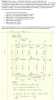 Problem 1 Floor Systems Self Weight, Tributary Load and Load Path (25 pts.) The attached structure supports a floor system which will be used for office space. This structure is located inside a larger structure and it is independently supported both laterally and vertically Essentially, it stands by itself. It is call a mezzanine system. Lateral bracing on all four walls is not shown for clarity. The sections provided below are preliminary. Using the information provided on the sketch determine...
Problem #2 (33%) Design the T-beam for the floor system shown below. The floor has a...
 Problem #2 (33%) Design the T-beam for the floor system shown below. The floor has a 4-in. slab suspoted by 22-ft-span-length beams cast monolithically with the slab. Beams are 8 ft- 0 in. on center and have a web width of 12 22 in.; fe' 3000 psi in. and a total depth and fy 60,000 psi. Service loads are 0.125- ksf live load and 0.200-ksf dead load. The given dead load does not include the weight of the floor system....
PartA The compound beam shown in (Figure 1) is subjected to a uniform dead load of...
 PartA The compound beam shown in (Figure 1) is subjected to a uniform dead load of 300 lb/ft and a single live load of 2 k. Assume C is a fixed support, B is a pin, and A is a roller Determine the negative bending moment with the maximum magnitude created by these loads at C Express your answer using three significant figures (Mc)max(-) k ft Figure 1 of 1 Submit uest Answer Part B Determine the negative shear with...
1. For the building shown below, calculate the dead load, reduced live load, and maximum design...
 1. For the building shown below, calculate the dead load, reduced live load, and maximum design load per IBC 2012, LRFD load combinations. Beam loads should be in plf, column loads should be in kips. [To be done by hand.] Note: It is acceptable check only equations 16-1 and 16-2 of IBC 2012. a. Beam I b. Веam II olumn A/3-supporting 1 story d. Column B/2- supporting 1 story C e. Column B/2-supporting 4 stories Given loading: Dead Load 60...
Loading Diagram (15 Points) blem 4: e structural steel floor system shown is to support a...
 Loading Diagram (15 Points) blem 4: e structural steel floor system shown is to support a live load of 100 psf, and dead d of 50 psf. Sketch the loading diagram for Girder G. Determine the Girder reactions? s-e GI Gader GiI Typical inurioe bay
The loor system shown below is subjected to a uniform load of q 120 psf. All connections are shea...
 The loor system shown below is subjected to a uniform load of q 120 psf. All connections are shear connections, I- 10 ft o.c. 30 ft Gl C1 10 ft О.С. 30 ft Floor Span I- 30 ft 30 ft Draw the free body diagram of girder Gl showing the loads applied by the beams it supports and the reaction forces that are transmitted to the supporting columns C1 and C2. You do not need to analyze all beam, girder,...
The beam below is subjected to a distributed load as shown in the figure. Replace the...
 The beam below is subjected to a distributed load as shown in the figure. Replace the loading by a single resultant force and specify the location of the force measured from the pin support on the left. Draw the resultant system. Find the magnitude of the support reactions.
The single-story unbraced frame shown below is subjected to dead load, roof live load, and wind load Figure 1 shows the...
 The single-story unbraced frame shown below is subjected to dead load, roof live load, and wind load Figure 1 shows the results of a first-order analysis relative to the columns of the frame. The axial load and end moment (also equal to the maximum moment in the column) are given separately for the different load cases (i.e., dead load, roof live load, and lateral wind load). All vertical loads are symmetrically placed and contribute only to the Mnt moments (i.e.,...
 For problems 2-3 and 2-4 below, the textbook adds live load and dead load without considering load factors. 2-3. The floor system used in a school classroom consists of a 4-in. reinforced stone concrete slab. Sketch the loading that acts along the joist BF and side girder ABCDE Set - 10 ft. b = 30 in Hin: See Tables 1-2 and 1-4.
 5" Floor Slab (R/C) Other Dead Load /O Live Load =125 Max, LL Deflection = L / 360 s-joist spacing L- joist span A floor system consists of open-web steel joists spaced as shown in figure. Assume the slab provides continuous lateral support. Using your own data determine the following: a-) The factored load (wu) on one joist. b-) Design and select a K-series joist. Solution:
 Problem 1 Floor Systems Self Weight, Tributary Load and Load Path (25 pts.) The attached structure supports a floor system which will be used for office space. This structure is located inside a larger structure and it is independently supported both laterally and vertically Essentially, it stands by itself. It is call a mezzanine system. Lateral bracing on all four walls is not shown for clarity. The sections provided below are preliminary. Using the information provided on the sketch determine...
 Problem #2 (33%) Design the T-beam for the floor system shown below. The floor has a 4-in. slab suspoted by 22-ft-span-length beams cast monolithically with the slab. Beams are 8 ft- 0 in. on center and have a web width of 12 22 in.; fe' 3000 psi in. and a total depth and fy 60,000 psi. Service loads are 0.125- ksf live load and 0.200-ksf dead load. The given dead load does not include the weight of the floor system....
 PartA The compound beam shown in (Figure 1) is subjected to a uniform dead load of 300 lb/ft and a single live load of 2 k. Assume C is a fixed support, B is a pin, and A is a roller Determine the negative bending moment with the maximum magnitude created by these loads at C Express your answer using three significant figures (Mc)max(-) k ft Figure 1 of 1 Submit uest Answer Part B Determine the negative shear with...
 1. For the building shown below, calculate the dead load, reduced live load, and maximum design load per IBC 2012, LRFD load combinations. Beam loads should be in plf, column loads should be in kips. [To be done by hand.] Note: It is acceptable check only equations 16-1 and 16-2 of IBC 2012. a. Beam I b. Веam II olumn A/3-supporting 1 story d. Column B/2- supporting 1 story C e. Column B/2-supporting 4 stories Given loading: Dead Load 60...
 Loading Diagram (15 Points) blem 4: e structural steel floor system shown is to support a live load of 100 psf, and dead d of 50 psf. Sketch the loading diagram for Girder G. Determine the Girder reactions? s-e GI Gader GiI Typical inurioe bay
 The loor system shown below is subjected to a uniform load of q 120 psf. All connections are shear connections, I- 10 ft o.c. 30 ft Gl C1 10 ft О.С. 30 ft Floor Span I- 30 ft 30 ft Draw the free body diagram of girder Gl showing the loads applied by the beams it supports and the reaction forces that are transmitted to the supporting columns C1 and C2. You do not need to analyze all beam, girder,...
 The beam below is subjected to a distributed load as shown in the figure. Replace the loading by a single resultant force and specify the location of the force measured from the pin support on the left. Draw the resultant system. Find the magnitude of the support reactions.
 The single-story unbraced frame shown below is subjected to dead load, roof live load, and wind load Figure 1 shows the results of a first-order analysis relative to the columns of the frame. The axial load and end moment (also equal to the maximum moment in the column) are given separately for the different load cases (i.e., dead load, roof live load, and lateral wind load). All vertical loads are symmetrically placed and contribute only to the Mnt moments (i.e.,...
Most questions answered within 3 hours.
-
Where is the error in this code sequence?
String s1 = "Hello";
String s2 = "ello";...
asked 10 months ago -
Financial data for Joel de Paris, Inc., for last year
follow:
Joel de Paris, Inc.
Balance...
asked 10 months ago -
Consider this reaction:
Al2(SO4)3 (aq)+ BaCl3
(aq) Al2Cl6 (aq)- +
3BaSO4(s) . What is the...
asked 10 months ago -
Suppose that Savneet is considering increasing her
recent random sample from 20 car rentals to 40...
asked 10 months ago -
Trucks arrive at an unloading terminal at an average rate of 120
per hour.
Trucks arrive...
asked 10 months ago -
Why are methanol and ethanol completely soluble in water while
octanol is not very little soluble....
asked 10 months ago -
A facilities manager at a university reads in a research report
that the mean amount of...
asked 10 months ago -
When the CuSO4 is rehydrated by adding water to the anhydrous
compound, is this an endothermic...
asked 10 months ago -
A ray of sunlight is passing from diamond into crown glass; the
angle of incidence is...
asked 10 months ago -
A block of mass 0.249 kg is placed on top of a light, vertical
spring of...
asked 10 months ago -
how do the kidneys compensate in the presences of acidosis
a) trigger hyperventilate
b) reserve acid...
asked 10 months ago -
Question 501 pts
The rental rate of capital to the firm increases. Which of the
following...
asked 10 months ago