
Homework Answers
Add Answer to:
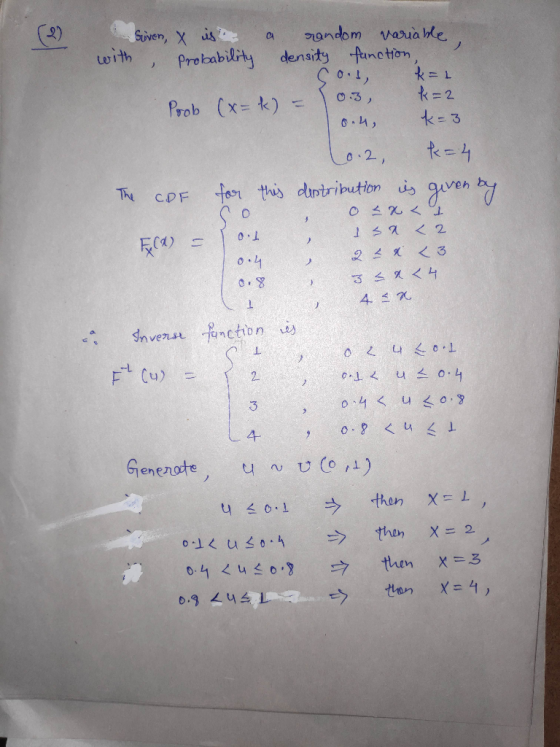
variates of X, where 2. Using the inverse transformation method to generate three randorm 0.1,k1 0.3,...
oated? variates from Apply the inverse transformation method to generate three 0.10, U;2 30.15 the following...
 oated? variates from Apply the inverse transformation method to generate three 0.10, U;2 30.15 the following distributions using Ui 0.10, U2 0.53, and U30 the following distributions using U1 a. Probability density function: for α < x < β elsewhere f(x)-1β-α where β 7 and α--4. b. Probability mass function: p(x)sP(X-x): 1.5 for x 1,2, 3, 4, 5 0 elsewhere ow would a random
Generate 100 Poisson (λ = 2) random numbers using the Inverse transformation method, and then compare...
Generate 100 Poisson (λ = 2) random numbers using the Inverse transformation method, and then compare with the theoretical mean and variance. please let me know the explanaiton with detail, and r code, If not, at least python
A discrete random variable X has probability mass function P() 0.1 0.2 0.2 0.2 0.3 Use...
 A discrete random variable X has probability mass function P() 0.1 0.2 0.2 0.2 0.3 Use the inverse transform method to generate a random sample of size from the distribution of X. Construct a relative frequency table and compare the empirical with the theoretical probabilities. Repeat using the R sample function. 1000
2) Consider a random variable with the following probability distribution: P(X = 0) = 0.1, P(X=1) =0.2, P(X=2) = 0.3, P(X=3) = 0.3, and P(X=4)= 0.1. A. Generate 400 values of this random variable with...
2) Consider a random variable with the following probability distribution: P(X = 0) = 0.1, P(X=1) =0.2, P(X=2) = 0.3, P(X=3) = 0.3, and P(X=4)= 0.1. A. Generate 400 values of this random variable with the given probability distribution using simulation. B. Compare the distribution of simulated values to the given probability distribution. Is the simulated distribution indicative of the given probability distribution? Explain why or why not. C. Compute the mean and standard deviation of the distribution of simulated...
#3.7 distribution. 0 and check that the mode of the generated samples is close to the...
 #3.7
distribution. 0 and check that the mode of the generated samples is close to the (check the histogram). theoretical mode mass function 3.5 A discrete random variable X has probability 3 4 AtB.8 HUS 2 X p(x) 0.1 0.2 0.2 0.2 0.3 a random sample of size Use the inverse transform method to generate 1000 from the distribution of X. Construct a relative frequency table and compare the empirical with the theoretical probabilities. Repeat using the R sample function....
#3.7
distribution. 0 and check that the mode of the generated samples is close to the (check the histogram). theoretical mode mass function 3.5 A discrete random variable X has probability 3 4 AtB.8 HUS 2 X p(x) 0.1 0.2 0.2 0.2 0.3 a random sample of size Use the inverse transform method to generate 1000 from the distribution of X. Construct a relative frequency table and compare the empirical with the theoretical probabilities. Repeat using the R sample function....
Using the inverse transform method... 4.2 Inverse-Transform Method 2, where l < t < 5, Explain...
 Using the inverse transform method...
4.2 Inverse-Transform Method 2, where l < t < 5, Explain how to generate values from a continuous distribution with density function/() = given u E O,1).
Using the inverse transform method...
4.2 Inverse-Transform Method 2, where l < t < 5, Explain how to generate values from a continuous distribution with density function/() = given u E O,1).
2) Consider a random variable with the following probability distribution: P(X-0)-0., Px-1)-0.2, PX-2)-0.3, PX-3) -0.3, and PX-4)-0.1 A. Generate 400 values of this random variable with the given pro...
 2) Consider a random variable with the following probability distribution: P(X-0)-0., Px-1)-0.2, PX-2)-0.3, PX-3) -0.3, and PX-4)-0.1 A. Generate 400 values of this random variable with the given probability distribution using simulation. B. Compare the distribution of simulated values to the given probability distribution. Is the simulated distribution indicative of the given probability distribution? Explain why or why not. C. Compute the mean and standard deviation of the distribution of simulated values. How do these summary measures compare to the...
Runge-Kutta method R-K method is given by the following algorithm. o y(xo)- given k2-f(xi5.yi tk,...
 Runge-Kutta method R-K method is given by the following algorithm. Yo = y(xo) = given. k1-f(xy) k4-f(xi +h,yi + k3) 6 For i = 0, 1, 2, , n, where h = (b-a)/n. Consider the same IVP given in problem 2 and answer the following a) Write a MATLAB script file to find y(2) using h = 0.1 and call the file odeRK 19.m b) Generate the following table now using both ode Euler and odeRK19 only for h -0.01....
Using Change of Variables.. Evaluate ∫∫ R 15y/x dA where R is the region bounded by xy = 2, xy = 6 , y = 4 and y =10 using the transformation x=v , y=2u/3v.
 Using Change of Variables..Evaluate ∫∫ R 15y/x dA where R is the region bounded by xy = 2, xy = 6 , y = 4 and y =10 usingthe transformation x=v , y=2u/3v.
2. SW2=1; SW1=SW3=0 Using KP=0.1, KI=4 and KD=0.3. Your program should display the transfer functions M1(s),M2(s),M3(s)...
 2. SW2=1; SW1=SW3=0
Using KP=0.1, KI=4 and KD=0.3. Your program should display the
transfer functions
M1(s),M2(s),M3(s) and M4(s)
you must use matlab and include the codes.
Ks) Sw I Where .(s) is the Laplace transform of the motor's speed w (t) V(s)Is the Laplace transform ofvoltage r(t) · . K 3 and r 0.5 Find the system's step response and its three performance specifications. Hint: The system's transfer function can be rewritten as: G (s)-K sta for a = 1/τ....
2. SW2=1; SW1=SW3=0
Using KP=0.1, KI=4 and KD=0.3. Your program should display the
transfer functions
M1(s),M2(s),M3(s) and M4(s)
you must use matlab and include the codes.
Ks) Sw I Where .(s) is the Laplace transform of the motor's speed w (t) V(s)Is the Laplace transform ofvoltage r(t) · . K 3 and r 0.5 Find the system's step response and its three performance specifications. Hint: The system's transfer function can be rewritten as: G (s)-K sta for a = 1/τ....
 oated? variates from Apply the inverse transformation method to generate three 0.10, U;2 30.15 the following distributions using Ui 0.10, U2 0.53, and U30 the following distributions using U1 a. Probability density function: for α < x < β elsewhere f(x)-1β-α where β 7 and α--4. b. Probability mass function: p(x)sP(X-x): 1.5 for x 1,2, 3, 4, 5 0 elsewhere ow would a random
 A discrete random variable X has probability mass function P() 0.1 0.2 0.2 0.2 0.3 Use the inverse transform method to generate a random sample of size from the distribution of X. Construct a relative frequency table and compare the empirical with the theoretical probabilities. Repeat using the R sample function. 1000
 #3.7
distribution. 0 and check that the mode of the generated samples is close to the (check the histogram). theoretical mode mass function 3.5 A discrete random variable X has probability 3 4 AtB.8 HUS 2 X p(x) 0.1 0.2 0.2 0.2 0.3 a random sample of size Use the inverse transform method to generate 1000 from the distribution of X. Construct a relative frequency table and compare the empirical with the theoretical probabilities. Repeat using the R sample function....
#3.7
distribution. 0 and check that the mode of the generated samples is close to the (check the histogram). theoretical mode mass function 3.5 A discrete random variable X has probability 3 4 AtB.8 HUS 2 X p(x) 0.1 0.2 0.2 0.2 0.3 a random sample of size Use the inverse transform method to generate 1000 from the distribution of X. Construct a relative frequency table and compare the empirical with the theoretical probabilities. Repeat using the R sample function....
 Using the inverse transform method...
4.2 Inverse-Transform Method 2, where l < t < 5, Explain how to generate values from a continuous distribution with density function/() = given u E O,1).
Using the inverse transform method...
4.2 Inverse-Transform Method 2, where l < t < 5, Explain how to generate values from a continuous distribution with density function/() = given u E O,1).
 2) Consider a random variable with the following probability distribution: P(X-0)-0., Px-1)-0.2, PX-2)-0.3, PX-3) -0.3, and PX-4)-0.1 A. Generate 400 values of this random variable with the given probability distribution using simulation. B. Compare the distribution of simulated values to the given probability distribution. Is the simulated distribution indicative of the given probability distribution? Explain why or why not. C. Compute the mean and standard deviation of the distribution of simulated values. How do these summary measures compare to the...
 Runge-Kutta method R-K method is given by the following algorithm. Yo = y(xo) = given. k1-f(xy) k4-f(xi +h,yi + k3) 6 For i = 0, 1, 2, , n, where h = (b-a)/n. Consider the same IVP given in problem 2 and answer the following a) Write a MATLAB script file to find y(2) using h = 0.1 and call the file odeRK 19.m b) Generate the following table now using both ode Euler and odeRK19 only for h -0.01....
 2. SW2=1; SW1=SW3=0
Using KP=0.1, KI=4 and KD=0.3. Your program should display the
transfer functions
M1(s),M2(s),M3(s) and M4(s)
you must use matlab and include the codes.
Ks) Sw I Where .(s) is the Laplace transform of the motor's speed w (t) V(s)Is the Laplace transform ofvoltage r(t) · . K 3 and r 0.5 Find the system's step response and its three performance specifications. Hint: The system's transfer function can be rewritten as: G (s)-K sta for a = 1/τ....
2. SW2=1; SW1=SW3=0
Using KP=0.1, KI=4 and KD=0.3. Your program should display the
transfer functions
M1(s),M2(s),M3(s) and M4(s)
you must use matlab and include the codes.
Ks) Sw I Where .(s) is the Laplace transform of the motor's speed w (t) V(s)Is the Laplace transform ofvoltage r(t) · . K 3 and r 0.5 Find the system's step response and its three performance specifications. Hint: The system's transfer function can be rewritten as: G (s)-K sta for a = 1/τ....
Most questions answered within 3 hours.
-
Where is the error in this code sequence?
String s1 = "Hello";
String s2 = "ello";...
asked 10 months ago -
Financial data for Joel de Paris, Inc., for last year
follow:
Joel de Paris, Inc.
Balance...
asked 10 months ago -
Consider this reaction:
Al2(SO4)3 (aq)+ BaCl3
(aq) Al2Cl6 (aq)- +
3BaSO4(s) . What is the...
asked 10 months ago -
Suppose that Savneet is considering increasing her
recent random sample from 20 car rentals to 40...
asked 10 months ago -
Trucks arrive at an unloading terminal at an average rate of 120
per hour.
Trucks arrive...
asked 10 months ago -
Why are methanol and ethanol completely soluble in water while
octanol is not very little soluble....
asked 10 months ago -
A facilities manager at a university reads in a research report
that the mean amount of...
asked 10 months ago -
When the CuSO4 is rehydrated by adding water to the anhydrous
compound, is this an endothermic...
asked 10 months ago -
A ray of sunlight is passing from diamond into crown glass; the
angle of incidence is...
asked 10 months ago -
A block of mass 0.249 kg is placed on top of a light, vertical
spring of...
asked 10 months ago -
how do the kidneys compensate in the presences of acidosis
a) trigger hyperventilate
b) reserve acid...
asked 10 months ago -
Question 501 pts
The rental rate of capital to the firm increases. Which of the
following...
asked 10 months ago