the answer ti his question is C Adiabetic compression. I do
uderstand that it is a compression but i dont understand how to
tell the difference between adiabetic and isothermal through a PV
digram 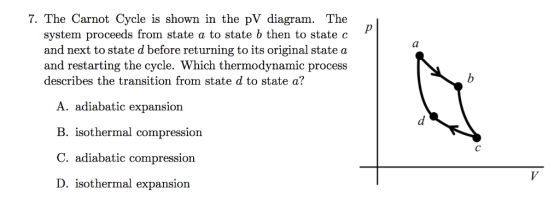
Homework Answers

Add Answer to:
the answer ti his question is C Adiabetic compression. I do
uderstand that it is a...
My questions: What are the volume of c and d? How do you calculate the delta...
 My questions:
What are the volume of c and d?
How do you calculate the delta S and delta S surroundings of
each step?
Consider the reversible Carnot cycle shown below. a PA Isothermal expansion Thoil Adiabatic compression Toold Pressure Thot PE Adiabatic expansion Thot cold Po- Isothermal compression Trot Toold Po Toold va Vc Vd Vo Volume The "working substance" (gas inside the piston, in red above) is 3.10 moles of a monatomic ideal gas, with Cvm = 3R/2....
My questions:
What are the volume of c and d?
How do you calculate the delta S and delta S surroundings of
each step?
Consider the reversible Carnot cycle shown below. a PA Isothermal expansion Thoil Adiabatic compression Toold Pressure Thot PE Adiabatic expansion Thot cold Po- Isothermal compression Trot Toold Po Toold va Vc Vd Vo Volume The "working substance" (gas inside the piston, in red above) is 3.10 moles of a monatomic ideal gas, with Cvm = 3R/2....
3. (20 pts) In the Carnot engine (refer to the figure in question 2), an ideal...
3. (20 pts) In the Carnot engine (refer to the figure in question 2), an ideal gas undergoes a cycle of isothermal expansion (A → B), adiabatic expansion (B → C), isothermal compression (C → D), and adiabatic compression (D → A). All processes are assumed to be reversible. The volumes at the points are given that 2VA=VB and VC=2VD. Th is 650 °C and Tc is 30 °C. (1) Calculate the amount of heat added to one mole gas...
An ideal gas (1.82 moles) undergoes the following reversible Carnot cycle. (1) An isothermal expansion at...
An ideal gas (1.82 moles) undergoes the following reversible Carnot cycle. (1) An isothermal expansion at Thot=850K from 3.20L to 20.40L. (2) An adiabatic expansion until the temperature falls to 298K. The system then undergoes (3) an isothermal compression and a subsequent (4) adiabatic compression until the initial state is reached. a. Calculate work and ΔS for each step in the cycle and its overall efficiency. b. Determine ΔH and ΔU for steps (1) and (2). c. Explain why ΔUcycle=...
Problem 8: Consider the reversible Carnot's cycle of an ideal monatomic gas in the cold cylinder...
 Problem 8: Consider the reversible Carnot's cycle of an ideal monatomic gas in the cold cylinder of 290 K corresponding to the isothermal compression step. Then the volume of the gas is further compressed by a factor of 7.5 in the adiabatic compression step. a) Find the temperature at the final step of the adiabatic compression. b) What is Thot for the isothermal expansion step? c) What is the maximum thermodynamic efficiency for this engine? d) How much would the...
7) An ideal gas is taken around the cycle shown in this p-V diagram, from a...
 7) An ideal gas is taken around the cycle shown in this p-V diagram, from a to b to c and back to a. Process b-c is isothermal. For process a- b, D. 0-0, AU<0 8) An ideal gas is compressed in a well-insulated chamber using a well-insulated piston. This process IS A) isochoric. B) isothermal. C) adiabatic. D) isobaric. 9) The process shown in the T-V diagram in the figure is an T. A) adiabatic compression. B) isothermal compression....
4. The pressure-volume diagram below shows a special reversible cycle called the Carnot cycle A mole...
 4. The pressure-volume diagram below shows a special reversible cycle called the Carnot cycle A mole of an ideal gas starts off in state 1 in contact with a large thermal reservoir at temperature Th. The gas then undergoes an isothermal expansion from Vi to V2. Upon reaching state 2, the gas container is removed from contact with the thermal reservoir and covered with thermal insulation. Next the gas is allowed to expand adiabatically from V2to Vs. Because the expansion...
An ideal gas undergoes a cycle consisting of the following mechanically reversible steps: An adiabatic compression...
 An ideal gas undergoes a cycle consisting of the following mechanically reversible steps: An adiabatic compression from Pu V1, T1 to P2, V2, T2 An isobaric expansion from P2, V2, T2 to P3 P2, Vs, T3 - An adiabatic expansion from P3, Vs, Ts to Pa, V4, T4 - A constant-volume process from Pa, V4, T4 to Pi, VV4, T1 (a) Sketch this cycle on a PV diagram (b) Derive an equation that expresses the thermal efficiency (n) of this...
please show me a sep wise solution for these problem as i am trying to learn...
 please show me a sep wise solution for these problem as i am
trying to learn from your solution. if you cant or you answer
partially dont answer please.
Problem 3 (20 pts): Consider a Carnot engine cycle in which we take an ideal monoatomic gas from point Ou a)on first leg ofthe cycle, a-+ b, we take the gas through an isothermal expansion at temperature TH Given the values shown on the P and V axes for the state...
please show me a sep wise solution for these problem as i am
trying to learn from your solution. if you cant or you answer
partially dont answer please.
Problem 3 (20 pts): Consider a Carnot engine cycle in which we take an ideal monoatomic gas from point Ou a)on first leg ofthe cycle, a-+ b, we take the gas through an isothermal expansion at temperature TH Given the values shown on the P and V axes for the state...
I thought... a-c is isobaric and isothermal compression from a gas to a liquid, and c-d...
 I thought... a-c is isobaric and isothermal compression from a
gas to a liquid, and c-d is adiabatic compression from a liquid to
a solid.
Am I correct? If not, please can you explain the correct
answer? Thanks very much.
The diagram shows a generic pVT surface of a substance. The substance is taken on a journey' across the pVT surface from point 'a' to point 'd' via two different processes. Describe the two different processes and give details of...
I thought... a-c is isobaric and isothermal compression from a
gas to a liquid, and c-d is adiabatic compression from a liquid to
a solid.
Am I correct? If not, please can you explain the correct
answer? Thanks very much.
The diagram shows a generic pVT surface of a substance. The substance is taken on a journey' across the pVT surface from point 'a' to point 'd' via two different processes. Describe the two different processes and give details of...
A Carnot cycle is conducted using an ideal diatomic gas. Initially, the gas is at temperature...
A Carnot cycle is conducted using an ideal diatomic gas. Initially, the gas is at temperature 25C., pressure of 100KPa and volume of 0.01m3. The system is then compressed isothermally to a volume 0.002m3. From that point, the gas undergoes an adiabatic compression ( with gamma= 1.4), until the volume further reduces to 0.001m3. After that, the system goes an isothermal expansion process to a point where the pressure of the system is 263.8KPa. Then the system continues the cycle...
 My questions:
What are the volume of c and d?
How do you calculate the delta S and delta S surroundings of
each step?
Consider the reversible Carnot cycle shown below. a PA Isothermal expansion Thoil Adiabatic compression Toold Pressure Thot PE Adiabatic expansion Thot cold Po- Isothermal compression Trot Toold Po Toold va Vc Vd Vo Volume The "working substance" (gas inside the piston, in red above) is 3.10 moles of a monatomic ideal gas, with Cvm = 3R/2....
My questions:
What are the volume of c and d?
How do you calculate the delta S and delta S surroundings of
each step?
Consider the reversible Carnot cycle shown below. a PA Isothermal expansion Thoil Adiabatic compression Toold Pressure Thot PE Adiabatic expansion Thot cold Po- Isothermal compression Trot Toold Po Toold va Vc Vd Vo Volume The "working substance" (gas inside the piston, in red above) is 3.10 moles of a monatomic ideal gas, with Cvm = 3R/2....
 Problem 8: Consider the reversible Carnot's cycle of an ideal monatomic gas in the cold cylinder of 290 K corresponding to the isothermal compression step. Then the volume of the gas is further compressed by a factor of 7.5 in the adiabatic compression step. a) Find the temperature at the final step of the adiabatic compression. b) What is Thot for the isothermal expansion step? c) What is the maximum thermodynamic efficiency for this engine? d) How much would the...
 7) An ideal gas is taken around the cycle shown in this p-V diagram, from a to b to c and back to a. Process b-c is isothermal. For process a- b, D. 0-0, AU<0 8) An ideal gas is compressed in a well-insulated chamber using a well-insulated piston. This process IS A) isochoric. B) isothermal. C) adiabatic. D) isobaric. 9) The process shown in the T-V diagram in the figure is an T. A) adiabatic compression. B) isothermal compression....
 4. The pressure-volume diagram below shows a special reversible cycle called the Carnot cycle A mole of an ideal gas starts off in state 1 in contact with a large thermal reservoir at temperature Th. The gas then undergoes an isothermal expansion from Vi to V2. Upon reaching state 2, the gas container is removed from contact with the thermal reservoir and covered with thermal insulation. Next the gas is allowed to expand adiabatically from V2to Vs. Because the expansion...
 An ideal gas undergoes a cycle consisting of the following mechanically reversible steps: An adiabatic compression from Pu V1, T1 to P2, V2, T2 An isobaric expansion from P2, V2, T2 to P3 P2, Vs, T3 - An adiabatic expansion from P3, Vs, Ts to Pa, V4, T4 - A constant-volume process from Pa, V4, T4 to Pi, VV4, T1 (a) Sketch this cycle on a PV diagram (b) Derive an equation that expresses the thermal efficiency (n) of this...
 please show me a sep wise solution for these problem as i am
trying to learn from your solution. if you cant or you answer
partially dont answer please.
Problem 3 (20 pts): Consider a Carnot engine cycle in which we take an ideal monoatomic gas from point Ou a)on first leg ofthe cycle, a-+ b, we take the gas through an isothermal expansion at temperature TH Given the values shown on the P and V axes for the state...
please show me a sep wise solution for these problem as i am
trying to learn from your solution. if you cant or you answer
partially dont answer please.
Problem 3 (20 pts): Consider a Carnot engine cycle in which we take an ideal monoatomic gas from point Ou a)on first leg ofthe cycle, a-+ b, we take the gas through an isothermal expansion at temperature TH Given the values shown on the P and V axes for the state...
 I thought... a-c is isobaric and isothermal compression from a
gas to a liquid, and c-d is adiabatic compression from a liquid to
a solid.
Am I correct? If not, please can you explain the correct
answer? Thanks very much.
The diagram shows a generic pVT surface of a substance. The substance is taken on a journey' across the pVT surface from point 'a' to point 'd' via two different processes. Describe the two different processes and give details of...
I thought... a-c is isobaric and isothermal compression from a
gas to a liquid, and c-d is adiabatic compression from a liquid to
a solid.
Am I correct? If not, please can you explain the correct
answer? Thanks very much.
The diagram shows a generic pVT surface of a substance. The substance is taken on a journey' across the pVT surface from point 'a' to point 'd' via two different processes. Describe the two different processes and give details of...
Most questions answered within 3 hours.
-
Where is the error in this code sequence?
String s1 = "Hello";
String s2 = "ello";...
asked 10 months ago -
Financial data for Joel de Paris, Inc., for last year
follow:
Joel de Paris, Inc.
Balance...
asked 10 months ago -
Consider this reaction:
Al2(SO4)3 (aq)+ BaCl3
(aq) Al2Cl6 (aq)- +
3BaSO4(s) . What is the...
asked 10 months ago -
Suppose that Savneet is considering increasing her
recent random sample from 20 car rentals to 40...
asked 10 months ago -
Trucks arrive at an unloading terminal at an average rate of 120
per hour.
Trucks arrive...
asked 10 months ago -
Why are methanol and ethanol completely soluble in water while
octanol is not very little soluble....
asked 10 months ago -
A facilities manager at a university reads in a research report
that the mean amount of...
asked 10 months ago -
When the CuSO4 is rehydrated by adding water to the anhydrous
compound, is this an endothermic...
asked 10 months ago -
A ray of sunlight is passing from diamond into crown glass; the
angle of incidence is...
asked 10 months ago -
A block of mass 0.249 kg is placed on top of a light, vertical
spring of...
asked 10 months ago -
how do the kidneys compensate in the presences of acidosis
a) trigger hyperventilate
b) reserve acid...
asked 10 months ago -
Question 501 pts
The rental rate of capital to the firm increases. Which of the
following...
asked 10 months ago