To leam about self-inductance from the example of a long solenoid.
Learning Goal:
To leam about self-inductance from the example of a long solenoid.
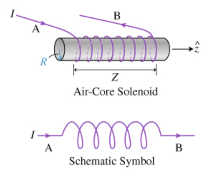
To explain self-inductance, it is helpful to consider the specific example of a long solervid, as shown in the figure. This solenoid has only one winding, and so the EMF induced by its changing current appoars across the solenoid itsel. This contrasts with mutual inductance, where this voltege appears across a second coil wound on the same cylincter as the lirst.
Part A
Suppose that the current in the solenoid is I(t). Within the solenoid, but far from its ends, what is the magnetic field B(t) due to this current?
Part B
What is the magnetic flux φ1(t) through a single tum of the solenoid?
Part C
Suppose that the current varies with time, so that dI(t)/dt≠0. Find the electromotive force ε induced across the entire solenoid due to the change in current through the entire solenoid.
Part D
The self-inductance L is related to the self-induced EMR ε(t) by the equation ε(t) = -Ldl(t) /dt. Find L for a long solenoid.
Now consider an inductor as a circuit element. Since we are now treating the inductor as a circuit element, we must discuss the voltage across it, not the EMF inside it. The important point is that the inductor is assumed to have no resistance. This means that the net electric field inside it must be zero when it is connected in a circuit. Otherwise, the current in it will become infinite. This means that the induced electric field \(\vec{E}_{\mathrm{n}}\) deposits charges on and around the inductor in such a way as to produce a nearly equal and opposite electric field \(\vec{E}_{\mathrm{c}}\) such that \(\vec{E}_{\mathrm{c}}+\overrightarrow{E_{\mathrm{n}}} \rightarrow 0 !\) Kirchhoff's loop law defines voltages only in terms of fields produced by charges (like \(\vec{E}_{\mathrm{c}}\) ), not those produced by changing magnetic fields (like \(\vec{E}_{\mathrm{n}}\) ). So if we wish to continue to use Kirchhoff's loop law, we must continue to use this definition consistently. That is, we must define the voltage \(V_{\mathrm{AB}}=V_{\mathrm{A}}-V_{\mathrm{B}}=+\int_{\mathrm{A}}^{\mathrm{B}} \vec{E}_{\mathrm{c}} \cdot d \vec{l}\) alone (note that the integral is from \(\mathrm{A}\) to \(\mathrm{B}\) rather than from \(\mathrm{B}\) to \(\mathrm{A}\), hence the positive sign). So finally, \(V_{\mathrm{AB}}=\int_{\mathrm{A}}^{\mathrm{B}} \vec{E}_{c} \cdot d \vec{l}=\int_{\mathrm{A}}^{\mathrm{B}}-\vec{E}_{n} \cdot d \vec{l}=-\mathcal{E}=+L \frac{d I(t)}{d t}\), where we have used \(\vec{E}_{c}+\vec{E}_{n}=0\) and the definition of \(\mathcal{E}\).
Part E
Which of the following statements is true about the inductor in the figure in the problem introduction, where I(t) is the current through the wire?
If I(t) is positive, the voltage at end A will necessarily be greater than that at end B
lf dI(t)/dt is positive, the voltage at end A will necessarily be greater than that at end B
If I(t) is positive, the voltage at end A will necessarily be less than that at end B.
If dI(t)/dt is positive, the voltage at end A will necessarily be less than that at end B.
Part F
Now consider the effect that applying an additional voltage to the inductor will have on the current I(t) already flowing through it (imagine that the voltage is applied to end A, while end B is grounded). Which one of the following statements is true?
If V is positive, then I(t) will necessarily be positive and dI(t)/dt will be negative
lf V is positive, then I(t) will necessarily be negative and di(t)/dt will be negative.
If V is positive, then I(t) could be positive or negative, while dI (t)/dt will necessarily be negative.
If V is positive, then I(t) will necessarily be positive and dI(t)/dt will be positive
If V is positive, then I(t) could be positive or negative while dI(t)/dt will necessarily be positive.
If V is positive, then It) will necessarily be negative and dI(t)/dt will be positive
Homework Answers


A solenoid is hooked to an alternating current source. a. Calculate the self-inductance of a 40.0...
A solenoid is hooked to an alternating current source. a. Calculate the self-inductance of a 40.0 cm long, 8.0 cm diameter solenoid having 800 loops. b. How much energy is stored in this inductor when 10.0 A of current flows through it? c. How fast can it be turned off if the induced emf cannot exceed 9.00 V?
22. A solenoid is hooked to an alternating current source. a. Calculate the self-inductance of a...
 22. A solenoid is hooked to an alternating current source. a. Calculate the self-inductance of a 40.0 cm long, 8.0 cm diameter solenoid having 800 loops. b. How much energy is stored in this inductor when 10.0 A of current flows through it? c. How fast can it be turned off if the induced emf cannot exceed 9.00 V?
(a) Calculate the self-inductance (in mH) of a 54.0 cm long, 10.0 cm diameter solenoid having...
 (a) Calculate the self-inductance (in mH) of a 54.0 cm long, 10.0 cm diameter solenoid having 1000 loops. mH (b) How much energy (in )) is stored in this inductor when 19.5 A of current flows through it? J (c) How fast (in s) can it be turned off if the induced emf cannot exceed 3.00 V?
(a) Calculate the self-inductance (in mH) of a 47.0 cm long, 10.0 cm diameter solenoid having...
 (a) Calculate the self-inductance (in mH) of a 47.0 cm long, 10.0 cm diameter solenoid having 1000 loops. 20.9 → mH (b) How much energy (in J) is stored in this inductor when 19.0 A of current flows through it? با (c) How fast (in s) can it be turned off if the induced emf cannot exceed 3.00 V? S
Calculate the self-inductance (in mH) of a 49.0 cm long, 10.0 cm diameter solenoid having 1000...
Calculate the self-inductance (in mH) of a 49.0 cm long, 10.0 cm diameter solenoid having 1000 loops. mH (b) How much energy (in J) is stored in this inductor when 22.0 A of current flows through it? J (c) How fast (in s) can it be turned off if the induced emf cannot exceed 3.00 V? s †
1. adapted from Prob. 5, p. 298-299, Brown's Introductory Physics II) Consider the second diagram on...
 1. adapted from Prob. 5, p. 298-299, Brown's Introductory Physics II) Consider the second diagram on p. 298. The solenoid has N turns, length / (L in the figure, which you might have confused with the self-inductance), and radius (A in the figure, which you might have confused with the area). The voltage of the battery is V, (v in the figure, which you might have confused with a velocity) (a) Find the self-inductance L of the solenoid in terms...
3. (20 points) A solenoid has a length of 0.1 m and cross sectional area 104...
 3. (20 points) A solenoid has a length of 0.1 m and cross sectional area 104 m2 The total number of turns of wire isN-1000. The current in the wire is 1-0.01 sin (100 π t). μο 4TY 107 in our SI units, a) Find the magnetic field B(t) inside the solenoid. b) Find the magnetic flux Ф, (t) inside the solenoid. c) Express the induced voltage on one turn of the wire,in terms of dI/dt. What is the inductance...
3. Calculate the self-induced emf in the solenoid of inductance L = 0.181 mH, if the...
 3. Calculate the self-induced emf in the solenoid of inductance L = 0.181 mH, if the current decreases at the rate of 50.0 A/s.
Font Paragraph Dyes Q4) (8 Points) A long solenoid with 100 turns has a radius of...
 Font Paragraph Dyes Q4) (8 Points) A long solenoid with 100 turns has a radius of 0.Im and its length is 0.8m. The curent through the solenoid increases according to the relation l(t)-6t+St. A) Calculate the self-inductance voltage in the solenoid at t-2s. B) What is the induced current if its resistance is 52 C What is the direetion of both induced magnetic field and current in the solenoid 1000000000000001
 22. A solenoid is hooked to an alternating current source. a. Calculate the self-inductance of a 40.0 cm long, 8.0 cm diameter solenoid having 800 loops. b. How much energy is stored in this inductor when 10.0 A of current flows through it? c. How fast can it be turned off if the induced emf cannot exceed 9.00 V?
 (a) Calculate the self-inductance (in mH) of a 54.0 cm long, 10.0 cm diameter solenoid having 1000 loops. mH (b) How much energy (in )) is stored in this inductor when 19.5 A of current flows through it? J (c) How fast (in s) can it be turned off if the induced emf cannot exceed 3.00 V?
 (a) Calculate the self-inductance (in mH) of a 47.0 cm long, 10.0 cm diameter solenoid having 1000 loops. 20.9 → mH (b) How much energy (in J) is stored in this inductor when 19.0 A of current flows through it? با (c) How fast (in s) can it be turned off if the induced emf cannot exceed 3.00 V? S
 1. adapted from Prob. 5, p. 298-299, Brown's Introductory Physics II) Consider the second diagram on p. 298. The solenoid has N turns, length / (L in the figure, which you might have confused with the self-inductance), and radius (A in the figure, which you might have confused with the area). The voltage of the battery is V, (v in the figure, which you might have confused with a velocity) (a) Find the self-inductance L of the solenoid in terms...
 3. (20 points) A solenoid has a length of 0.1 m and cross sectional area 104 m2 The total number of turns of wire isN-1000. The current in the wire is 1-0.01 sin (100 π t). μο 4TY 107 in our SI units, a) Find the magnetic field B(t) inside the solenoid. b) Find the magnetic flux Ф, (t) inside the solenoid. c) Express the induced voltage on one turn of the wire,in terms of dI/dt. What is the inductance...
 3. Calculate the self-induced emf in the solenoid of inductance L = 0.181 mH, if the current decreases at the rate of 50.0 A/s.
 Font Paragraph Dyes Q4) (8 Points) A long solenoid with 100 turns has a radius of 0.Im and its length is 0.8m. The curent through the solenoid increases according to the relation l(t)-6t+St. A) Calculate the self-inductance voltage in the solenoid at t-2s. B) What is the induced current if its resistance is 52 C What is the direetion of both induced magnetic field and current in the solenoid 1000000000000001
Most questions answered within 3 hours.
-
Where is the error in this code sequence?
String s1 = "Hello";
String s2 = "ello";...
asked 10 months ago -
Financial data for Joel de Paris, Inc., for last year
follow:
Joel de Paris, Inc.
Balance...
asked 10 months ago -
Consider this reaction:
Al2(SO4)3 (aq)+ BaCl3
(aq) Al2Cl6 (aq)- +
3BaSO4(s) . What is the...
asked 10 months ago -
Suppose that Savneet is considering increasing her
recent random sample from 20 car rentals to 40...
asked 10 months ago -
Trucks arrive at an unloading terminal at an average rate of 120
per hour.
Trucks arrive...
asked 10 months ago -
Why are methanol and ethanol completely soluble in water while
octanol is not very little soluble....
asked 10 months ago -
A facilities manager at a university reads in a research report
that the mean amount of...
asked 10 months ago -
When the CuSO4 is rehydrated by adding water to the anhydrous
compound, is this an endothermic...
asked 10 months ago -
A ray of sunlight is passing from diamond into crown glass; the
angle of incidence is...
asked 10 months ago -
A block of mass 0.249 kg is placed on top of a light, vertical
spring of...
asked 10 months ago -
how do the kidneys compensate in the presences of acidosis
a) trigger hyperventilate
b) reserve acid...
asked 10 months ago -
Question 501 pts
The rental rate of capital to the firm increases. Which of the
following...
asked 10 months ago