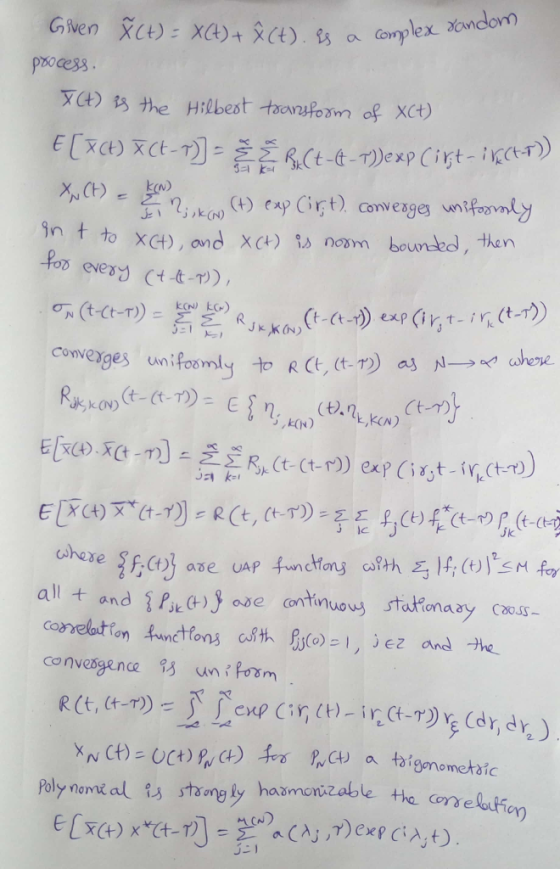
![Ⅳ、X()=X(t)+X(,) is a complex random process, X(t) is the Hilbert transform of X(1), find that ETX(1)X(1-r)] and ElX(1)X.(t-t)]. (15 points)](http://img.homeworklib.com/questions/45544820-2aba-11eb-8f85-b5f9d3c7515e.png?x-oss-process=image/resize,w_560)
Homework Answers
Add Answer to:
Ⅳ、X()=X(t)+X(,) is a complex random process, X(t) is the Hilbert transform of X(1), find that ETX(1)X(1-r)]...
Problem 4 (20 points) Given that the Fourier transform of x(t) is find the Fourier transform...
 Problem 4 (20 points) Given that the Fourier transform of x(t) is find the Fourier transform of the following signals in terms of X(jo) a. y(t)-etx(t 1) b. y(t)-x(-t) x(t-1) c. y(t)tx(t)
1) Random Processes: Suppose that a wide-sense stationary Gaussian random process X (t) is input to the filter shown below. The autocorrelation function of X(t) is 2xx (r) = exp(-ary Y(t) X(t) Delay...
 1) Random Processes: Suppose that a wide-sense stationary Gaussian random process X (t) is input to the filter shown below. The autocorrelation function of X(t) is 2xx (r) = exp(-ary Y(t) X(t) Delay a) (4 points) Find the power spectral density of the output random process y(t), ΦΥΥ(f) b) (1 points) What frequency components are not present in ΦYYU)? c) (4 points) Find the output autocorrelation function Фуу(r) d) (1 points) What is the total power in the output process...
1. A binomial random variable has the moment generating function, (t) E(etx)II1 E(etX) (pet+1-p)". Show that...
 1. A binomial random variable has the moment generating function, (t) E(etx)II1 E(etX) (pet+1-p)". Show that EX] = np and Var(X) = np(1-p) using that EX] = ψ(0) and E(X2] = ψ"(0). 2. Lex X be uniformly distributed over (a,b). Show that E[xt and Var(X) using the first and second moments of this random variable where the pdf of X is f(x). Note that the nth moment of a continuous random variable is defined as EXj-Γοχ"f(x)dx (b-a)2 exp 2
1) Random Processes: Suppose that a wide-sense stationary Gaussian random process X (t) is input to...
 1) Random Processes: Suppose that a wide-sense stationary Gaussian random process X (t) is input to the filter shown below. The autocorrelation function of X(t) is 2xx (r) = exp(-ary Y(t) X(t) Delay a) (4 points) Find the power spectral density of the output random process y(t), ΦΥΥ(f) b) (1 points) What frequency components are not present in ΦYYU)? c) (4 points) Find the output autocorrelation function Фуу(r) d) (1 points) What is the total power in the output process...
1. Consider the complex-valued signal r(t) with Fourier transform as shown in the figure. Keep in...
 1. Consider the complex-valued signal r(t) with Fourier transform as shown in the figure. Keep in mind that there are no symmetry properties this signal satisfies in the fre- quency domain. In particular, the Fourier transform is zero for negative frequencies Suppose we impulse-train sample x(t) at the rate of 500 samples/second. 200 400 600 800 1000 FREQUENCY (Hz.) (a) Sketch the Fourier transform of the impulse-train sampled signal in the range of frequencies from -1000 Hz. to 1000 Hz....
2. Consider the random process x(t) defined by x(t) a cos(wt + 6).where w and a...
 2. Consider the random process x(t) defined by x(t) a cos(wt + 6).where w and a are constants, and 0 is a random variable uniformly distributed in the range (-T, ) Sketch the ensemble (sample functions) representing x(t). (2.5 points). a. b. Find the mean and variance of the random variable 0. (2.5 points). Find the mean of x(t), m (t) E(x(t)). (2.5 points). c. d. Find the autocorrelation of x(t), R (t,, t) = E(x, (t)x2 (t)). (5 points)....
Let X(t) X(t) be a Gaussian random process with μ X (t)=0 μX(t)=0 and R X...
Let X(t) X(t) be a Gaussian random process with μ X (t)=0 μX(t)=0 and R X ( t 1 , t 2 )=min( t 1 , t 2 ) RX(t1,t2)=min(t1,t2) . Find P(X(4)<3|X(1)=1) P(X(4)<3|X(1)=1) .
7. Use a suitable Fourier Transform to find the solution of the IVP 2t-r-1 ,2-1 t 〉 0, , u(x, t)...
 Please show all steps to solution.
7. Use a suitable Fourier Transform to find the solution of the IVP 2t-r-1 ,2-1 t 〉 0, , u(x, t), uz (x, t) 0asx→00, t〉0, →
7. Use a suitable Fourier Transform to find the solution of the IVP 2t-r-1 ,2-1 t 〉 0, , u(x, t), uz (x, t) 0asx→00, t〉0, →
Please show all steps to solution.
7. Use a suitable Fourier Transform to find the solution of the IVP 2t-r-1 ,2-1 t 〉 0, , u(x, t), uz (x, t) 0asx→00, t〉0, →
7. Use a suitable Fourier Transform to find the solution of the IVP 2t-r-1 ,2-1 t 〉 0, , u(x, t), uz (x, t) 0asx→00, t〉0, →
Autocorrelation of an X(t) random process is Rxx (t1, t2) = 4e-t-t2 This a Gaussian process...
 Autocorrelation of an X(t) random process is Rxx (t1, t2) = 4e-t-t2 This a Gaussian process with mean zero. a) [6p] Is this process wide sense stationary? Briefly explain. b) [9p] Calculate the probability P (X(2)> 1) using the Table at the cover. c) [10p] Calculate approximately the probability P(X(2) > X(4) + 1). Some useful relations 1. Var(X(t)) = E({€)) - (E(X(t))) 2. R(X(t)X(t) = ELX(t-)X(02)]| 3. Var(X(c) +X)) = Var( (t) ) + Var (X (t2) - 2Cov(X...
35-1 Let x(t) = δ(t). (a) Find i(t) from Eq. (2) and use your result to...
 35-1 Let x(t) = δ(t). (a) Find i(t) from Eq. (2) and use your result to confirm that y:-'[-jsgnf]-1/mt. (b) Then derive another Hilbert transform pair from the property x(t)*(-1/Tt ) = x(t).
 Problem 4 (20 points) Given that the Fourier transform of x(t) is find the Fourier transform of the following signals in terms of X(jo) a. y(t)-etx(t 1) b. y(t)-x(-t) x(t-1) c. y(t)tx(t)
 1) Random Processes: Suppose that a wide-sense stationary Gaussian random process X (t) is input to the filter shown below. The autocorrelation function of X(t) is 2xx (r) = exp(-ary Y(t) X(t) Delay a) (4 points) Find the power spectral density of the output random process y(t), ΦΥΥ(f) b) (1 points) What frequency components are not present in ΦYYU)? c) (4 points) Find the output autocorrelation function Фуу(r) d) (1 points) What is the total power in the output process...
 1. A binomial random variable has the moment generating function, (t) E(etx)II1 E(etX) (pet+1-p)". Show that EX] = np and Var(X) = np(1-p) using that EX] = ψ(0) and E(X2] = ψ"(0). 2. Lex X be uniformly distributed over (a,b). Show that E[xt and Var(X) using the first and second moments of this random variable where the pdf of X is f(x). Note that the nth moment of a continuous random variable is defined as EXj-Γοχ"f(x)dx (b-a)2 exp 2
 1) Random Processes: Suppose that a wide-sense stationary Gaussian random process X (t) is input to the filter shown below. The autocorrelation function of X(t) is 2xx (r) = exp(-ary Y(t) X(t) Delay a) (4 points) Find the power spectral density of the output random process y(t), ΦΥΥ(f) b) (1 points) What frequency components are not present in ΦYYU)? c) (4 points) Find the output autocorrelation function Фуу(r) d) (1 points) What is the total power in the output process...
 1. Consider the complex-valued signal r(t) with Fourier transform as shown in the figure. Keep in mind that there are no symmetry properties this signal satisfies in the fre- quency domain. In particular, the Fourier transform is zero for negative frequencies Suppose we impulse-train sample x(t) at the rate of 500 samples/second. 200 400 600 800 1000 FREQUENCY (Hz.) (a) Sketch the Fourier transform of the impulse-train sampled signal in the range of frequencies from -1000 Hz. to 1000 Hz....
 2. Consider the random process x(t) defined by x(t) a cos(wt + 6).where w and a are constants, and 0 is a random variable uniformly distributed in the range (-T, ) Sketch the ensemble (sample functions) representing x(t). (2.5 points). a. b. Find the mean and variance of the random variable 0. (2.5 points). Find the mean of x(t), m (t) E(x(t)). (2.5 points). c. d. Find the autocorrelation of x(t), R (t,, t) = E(x, (t)x2 (t)). (5 points)....
 Please show all steps to solution.
7. Use a suitable Fourier Transform to find the solution of the IVP 2t-r-1 ,2-1 t 〉 0, , u(x, t), uz (x, t) 0asx→00, t〉0, →
7. Use a suitable Fourier Transform to find the solution of the IVP 2t-r-1 ,2-1 t 〉 0, , u(x, t), uz (x, t) 0asx→00, t〉0, →
Please show all steps to solution.
7. Use a suitable Fourier Transform to find the solution of the IVP 2t-r-1 ,2-1 t 〉 0, , u(x, t), uz (x, t) 0asx→00, t〉0, →
7. Use a suitable Fourier Transform to find the solution of the IVP 2t-r-1 ,2-1 t 〉 0, , u(x, t), uz (x, t) 0asx→00, t〉0, →
 Autocorrelation of an X(t) random process is Rxx (t1, t2) = 4e-t-t2 This a Gaussian process with mean zero. a) [6p] Is this process wide sense stationary? Briefly explain. b) [9p] Calculate the probability P (X(2)> 1) using the Table at the cover. c) [10p] Calculate approximately the probability P(X(2) > X(4) + 1). Some useful relations 1. Var(X(t)) = E({€)) - (E(X(t))) 2. R(X(t)X(t) = ELX(t-)X(02)]| 3. Var(X(c) +X)) = Var( (t) ) + Var (X (t2) - 2Cov(X...
 35-1 Let x(t) = δ(t). (a) Find i(t) from Eq. (2) and use your result to confirm that y:-'[-jsgnf]-1/mt. (b) Then derive another Hilbert transform pair from the property x(t)*(-1/Tt ) = x(t).
Most questions answered within 3 hours.
-
Where is the error in this code sequence?
String s1 = "Hello";
String s2 = "ello";...
asked 10 months ago -
Financial data for Joel de Paris, Inc., for last year
follow:
Joel de Paris, Inc.
Balance...
asked 10 months ago -
Consider this reaction:
Al2(SO4)3 (aq)+ BaCl3
(aq) Al2Cl6 (aq)- +
3BaSO4(s) . What is the...
asked 10 months ago -
Suppose that Savneet is considering increasing her
recent random sample from 20 car rentals to 40...
asked 10 months ago -
Trucks arrive at an unloading terminal at an average rate of 120
per hour.
Trucks arrive...
asked 10 months ago -
Why are methanol and ethanol completely soluble in water while
octanol is not very little soluble....
asked 10 months ago -
A facilities manager at a university reads in a research report
that the mean amount of...
asked 10 months ago -
When the CuSO4 is rehydrated by adding water to the anhydrous
compound, is this an endothermic...
asked 10 months ago -
A ray of sunlight is passing from diamond into crown glass; the
angle of incidence is...
asked 10 months ago -
A block of mass 0.249 kg is placed on top of a light, vertical
spring of...
asked 10 months ago -
how do the kidneys compensate in the presences of acidosis
a) trigger hyperventilate
b) reserve acid...
asked 10 months ago -
Question 501 pts
The rental rate of capital to the firm increases. Which of the
following...
asked 10 months ago