
Homework Answers
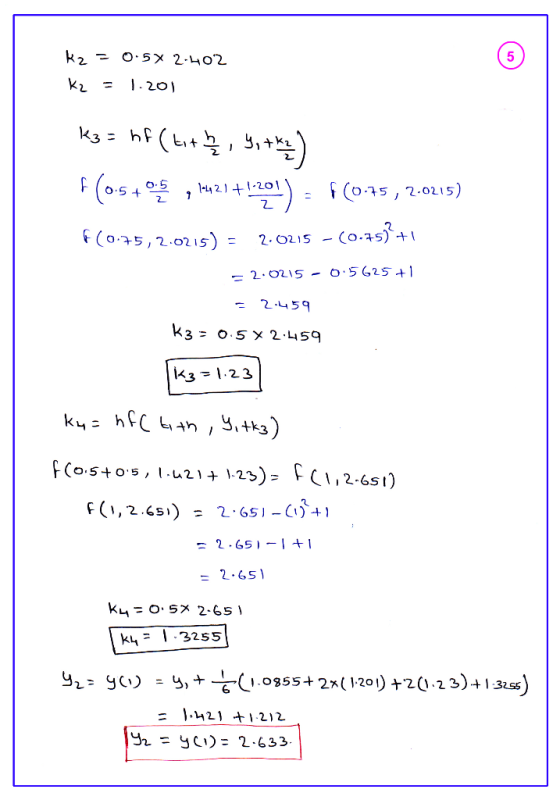
![9324(1-5) =42+ = (k)+ 2xz+ 2x3 +ku] © y 2=2.633 (3= 1.5 62 = 1 ki = hf (tz, B2) f(1,2.633) = 2:633-1 +1 = 2.633 F (112.633) =](http://img.homeworklib.com/questions/55c0a4f0-2b2f-11eb-a9f6-878f0ca62561.png?x-oss-process=image/resize,w_560)
Add Answer to:
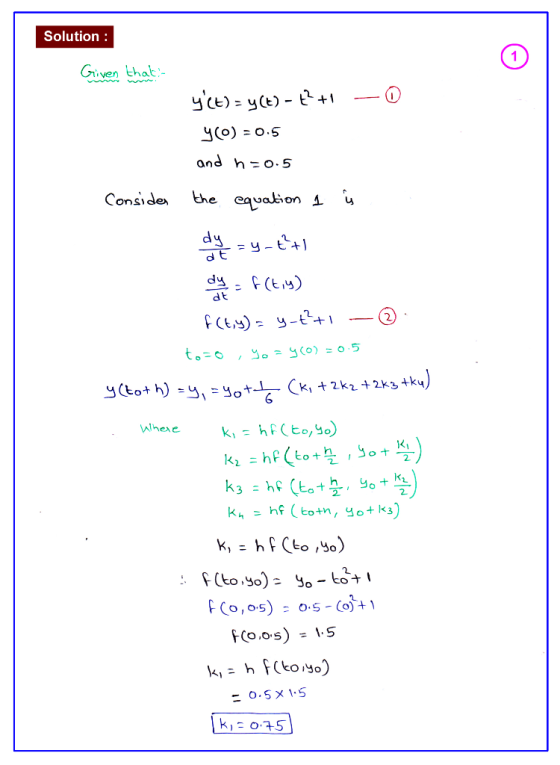
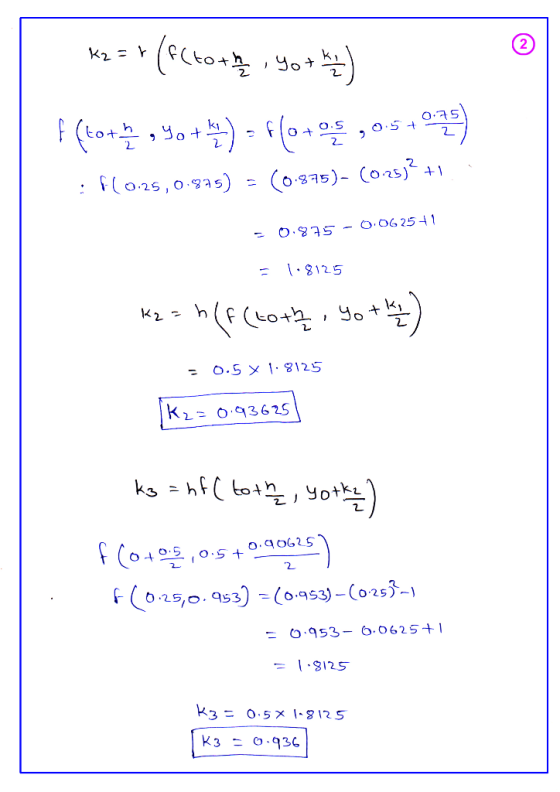
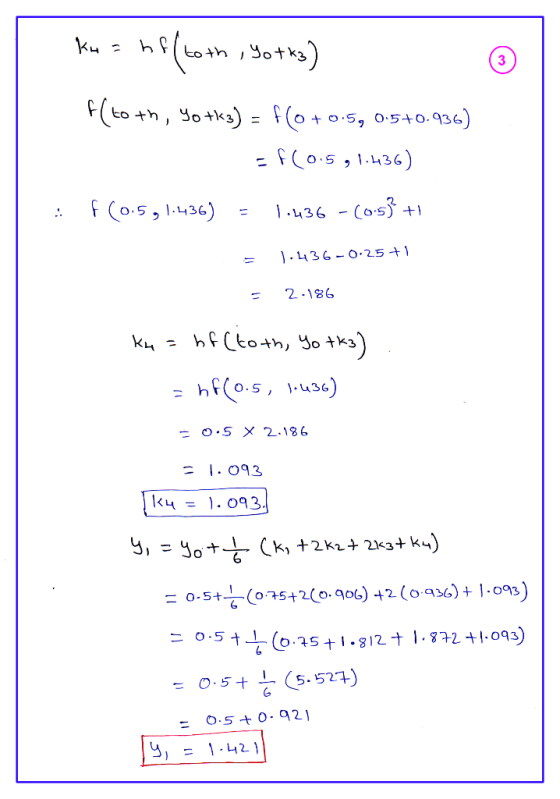
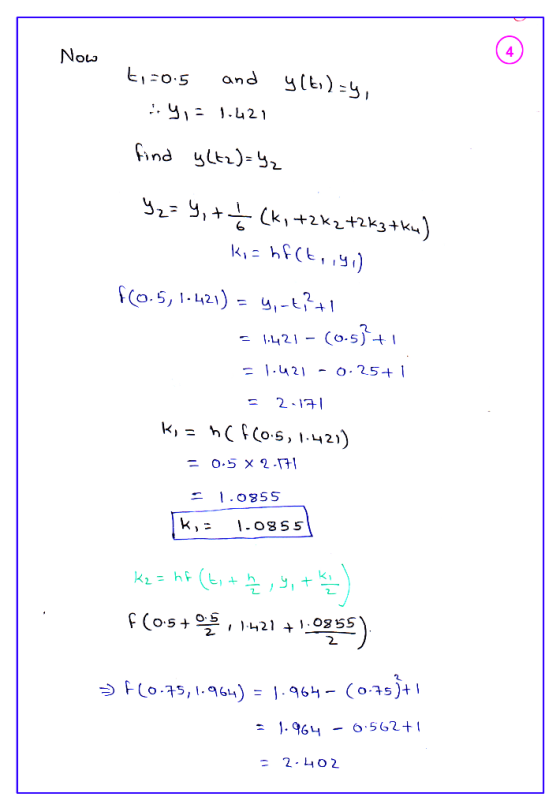
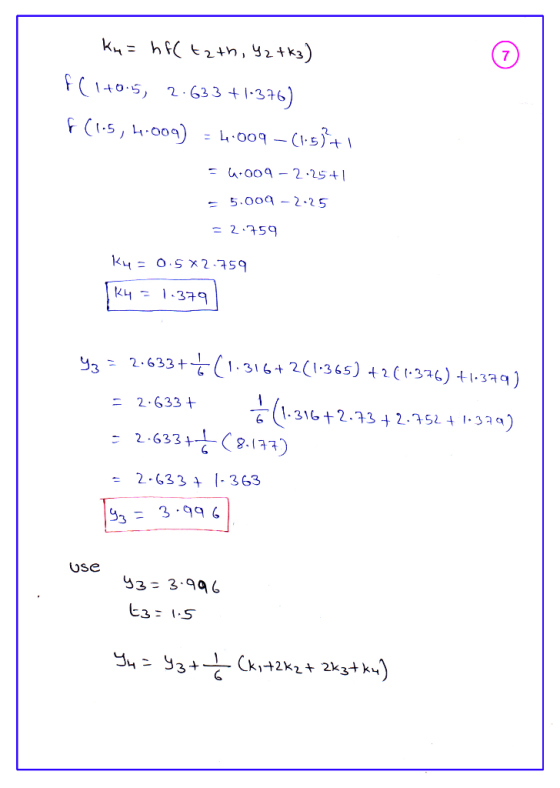
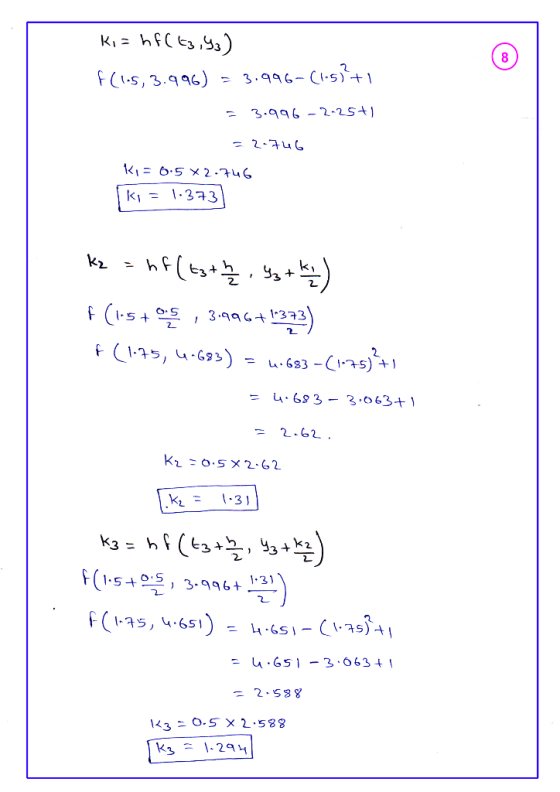
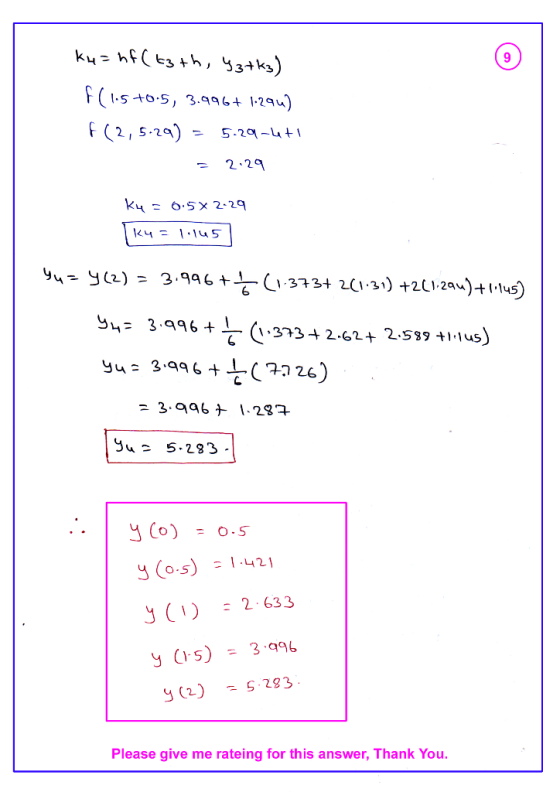
For the following segments, consider the first order initial value problem : () =(t)-tº+1, (0) =...
Using the fourth order Runge-Kutta method (KK4 to solve a first order initial value problem NOTE:...
 Need help with this MATLAB problem:
Using the fourth order Runge-Kutta method (KK4 to solve a first order initial value problem NOTE: This assignment is to be completed using MATLAB, and your final results including the corresponding M- iles shonma ac Given the first order initial value problem with h-time step size (i.e. ti = to + ih), then the following formula computes an approximate solution to (): i vit), where y(ti) - true value (ezact solution), (t)-f(t, v), vto)...
Need help with this MATLAB problem:
Using the fourth order Runge-Kutta method (KK4 to solve a first order initial value problem NOTE: This assignment is to be completed using MATLAB, and your final results including the corresponding M- iles shonma ac Given the first order initial value problem with h-time step size (i.e. ti = to + ih), then the following formula computes an approximate solution to (): i vit), where y(ti) - true value (ezact solution), (t)-f(t, v), vto)...
1. Solve the following initial value problem over the interval from x- 0 to 0.5 with a step size h-0.5 where y(0)-1 dy dx Using Heun method with 2 corrector steps. Calculate g for the corrector steps...
 1. Solve the following initial value problem over the interval from x- 0 to 0.5 with a step size h-0.5 where y(0)-1 dy dx Using Heun method with 2 corrector steps. Calculate g for the corrector steps. Using midpoint method a. b.
1. Solve the following initial value problem over the interval from x- 0 to 0.5 with a step size h-0.5 where y(0)-1 dy dx Using Heun method with 2 corrector steps. Calculate g for the corrector steps. Using...
1. Solve the following initial value problem over the interval from x- 0 to 0.5 with a step size h-0.5 where y(0)-1 dy dx Using Heun method with 2 corrector steps. Calculate g for the corrector steps. Using midpoint method a. b.
1. Solve the following initial value problem over the interval from x- 0 to 0.5 with a step size h-0.5 where y(0)-1 dy dx Using Heun method with 2 corrector steps. Calculate g for the corrector steps. Using...
Find the value of x(0.5) for the initial value problem at = thx(0)=1 using Euler's method with step size h 0.05 Find the value of x(0.4) for the coupled first order differential equations toge...
 Find the value of x(0.5) for the initial value problem at = thx(0)=1 using Euler's method with step size h 0.05 Find the value of x(0.4) for the coupled first order differential equations together with initial conditions with step size 0.1: 2. dt t+x 3. dx dt = y, dy dt x(0) = 1.2 and --ty +xt2 + y(o) 0.8
Find the value of x(0.5) for the initial value problem at = thx(0)=1 using Euler's method with step size h...
Find the value of x(0.5) for the initial value problem at = thx(0)=1 using Euler's method with step size h 0.05 Find the value of x(0.4) for the coupled first order differential equations together with initial conditions with step size 0.1: 2. dt t+x 3. dx dt = y, dy dt x(0) = 1.2 and --ty +xt2 + y(o) 0.8
Find the value of x(0.5) for the initial value problem at = thx(0)=1 using Euler's method with step size h...
Exercise 1 Consider the initial-value problem y(t)=1+3940), 25t<3; y(2) = 0. a) Show that the problem...
 Exercise 1 Consider the initial-value problem y(t)=1+3940), 25t<3; y(2) = 0. a) Show that the problem has a unique solution. b) Compute (by hand) an approximation of y(3) using the forward Euler method with a step size h = 0.5 (namely perform 2 steps of the method).
Q2 Using Fourth-order RK method, solve the following initial value problem over the interval from t...
 Q2 Using Fourth-order RK method, solve the following initial value problem over the interval from t = 0 to 1. Take the initial condition of y(0) = 1 and a step size (h)=0.5. dy = f(t, y) = y t- 1.1 y dt
Problem Thre: 125 points) Consider the following initial value problem: dy-2y+ t The y(0) -1 ea dt ical solution of the differential equation is: y(O)(2-2t+3e-2+1)y fr exoc the differential equat...
 Problem Thre: 125 points) Consider the following initial value problem: dy-2y+ t The y(0) -1 ea dt ical solution of the differential equation is: y(O)(2-2t+3e-2+1)y fr exoc the differential equation numerically over the interval 0 s i s 2.0 and a step size h At 0.5.A Apply the following Runge-Kutta methods for each of the step. (show your calculations) i. [0.0 0.5: Euler method ii. [0.5 1.0]: Heun method. ii. [1.0 1.5): Midpoint method. iv. [1.5 2.0): 4h RK method...
Consider the following initial value problem y = -5y + 5++ 2t, Ostsi, y(0) = 1/3,...
 Consider the following initial value problem y = -5y + 5++ 2t, Ostsi, y(0) = 1/3, with h = 0.1. The exact solution of this problem is y(t) = {2 + e-5t. (2) If you use 2-step Adams-Moulton method (AM2) to solve this problem, what is the specific formula expressing Yi+1 in terms of Yi, Yi-1, të+1, ti, and ti-1 for solving this problem? (3) Use 2-step Adams-Moulton method (AM2) to solve this problem and plot the results to compare...
Consider the following initial value problem: 1. Use Euler's explicit scheme to solve the above initial value probl...
Consider the following initial value problem: 1. Use Euler's explicit scheme to solve the above initial value problem with time step h= 0.5. Express all the computed results with a precision of three decimal places. 2. The analytical or exact solution is compute the absolute error at each tivalue. Express all the computed results with a precision of three decimal places. 3. Write a matlab function that solves the above (IVP) using (RK2.M) for arbitrary time-step h. y(t) ly(0) 3...
3. Consider the initial value problem y'(t) = y2, y(0) = 1. a. Write down (i.e.,...
 3. Consider the initial value problem y'(t) = y2, y(0) = 1. a. Write down (i.e., write the formula which describes one step, Yn+1 = yn + ...) the second order Taylor method with step size h for this initial value problem. b. Write down the time stepping formula Yn+1 = Yn +... for the modified Euler method h Yn+1 := yn + hf(tn + h 2:9 » Yn + 5 f (tnYn)), for this initial value problem. c. What...
3. Consider the initial value problem y(t) = y, y(0) = 1. a. Write down (i.e.,...
 3. Consider the initial value problem y(t) = y, y(0) = 1. a. Write down (i.e., write the formula which describes one step, Yn+1 = yn + ...) the second order Taylor method with step size h for this initial value problem. b. Write down the time stepping formula Yn+1 = Yn +... for the modified Euler method 9n+1 := yn + hf(en +3.29 + s(tn, yn)), for this initial value problem. c. What is the difference between the two...
 Need help with this MATLAB problem:
Using the fourth order Runge-Kutta method (KK4 to solve a first order initial value problem NOTE: This assignment is to be completed using MATLAB, and your final results including the corresponding M- iles shonma ac Given the first order initial value problem with h-time step size (i.e. ti = to + ih), then the following formula computes an approximate solution to (): i vit), where y(ti) - true value (ezact solution), (t)-f(t, v), vto)...
Need help with this MATLAB problem:
Using the fourth order Runge-Kutta method (KK4 to solve a first order initial value problem NOTE: This assignment is to be completed using MATLAB, and your final results including the corresponding M- iles shonma ac Given the first order initial value problem with h-time step size (i.e. ti = to + ih), then the following formula computes an approximate solution to (): i vit), where y(ti) - true value (ezact solution), (t)-f(t, v), vto)...
 1. Solve the following initial value problem over the interval from x- 0 to 0.5 with a step size h-0.5 where y(0)-1 dy dx Using Heun method with 2 corrector steps. Calculate g for the corrector steps. Using midpoint method a. b.
1. Solve the following initial value problem over the interval from x- 0 to 0.5 with a step size h-0.5 where y(0)-1 dy dx Using Heun method with 2 corrector steps. Calculate g for the corrector steps. Using...
1. Solve the following initial value problem over the interval from x- 0 to 0.5 with a step size h-0.5 where y(0)-1 dy dx Using Heun method with 2 corrector steps. Calculate g for the corrector steps. Using midpoint method a. b.
1. Solve the following initial value problem over the interval from x- 0 to 0.5 with a step size h-0.5 where y(0)-1 dy dx Using Heun method with 2 corrector steps. Calculate g for the corrector steps. Using...
 Find the value of x(0.5) for the initial value problem at = thx(0)=1 using Euler's method with step size h 0.05 Find the value of x(0.4) for the coupled first order differential equations together with initial conditions with step size 0.1: 2. dt t+x 3. dx dt = y, dy dt x(0) = 1.2 and --ty +xt2 + y(o) 0.8
Find the value of x(0.5) for the initial value problem at = thx(0)=1 using Euler's method with step size h...
Find the value of x(0.5) for the initial value problem at = thx(0)=1 using Euler's method with step size h 0.05 Find the value of x(0.4) for the coupled first order differential equations together with initial conditions with step size 0.1: 2. dt t+x 3. dx dt = y, dy dt x(0) = 1.2 and --ty +xt2 + y(o) 0.8
Find the value of x(0.5) for the initial value problem at = thx(0)=1 using Euler's method with step size h...
 Exercise 1 Consider the initial-value problem y(t)=1+3940), 25t<3; y(2) = 0. a) Show that the problem has a unique solution. b) Compute (by hand) an approximation of y(3) using the forward Euler method with a step size h = 0.5 (namely perform 2 steps of the method).
 Q2 Using Fourth-order RK method, solve the following initial value problem over the interval from t = 0 to 1. Take the initial condition of y(0) = 1 and a step size (h)=0.5. dy = f(t, y) = y t- 1.1 y dt
 Problem Thre: 125 points) Consider the following initial value problem: dy-2y+ t The y(0) -1 ea dt ical solution of the differential equation is: y(O)(2-2t+3e-2+1)y fr exoc the differential equation numerically over the interval 0 s i s 2.0 and a step size h At 0.5.A Apply the following Runge-Kutta methods for each of the step. (show your calculations) i. [0.0 0.5: Euler method ii. [0.5 1.0]: Heun method. ii. [1.0 1.5): Midpoint method. iv. [1.5 2.0): 4h RK method...
 Consider the following initial value problem y = -5y + 5++ 2t, Ostsi, y(0) = 1/3, with h = 0.1. The exact solution of this problem is y(t) = {2 + e-5t. (2) If you use 2-step Adams-Moulton method (AM2) to solve this problem, what is the specific formula expressing Yi+1 in terms of Yi, Yi-1, të+1, ti, and ti-1 for solving this problem? (3) Use 2-step Adams-Moulton method (AM2) to solve this problem and plot the results to compare...
 3. Consider the initial value problem y'(t) = y2, y(0) = 1. a. Write down (i.e., write the formula which describes one step, Yn+1 = yn + ...) the second order Taylor method with step size h for this initial value problem. b. Write down the time stepping formula Yn+1 = Yn +... for the modified Euler method h Yn+1 := yn + hf(tn + h 2:9 » Yn + 5 f (tnYn)), for this initial value problem. c. What...
 3. Consider the initial value problem y(t) = y, y(0) = 1. a. Write down (i.e., write the formula which describes one step, Yn+1 = yn + ...) the second order Taylor method with step size h for this initial value problem. b. Write down the time stepping formula Yn+1 = Yn +... for the modified Euler method 9n+1 := yn + hf(en +3.29 + s(tn, yn)), for this initial value problem. c. What is the difference between the two...
Most questions answered within 3 hours.
-
Where is the error in this code sequence?
String s1 = "Hello";
String s2 = "ello";...
asked 10 months ago -
Financial data for Joel de Paris, Inc., for last year
follow:
Joel de Paris, Inc.
Balance...
asked 10 months ago -
Consider this reaction:
Al2(SO4)3 (aq)+ BaCl3
(aq) Al2Cl6 (aq)- +
3BaSO4(s) . What is the...
asked 10 months ago -
Suppose that Savneet is considering increasing her
recent random sample from 20 car rentals to 40...
asked 10 months ago -
Trucks arrive at an unloading terminal at an average rate of 120
per hour.
Trucks arrive...
asked 10 months ago -
Why are methanol and ethanol completely soluble in water while
octanol is not very little soluble....
asked 10 months ago -
A facilities manager at a university reads in a research report
that the mean amount of...
asked 10 months ago -
When the CuSO4 is rehydrated by adding water to the anhydrous
compound, is this an endothermic...
asked 10 months ago -
A ray of sunlight is passing from diamond into crown glass; the
angle of incidence is...
asked 10 months ago -
A block of mass 0.249 kg is placed on top of a light, vertical
spring of...
asked 10 months ago -
how do the kidneys compensate in the presences of acidosis
a) trigger hyperventilate
b) reserve acid...
asked 10 months ago -
Question 501 pts
The rental rate of capital to the firm increases. Which of the
following...
asked 10 months ago