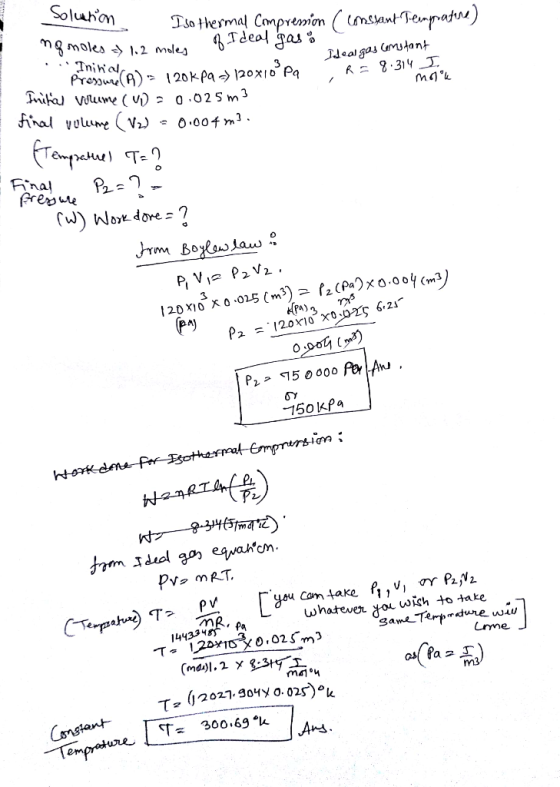
1.2 moles of ideal gas in a cylinder are compressed isothermally from an initial pressure of...
1.2 moles of ideal gas in a cylinder are compressed isothermally from an initial pressure of 120 kPa and a volume of 0.025 m3 to a final volume of 0.004 m3. Calculate the temperature and the final pressure of the gas; and also estimate the work done on the gas.
Homework Answers
 Thank you
Wish you all the best buddy ?? please upvote :)
Add Answer to:
1.2 moles of ideal gas in a cylinder are compressed isothermally
from an initial pressure of...
3 moles of an ideal monatomic gas are compressed reversibly and isothermally from an initial volume...
3 moles of an ideal monatomic gas are compressed reversibly and isothermally from an initial volume of 500 l at 30° C to a final volume of 50 l. Calculate: (a) the initial and final pressure of the gas, and (b) ΔQ , ΔW, ΔU, ΔΗ for the compression.
Five moles of the monatomic gas argon expand isothermally at 302 K from an initial volume...
Five moles of the monatomic gas argon expand isothermally at 302 K from an initial volume of 0.020 m3 to a final volume of 0.050m3. Assuming that argon is an ideal gas, find (a) the work done by the gas, (b) the change in internal energy of the gas, and (c) the heat supplied to the gas. Four mole of gas at temperature 320 K expands isothermally from an initial volume of 1.5 L to 7 L. (a) What is...
(1) An ideal monatomic gas expands isothermally from 0.600 m3 to 1.25 m3 at a constant...
(1) An ideal monatomic gas expands isothermally from 0.600 m3 to 1.25 m3 at a constant temperature of 640 K. If the initial pressure is 1.01 ✕ 105 Pa find the following. (a) the work done on the gas J (b) the thermal energy transfer Q J (c) the change in the internal energy J (2) Gas in a container is at a pressure of 1.2 atm and a volume of 5.0 m3. (a) What is the work done on...
An ideal gas is compressed isothermally from 8.07 L to 6.35 L, at a starting pressure...
An ideal gas is compressed isothermally from 8.07 L to 6.35 L, at a starting pressure of 0.467 atm and temperature of 78.00 °C. 1. How many moles of gas are present? Tries 0/3 2. What is the final pressure (in atm) of the gas? Tries 0/3 3. If the compression is carried out reversibly and isothermally, how much work (in J) is done on the system? Tries 0/3 4. What is the heat flow in part 3? Remember that...
d. Two moles of an ideal gas are compressed in a cylinder at a constant temperature...
 d. Two moles of an ideal gas are compressed in a cylinder at a constant temperature of (75°C) until the original pressure, (2x10$ Pa), is tripled. Given that (R = 8.314 J/mol-K), Find: (1) The amount of work done. () The final volume of the gas.
400 moles of an ideal monatomic gas are kept in a cylinder fitted with a light...
400 moles of an ideal monatomic gas are kept in a cylinder fitted with a light frictionless piston. The gas is maintained at the atmospheric pressure. Heat is added to the gas. The gas consequently expands slowly from an initial volume of 10 m3 to 15 m3. (a) Draw a P-V diagram for this process. (b) Is this thermodynamic process an isothermal expansion, an isobaric expansion or an adiabatic expansion? (c) Calculate the work done by the gas. (d) Calculate...
61N 16. Two moles of an ideal gas are compressed in a cylinder at a constant...
 61N 16. Two moles of an ideal gas are compressed in a cylinder at a constant temperature of 65 °C until the original pressure has tripled. (a) Sketch a pV diagram for this process. (b) Calculate the amount of work done.
5 moles of an ideal gas expand isothermally at T-27°C from an initial volume of 20...
 5 moles of an ideal gas expand isothermally at T-27°C from an initial volume of 20 dm3 to a final volume of 60 dm3. Calculate the work for this process for a) expansion against constant external pressure of 105 Pa and b) reversible expansion. 2.
Five moles of an ideal gas expands isothermally at 300 K from an initial volume of...
 Five moles of an ideal gas expands isothermally at 300 K from an initial volume of 100 L to a final volume of 500 L. Calculate: (a) the maximum work the gas can deliver, (b) the heat accompanying the process, (c) AS for the gas.
When an ideal gas at an initial volume of 'V' and pressure of 'P' is isothermally...
When an ideal gas at an initial volume of 'V' and pressure of 'P' is isothermally (constant temperature) compressed to V/4. What is the new pressure?
 d. Two moles of an ideal gas are compressed in a cylinder at a constant temperature of (75°C) until the original pressure, (2x10$ Pa), is tripled. Given that (R = 8.314 J/mol-K), Find: (1) The amount of work done. () The final volume of the gas.
 61N 16. Two moles of an ideal gas are compressed in a cylinder at a constant temperature of 65 °C until the original pressure has tripled. (a) Sketch a pV diagram for this process. (b) Calculate the amount of work done.
 5 moles of an ideal gas expand isothermally at T-27°C from an initial volume of 20 dm3 to a final volume of 60 dm3. Calculate the work for this process for a) expansion against constant external pressure of 105 Pa and b) reversible expansion. 2.
 Five moles of an ideal gas expands isothermally at 300 K from an initial volume of 100 L to a final volume of 500 L. Calculate: (a) the maximum work the gas can deliver, (b) the heat accompanying the process, (c) AS for the gas.
Most questions answered within 3 hours.
-
Where is the error in this code sequence?
String s1 = "Hello";
String s2 = "ello";...
asked 11 months ago -
Financial data for Joel de Paris, Inc., for last year
follow:
Joel de Paris, Inc.
Balance...
asked 11 months ago -
Consider this reaction:
Al2(SO4)3 (aq)+ BaCl3
(aq) Al2Cl6 (aq)- +
3BaSO4(s) . What is the...
asked 11 months ago -
Suppose that Savneet is considering increasing her
recent random sample from 20 car rentals to 40...
asked 11 months ago -
Trucks arrive at an unloading terminal at an average rate of 120
per hour.
Trucks arrive...
asked 11 months ago -
Why are methanol and ethanol completely soluble in water while
octanol is not very little soluble....
asked 11 months ago -
A facilities manager at a university reads in a research report
that the mean amount of...
asked 11 months ago -
When the CuSO4 is rehydrated by adding water to the anhydrous
compound, is this an endothermic...
asked 11 months ago -
A ray of sunlight is passing from diamond into crown glass; the
angle of incidence is...
asked 11 months ago -
A block of mass 0.249 kg is placed on top of a light, vertical
spring of...
asked 11 months ago -
how do the kidneys compensate in the presences of acidosis
a) trigger hyperventilate
b) reserve acid...
asked 11 months ago -
Question 501 pts
The rental rate of capital to the firm increases. Which of the
following...
asked 11 months ago