In 1939, the box office records set by Gone with the Wind and The Wizard of...
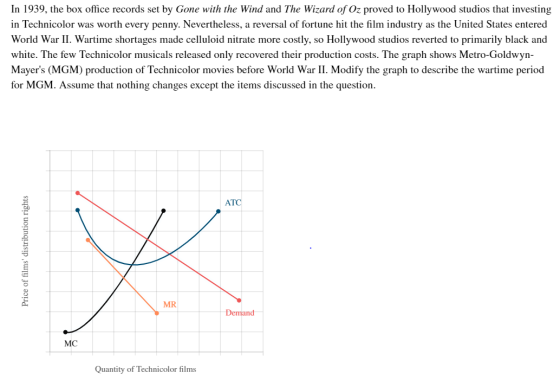
In 1939, the box office records set by Gone with the Wind and The Wizard of Oz proved to Hollywood studios that investing in Technicolor was worth every penny. Nevertheless, a reversal of fortune hit the film industry as the United States entered World War II. Wartime shortages made celluloid nitrate more costly, so Hollywood studios reverted to primarily black and white. The few Technicolor musicals released only recovered their production costs. The graph shows Metro-Goldwyn-Mayer's (MGM) production of Technicolor movies before World War II. Modify the graph to describe the wartime period for MGM. Assume that nothing changes except the items discussed in the question.
Homework Answers
Request Answer!
We need at least 10 more requests to produce the answer.
0 / 10 have requested this problem solution
The more requests, the faster the answer.
Add Answer to:
In 1939, the box office records set by Gone with the Wind and The Wizard of...
In 1939, the box office records set by Gone with the Wind and The Wizard of...
 In 1939, the box office records set by Gone with the Wind and The Wizard of Oz proved to Hollywood studios that investing in Technicolor was worth every penny. Nevertheless, a reversal of fortune hit the film industry as the United States entered World War II. Wartime shortages made celluloid nitrate more costly, so Hollywood studios reverted to primarily black and white. The few Technicolor musicals released only recovered their production costs. The graph shows Metro-Goldwyn- Mayer's (MGM) production of...
50 A MC The accompanying graph depicts average total cost (ATC), marginal cost (MC), marginal revenue...
 50 A MC The accompanying graph depicts average total cost (ATC), marginal cost (MC), marginal revenue (M), and demand (D) facing a monopolistically competitive firm. Place point A at the firm's profit maximizing price and quantity. What is the firm's total cost? 45 40 35 30 ATC Price and Cost ($) 25 total cost: $ 20 D 15 10 What is the firm's total revenue? 5 MR 0 total revenue: $ 0 5 10 15 20 25 30 35 40...
 In 1939, the box office records set by Gone with the Wind and The Wizard of Oz proved to Hollywood studios that investing in Technicolor was worth every penny. Nevertheless, a reversal of fortune hit the film industry as the United States entered World War II. Wartime shortages made celluloid nitrate more costly, so Hollywood studios reverted to primarily black and white. The few Technicolor musicals released only recovered their production costs. The graph shows Metro-Goldwyn- Mayer's (MGM) production of...
 50 A MC The accompanying graph depicts average total cost (ATC), marginal cost (MC), marginal revenue (M), and demand (D) facing a monopolistically competitive firm. Place point A at the firm's profit maximizing price and quantity. What is the firm's total cost? 45 40 35 30 ATC Price and Cost ($) 25 total cost: $ 20 D 15 10 What is the firm's total revenue? 5 MR 0 total revenue: $ 0 5 10 15 20 25 30 35 40...
Most questions answered within 3 hours.
-
Where is the error in this code sequence?
String s1 = "Hello";
String s2 = "ello";...
asked 10 months ago -
Financial data for Joel de Paris, Inc., for last year
follow:
Joel de Paris, Inc.
Balance...
asked 10 months ago -
Consider this reaction:
Al2(SO4)3 (aq)+ BaCl3
(aq) Al2Cl6 (aq)- +
3BaSO4(s) . What is the...
asked 10 months ago -
Suppose that Savneet is considering increasing her
recent random sample from 20 car rentals to 40...
asked 10 months ago -
Trucks arrive at an unloading terminal at an average rate of 120
per hour.
Trucks arrive...
asked 10 months ago -
Why are methanol and ethanol completely soluble in water while
octanol is not very little soluble....
asked 10 months ago -
A facilities manager at a university reads in a research report
that the mean amount of...
asked 10 months ago -
When the CuSO4 is rehydrated by adding water to the anhydrous
compound, is this an endothermic...
asked 10 months ago -
A ray of sunlight is passing from diamond into crown glass; the
angle of incidence is...
asked 10 months ago -
A block of mass 0.249 kg is placed on top of a light, vertical
spring of...
asked 10 months ago -
how do the kidneys compensate in the presences of acidosis
a) trigger hyperventilate
b) reserve acid...
asked 10 months ago -
Question 501 pts
The rental rate of capital to the firm increases. Which of the
following...
asked 10 months ago