A wave pulse (pulse A) on a spring is 4.00cm high and oriented upward. This pulse...
A wave pulse (pulse A) on a spring is 4.00cm high and oriented upward. This pulse meets another pulse, pulse B, of the same shape, and during the time when the pulses are together, the resultant wave is 2.50cm high but oriented downward.
What was the amplitude of pulse B? Note: if the pulse is oriented upward, make its amplitude positive. If it is oriented downward, make its amplitude negative.
Homework Answers
As, Resultant amplitude , R = A + B
=> - 2.50 = 4 + B
=> B = - 6.5 cm
Thus, the amplitude of pulse B = - 6.5 cm
Add Answer to:
A wave pulse (pulse A) on a spring is 4.00cm high and oriented
upward. This pulse...
Pulse 1 moves to the right along a spring, as shown in Figure (a) below. Another...
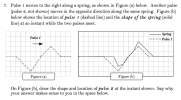 Pulse 1 moves to the right along a spring, as shown in Figure
(a) below. Another pulse (pulse 2, not shown) moves in the opposite
direction along the same spring. Figure (b) below shows the
location ofpulse 1 (dashed line) and the shape of the spring (solid
line) at an instant while the two pulses meet.
7. Pulse 1 moves to the right along a spring, as shown in Figure (a) below. Another pulse (pulse 2, not shown) moves in...
Pulse 1 moves to the right along a spring, as shown in Figure
(a) below. Another pulse (pulse 2, not shown) moves in the opposite
direction along the same spring. Figure (b) below shows the
location ofpulse 1 (dashed line) and the shape of the spring (solid
line) at an instant while the two pulses meet.
7. Pulse 1 moves to the right along a spring, as shown in Figure (a) below. Another pulse (pulse 2, not shown) moves in...
A wave pulse travels down a slinky. The mass of the slinky is m = 0.94...
A wave pulse travels down a slinky. The mass of the slinky is m = 0.94 kg and is initially stretched to a length L = 7.4 m. The wave pulse has an amplitude of A = 0.23 m and takes t = 0.412 s to travel down the stretched length of the slinky. The frequency of the wave pulse is f = 0.45 Hz. 3)What is the average speed of a piece of the slinky as a complete wave...
20.3.5 Observe and explain Observe the series of sketches at the right. The pulses travel at speed v along the string of length L. Based on your analysis and using these two quantities, decide the ti...
 20.3.5 Observe and explain Observe the series of sketches at the right. The pulses travel at speed v along the string of length L. Based on your analysis and using these two quantities, decide the time interval T (called the period for the first vibration) between upward pulls of the hand so that each upward pull sup-b. ports or enhances the pulse that has just returned to and reflected from your hand after one trip down the string and back....
mass vibrates on an ideal spring as illustrated below. The total energy of the spring is...
mass vibrates on an ideal spring as illustrated below. The total energy of the spring is 100 J. What is the kinetic energy of the mass at point P, halfway between the equilibrium point and the amplitude? P Equilibrium A. 50 J B. 200 J C. 75 J D. 100 J E. 25 J When a weight Wis hanging from a light vertical string, the speed of pulses on the string is v. If a second weight Wis added without...
A mass vibrates on an ideal spring as illustrated below. The total energy of the spring...
 A mass vibrates on an ideal spring as illustrated below. The total energy of the spring is 100 J. What is the kinetic energy of the mass at point P, halfway between the equilibrium point and the amplitude? P Equilibrium A. 50 J B. 200 J C. 75 J D. 100 J E. 25 J When a weight Wis hanging from a light vertical string, the speed of pulses on the string is v. If a second weight Wis added...
A stone is thrown vertically upward with speed of 12.5 from the edgae of ...... please...
 A stone is thrown vertically upward with speed of 12.5 from
the edgae of ......
please show all the steps. problem #81
ch inter- 1 km/h -d limit, e lights alculate 81. A stone is thrown vertically upward with a speed of 12.5 m/s from the edge of a cliff 75.0 m high (Fig. 2-49). (a) How much later does it reach the bottom of y=0 the cliff? (b) What is its speed just before hitting? (c) What total distance...
A stone is thrown vertically upward with speed of 12.5 from
the edgae of ......
please show all the steps. problem #81
ch inter- 1 km/h -d limit, e lights alculate 81. A stone is thrown vertically upward with a speed of 12.5 m/s from the edge of a cliff 75.0 m high (Fig. 2-49). (a) How much later does it reach the bottom of y=0 the cliff? (b) What is its speed just before hitting? (c) What total distance...
A bridge oscillates too much during high winds. The bridge is modeled as a spring with...
 A bridge oscillates too much during high winds. The bridge is modeled as a spring with simple harmonic motion. The mass of the bridge is 5.0x10⁶ kg and its spring constant is 4.9x10' N/m. The peak vertical displacement of the bridge is 1.0 m from its equilibrium position. In order to reduce this motion, dampers are added to the bridge with a damping coefficient of 3.13x10² kg/s. a) Derive, but do not solve, the equation of motion which describes the...
A bridge oscillates too much during high winds. The bridge is modeled as a spring with...
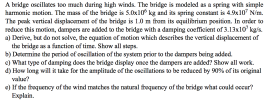 A bridge oscillates too much during high winds. The bridge is modeled as a spring with simple harmonic motion. The mass of the bridge is 5.0x10 kg and its spring constant is 4.9x10⁷ N/m. The peak vertical displacement of the bridge is 1.0 m from its equilibrium position. In order to reduce this motion, dampers are added to the bridge with a damping coefficient of 3.13x10⁷ kg/s. a) Derive, but do not solve, the equation of motion which describes the...
Differential Equation class. Show the steps for the solutions please. Section 3.2 Exercises To Solutions 1. Suppose th...
 Differential Equation class. Show the steps for the solutions
please.
Section 3.2 Exercises To Solutions 1. Suppose that the mass is set in motion by moving it upward by 2.5 cm and releasing it with no initial velocity (a) Sketch what you think the graph of y versus t will look like, taking care with the fact that positive y is upward. Make the amplitude of the motion clear on your graph. (b) Express the initial conditions mathematically by giving...
Differential Equation class. Show the steps for the solutions
please.
Section 3.2 Exercises To Solutions 1. Suppose that the mass is set in motion by moving it upward by 2.5 cm and releasing it with no initial velocity (a) Sketch what you think the graph of y versus t will look like, taking care with the fact that positive y is upward. Make the amplitude of the motion clear on your graph. (b) Express the initial conditions mathematically by giving...
I need help on everything. Measured Force Constant, k (N/m): 5.29 (20 points) Mass, m (kg)_0.100...
 I need help on everything.
Measured Force Constant, k (N/m): 5.29 (20 points) Mass, m (kg)_0.100 kg tittettststtst Time (s) 208 2.94 3.844.12 5.60 6.48 1.36 8.249.14 Period (s) .86.9 -88 -88.88.88.88.9 Calculate the experimental values for the period of oscillation between each consecutive time value, then use those values to calculate the experimental average period value. (10 points) Average Period, Tavg (s): -88 Physical Quantity Crest (m) Trough (m) Amplitude (m) Position Wave 501 .348 0.79 Velocity Wave I-0.57...
I need help on everything.
Measured Force Constant, k (N/m): 5.29 (20 points) Mass, m (kg)_0.100 kg tittettststtst Time (s) 208 2.94 3.844.12 5.60 6.48 1.36 8.249.14 Period (s) .86.9 -88 -88.88.88.88.9 Calculate the experimental values for the period of oscillation between each consecutive time value, then use those values to calculate the experimental average period value. (10 points) Average Period, Tavg (s): -88 Physical Quantity Crest (m) Trough (m) Amplitude (m) Position Wave 501 .348 0.79 Velocity Wave I-0.57...
 Pulse 1 moves to the right along a spring, as shown in Figure
(a) below. Another pulse (pulse 2, not shown) moves in the opposite
direction along the same spring. Figure (b) below shows the
location ofpulse 1 (dashed line) and the shape of the spring (solid
line) at an instant while the two pulses meet.
7. Pulse 1 moves to the right along a spring, as shown in Figure (a) below. Another pulse (pulse 2, not shown) moves in...
Pulse 1 moves to the right along a spring, as shown in Figure
(a) below. Another pulse (pulse 2, not shown) moves in the opposite
direction along the same spring. Figure (b) below shows the
location ofpulse 1 (dashed line) and the shape of the spring (solid
line) at an instant while the two pulses meet.
7. Pulse 1 moves to the right along a spring, as shown in Figure (a) below. Another pulse (pulse 2, not shown) moves in...
 20.3.5 Observe and explain Observe the series of sketches at the right. The pulses travel at speed v along the string of length L. Based on your analysis and using these two quantities, decide the time interval T (called the period for the first vibration) between upward pulls of the hand so that each upward pull sup-b. ports or enhances the pulse that has just returned to and reflected from your hand after one trip down the string and back....
 A mass vibrates on an ideal spring as illustrated below. The total energy of the spring is 100 J. What is the kinetic energy of the mass at point P, halfway between the equilibrium point and the amplitude? P Equilibrium A. 50 J B. 200 J C. 75 J D. 100 J E. 25 J When a weight Wis hanging from a light vertical string, the speed of pulses on the string is v. If a second weight Wis added...
 A stone is thrown vertically upward with speed of 12.5 from
the edgae of ......
please show all the steps. problem #81
ch inter- 1 km/h -d limit, e lights alculate 81. A stone is thrown vertically upward with a speed of 12.5 m/s from the edge of a cliff 75.0 m high (Fig. 2-49). (a) How much later does it reach the bottom of y=0 the cliff? (b) What is its speed just before hitting? (c) What total distance...
A stone is thrown vertically upward with speed of 12.5 from
the edgae of ......
please show all the steps. problem #81
ch inter- 1 km/h -d limit, e lights alculate 81. A stone is thrown vertically upward with a speed of 12.5 m/s from the edge of a cliff 75.0 m high (Fig. 2-49). (a) How much later does it reach the bottom of y=0 the cliff? (b) What is its speed just before hitting? (c) What total distance...
 A bridge oscillates too much during high winds. The bridge is modeled as a spring with simple harmonic motion. The mass of the bridge is 5.0x10⁶ kg and its spring constant is 4.9x10' N/m. The peak vertical displacement of the bridge is 1.0 m from its equilibrium position. In order to reduce this motion, dampers are added to the bridge with a damping coefficient of 3.13x10² kg/s. a) Derive, but do not solve, the equation of motion which describes the...
 A bridge oscillates too much during high winds. The bridge is modeled as a spring with simple harmonic motion. The mass of the bridge is 5.0x10 kg and its spring constant is 4.9x10⁷ N/m. The peak vertical displacement of the bridge is 1.0 m from its equilibrium position. In order to reduce this motion, dampers are added to the bridge with a damping coefficient of 3.13x10⁷ kg/s. a) Derive, but do not solve, the equation of motion which describes the...
 Differential Equation class. Show the steps for the solutions
please.
Section 3.2 Exercises To Solutions 1. Suppose that the mass is set in motion by moving it upward by 2.5 cm and releasing it with no initial velocity (a) Sketch what you think the graph of y versus t will look like, taking care with the fact that positive y is upward. Make the amplitude of the motion clear on your graph. (b) Express the initial conditions mathematically by giving...
Differential Equation class. Show the steps for the solutions
please.
Section 3.2 Exercises To Solutions 1. Suppose that the mass is set in motion by moving it upward by 2.5 cm and releasing it with no initial velocity (a) Sketch what you think the graph of y versus t will look like, taking care with the fact that positive y is upward. Make the amplitude of the motion clear on your graph. (b) Express the initial conditions mathematically by giving...
 I need help on everything.
Measured Force Constant, k (N/m): 5.29 (20 points) Mass, m (kg)_0.100 kg tittettststtst Time (s) 208 2.94 3.844.12 5.60 6.48 1.36 8.249.14 Period (s) .86.9 -88 -88.88.88.88.9 Calculate the experimental values for the period of oscillation between each consecutive time value, then use those values to calculate the experimental average period value. (10 points) Average Period, Tavg (s): -88 Physical Quantity Crest (m) Trough (m) Amplitude (m) Position Wave 501 .348 0.79 Velocity Wave I-0.57...
I need help on everything.
Measured Force Constant, k (N/m): 5.29 (20 points) Mass, m (kg)_0.100 kg tittettststtst Time (s) 208 2.94 3.844.12 5.60 6.48 1.36 8.249.14 Period (s) .86.9 -88 -88.88.88.88.9 Calculate the experimental values for the period of oscillation between each consecutive time value, then use those values to calculate the experimental average period value. (10 points) Average Period, Tavg (s): -88 Physical Quantity Crest (m) Trough (m) Amplitude (m) Position Wave 501 .348 0.79 Velocity Wave I-0.57...
Most questions answered within 3 hours.
-
Where is the error in this code sequence?
String s1 = "Hello";
String s2 = "ello";...
asked 10 months ago -
Financial data for Joel de Paris, Inc., for last year
follow:
Joel de Paris, Inc.
Balance...
asked 10 months ago -
Consider this reaction:
Al2(SO4)3 (aq)+ BaCl3
(aq) Al2Cl6 (aq)- +
3BaSO4(s) . What is the...
asked 10 months ago -
Suppose that Savneet is considering increasing her
recent random sample from 20 car rentals to 40...
asked 10 months ago -
Trucks arrive at an unloading terminal at an average rate of 120
per hour.
Trucks arrive...
asked 10 months ago -
Why are methanol and ethanol completely soluble in water while
octanol is not very little soluble....
asked 10 months ago -
A facilities manager at a university reads in a research report
that the mean amount of...
asked 10 months ago -
When the CuSO4 is rehydrated by adding water to the anhydrous
compound, is this an endothermic...
asked 10 months ago -
A ray of sunlight is passing from diamond into crown glass; the
angle of incidence is...
asked 10 months ago -
A block of mass 0.249 kg is placed on top of a light, vertical
spring of...
asked 10 months ago -
how do the kidneys compensate in the presences of acidosis
a) trigger hyperventilate
b) reserve acid...
asked 10 months ago -
Question 501 pts
The rental rate of capital to the firm increases. Which of the
following...
asked 10 months ago