
Homework Answers
Add Answer to:
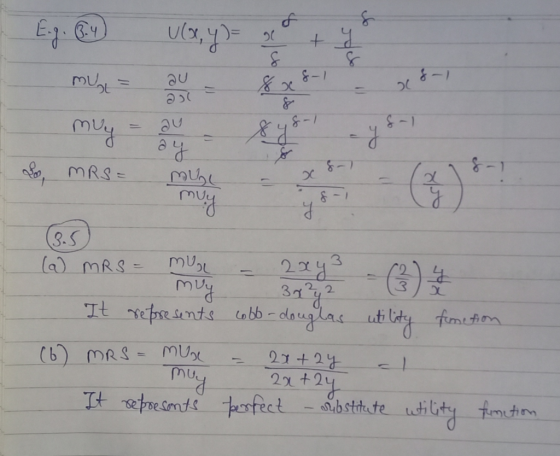
Example 3.4: Find the MRS (if you can): CES utility (above are special cases) U(x,y) =...
4. Consider the utility function U(x,y) -Iny (a) Find the marginal rate of substitution, MRS of...
 4. Consider the utility function U(x,y) -Iny (a) Find the marginal rate of substitution, MRS of this function. Interpret the result (b) Find the equation of the indifference curve for this function (c) Compare the marginal utility of x and y. How do you interpret these functions? How might a consumer choose between z and y as she tries to increase utility by, for example, consuming more when their income increases?
4. Consider the utility function U(x, y) = x + ln y. (a) Find the marginal...
 4. Consider the utility function U(x, y) = x + ln y. (a) Find the marginal rate of substitution, MRS of this function. Interpret the result (b) Find the equation of the indifference curve for this function (c) Compare the marginal utility of x and y. How do you interpret these functions? How might a consumer choose between x and y as she tries to increase utility by, for example, consuming more when their income increases?
Joe has a utility function given by u(x, y) = x^ 2 + 2xy + y^...
Joe has a utility function given by u(x, y) = x^ 2 + 2xy + y^ 2 a. Compute Joes marginal rate of substitution, MRS(x, y). b. Joe’s cousin, Alex, has a utility function v(x, y) = x+y. Compute Alex’s marginal rate of substitution, MRS(x, y). c. Do u(x, y) and v(x, y) represent the same preferences?
A) Let utility over 2 goods be defined as U(x,y)=x+xy+y. Find the MRS by implicitly solving...
A) Let utility over 2 goods be defined as U(x,y)=x+xy+y. Find the MRS by implicitly solving for y (hint: set U=k) and calculate -dy/dx. B) Now find the MRS by using MRS =Ux/Uy.
A consumer of two goods (X and Y) has the following utility function: U(x,y)=xy-ay^2, whre x>=0...
A consumer of two goods (X and Y) has the following utility function: U(x,y)=xy-ay^2, whre x>=0 and y>=0 and a>0 is a parameter. (a) Are there bundles for which one of the goods is actually a "bad" (in the sense that consuming more of it reduces utility)? (b) Find the MRS.
3. (ICs for Quasi-Linear Preferences) Consider the utility function: u(x, y) = x1/2 + y. a....
3. (ICs for Quasi-Linear Preferences) Consider the utility function: u(x, y) = x1/2 + y. a. Find the expression for the MRS (= – dy/dx). b. Draw one IC making sure its shape reflects your expression for MRS above. c. Given your expression for MRS, draw another IC above the one you just drew, and comment on how the slopes of the ICs compare at a given level of x (e.g., at x = 1).
18. (20 points) Matt's utility is given by u(x,,x2) - minfx,, x2) + minfx3, x4 Which...
 18. (20 points) Matt's utility is given by u(x,,x2) - minfx,, x2) + minfx3, x4 Which of the following four bundles (A, B, C, and D) will he most prefer? Bundles are written (x.x2,x3,x4) a. A b. B (2, 2, 2, 2) (6, 0, 0, 2) d. D (6,1,3, 1 af(x,y,z) 19. If f(x, y.z) 3x2 + 2xyz +8y*z + Vž, find o 692when x - 1. y 2, z 3 20. If u(x1, x2) -8x1 + 4x2, find the...
The problem is to maximise utility u(x,y) = 2*x +y s.t. x,y≥0 and p*x + q*y...
The problem is to maximise utility u(x,y) = 2*x +y s.t. x,y≥0 and p*x + q*y ≤w, where p=17.6 and q=3.4 and w=1. The solution to this problem is denoted (x_0, y_0) = (x(p, q, w), y(p, q, w)). The solution is the global max. Find du(x_0,y_0)/dp evaluated at the parameters (p, q, w) = (17.6, 3.4, 1). Write the answer as a number in decimal notation with at least two digits after the decimal point.
1. Clara's utility function is U(X,Y)= (x + 2)(Y +1). a) Write an equation for Clara's...
 1. Clara's utility function is U(X,Y)= (x + 2)(Y +1). a) Write an equation for Clara's indifference curve that goes through the point(X,Y)-(2,8). b) Suppose that the price of each good is one and that Clara has an income of 11. Write an equation that describes her budget constraint. c) Find an equation the describes Clara's MRS for any given commodity bundle (X,Y). d) Use the equations in parts b) and e) to solve for Clara's optimal bundle Hint use...
Consider a utility function u(x,y) = Xayb, where 0くaく1 and 0 < b 〈 1. Also...
 Consider a utility function u(x,y) = Xayb, where 0くaく1 and 0 < b 〈 1. Also assume that x,y>0 7.1. Derive the marginal utility of x and the marginal utility of y and state whether or not the assumption that more is better is satisfied for both goods. 7.2. Does the marginal utility of x diminish, remain constant, or increase as the consumer buys more x?What does it mean in words? 7.3. What is MRS.y? 7.4. Suppose a, b- Wht...
 4. Consider the utility function U(x,y) -Iny (a) Find the marginal rate of substitution, MRS of this function. Interpret the result (b) Find the equation of the indifference curve for this function (c) Compare the marginal utility of x and y. How do you interpret these functions? How might a consumer choose between z and y as she tries to increase utility by, for example, consuming more when their income increases?
 4. Consider the utility function U(x, y) = x + ln y. (a) Find the marginal rate of substitution, MRS of this function. Interpret the result (b) Find the equation of the indifference curve for this function (c) Compare the marginal utility of x and y. How do you interpret these functions? How might a consumer choose between x and y as she tries to increase utility by, for example, consuming more when their income increases?
 18. (20 points) Matt's utility is given by u(x,,x2) - minfx,, x2) + minfx3, x4 Which of the following four bundles (A, B, C, and D) will he most prefer? Bundles are written (x.x2,x3,x4) a. A b. B (2, 2, 2, 2) (6, 0, 0, 2) d. D (6,1,3, 1 af(x,y,z) 19. If f(x, y.z) 3x2 + 2xyz +8y*z + Vž, find o 692when x - 1. y 2, z 3 20. If u(x1, x2) -8x1 + 4x2, find the...
 1. Clara's utility function is U(X,Y)= (x + 2)(Y +1). a) Write an equation for Clara's indifference curve that goes through the point(X,Y)-(2,8). b) Suppose that the price of each good is one and that Clara has an income of 11. Write an equation that describes her budget constraint. c) Find an equation the describes Clara's MRS for any given commodity bundle (X,Y). d) Use the equations in parts b) and e) to solve for Clara's optimal bundle Hint use...
 Consider a utility function u(x,y) = Xayb, where 0くaく1 and 0 < b 〈 1. Also assume that x,y>0 7.1. Derive the marginal utility of x and the marginal utility of y and state whether or not the assumption that more is better is satisfied for both goods. 7.2. Does the marginal utility of x diminish, remain constant, or increase as the consumer buys more x?What does it mean in words? 7.3. What is MRS.y? 7.4. Suppose a, b- Wht...
Most questions answered within 3 hours.
-
Where is the error in this code sequence?
String s1 = "Hello";
String s2 = "ello";...
asked 10 months ago -
Financial data for Joel de Paris, Inc., for last year
follow:
Joel de Paris, Inc.
Balance...
asked 10 months ago -
Consider this reaction:
Al2(SO4)3 (aq)+ BaCl3
(aq) Al2Cl6 (aq)- +
3BaSO4(s) . What is the...
asked 10 months ago -
Suppose that Savneet is considering increasing her
recent random sample from 20 car rentals to 40...
asked 10 months ago -
Trucks arrive at an unloading terminal at an average rate of 120
per hour.
Trucks arrive...
asked 10 months ago -
Why are methanol and ethanol completely soluble in water while
octanol is not very little soluble....
asked 10 months ago -
A facilities manager at a university reads in a research report
that the mean amount of...
asked 10 months ago -
When the CuSO4 is rehydrated by adding water to the anhydrous
compound, is this an endothermic...
asked 10 months ago -
A ray of sunlight is passing from diamond into crown glass; the
angle of incidence is...
asked 10 months ago -
A block of mass 0.249 kg is placed on top of a light, vertical
spring of...
asked 10 months ago -
how do the kidneys compensate in the presences of acidosis
a) trigger hyperventilate
b) reserve acid...
asked 10 months ago -
Question 501 pts
The rental rate of capital to the firm increases. Which of the
following...
asked 10 months ago