


Homework Answers

Add Answer to:
Table I. Summary of Titration Data for H3PO4 Acid Titration Point Volume of NaOH added 0.00...
Calculating Ka from titration curve. We titrated H3PO4 with NaOH. We began with 40.0 mL 0.0970...
Calculating Ka from titration curve. We titrated H3PO4 with NaOH. We began with 40.0 mL 0.0970 MH3PO4, titrated with 0.2085 M NaOH. We reached first equivalence at 18.78 mL NaOH titrated, and second equivalence at 38.50 mL titrated. Calculate Ka1 for H3PO4 using the following data obtained from a titration curve: 1) From the initial pH = 1.97 2) From the pH value half way to the first equivalence point = 2.10 Calculate Ka2 for H3PO4 from the following data...
Please refer to data set D 1. For each data set, the volume of acid being...
 Please refer to data set D
1. For each data set, the volume of acid being analyzed is 10.00 mL and the concentration of NAOH is 0.100 M. 2nd Volume of pH at 1st eq. pt pH at pt Conc. of Volume of Data Set eq. acid (g/L) NaOH at 1st NAOH at 2nd eq.point (mL) eq.point (mL) 9.12 4.1 15.98 9.6 8.06 9.2 15.12 11.95 4.3 24.09 В 3.9 18.10 12.42 8.96 8.8 С D 21.00 14.08 27.96 9.1...
Please refer to data set D
1. For each data set, the volume of acid being analyzed is 10.00 mL and the concentration of NAOH is 0.100 M. 2nd Volume of pH at 1st eq. pt pH at pt Conc. of Volume of Data Set eq. acid (g/L) NaOH at 1st NAOH at 2nd eq.point (mL) eq.point (mL) 9.12 4.1 15.98 9.6 8.06 9.2 15.12 11.95 4.3 24.09 В 3.9 18.10 12.42 8.96 8.8 С D 21.00 14.08 27.96 9.1...
DETERMINATION OF MOLECULAR WEIGHT OF AN UNKNOWN DIPROTIC ACID Use Data Set to answer the followin...
 DETERMINATION OF MOLECULAR WEIGHT OF AN UNKNOWN DIPROTIC ACID Use Data Set to answer the following questions 1. Using the data, sketch a titration curve for the titration of the acid with 0.1 M NaOH pH 0 volume of NaOH added 2. Using the first equivalence point, determine the molecular weight of the acid. Use the sequence of steps employed in the in-class exercise. Homework Molecular Weight of an Unknown Diprotic Acid 3. Using the second equivalence point, determine the...
a) Use this plot to estimate the volume of NaOH required to reach the equivalence point...
 a) Use this plot to estimate the volume of NaOH
required to reach the equivalence point of each titration
curve.
b) Estimate the original concentration of weak acid in
solution before strong base was added.
c) Find the midpoint pH for each of the trials using
half the volume of NaOH required to reach the equivalence point for
that trial. Check if this pH is at the most flat part of the
titration curve. This is the pKa of the...
a) Use this plot to estimate the volume of NaOH
required to reach the equivalence point of each titration
curve.
b) Estimate the original concentration of weak acid in
solution before strong base was added.
c) Find the midpoint pH for each of the trials using
half the volume of NaOH required to reach the equivalence point for
that trial. Check if this pH is at the most flat part of the
titration curve. This is the pKa of the...
1.Draw the pH titration curve for the titration of 35 mL of 0.150 M acetic acid with 0.200 M NaOH. Include the pH v...
 1.Draw the pH titration curve for the titration of 35 mL of 0.150 M acetic acid with 0.200 M NaOH. Include the pH values and NaOH volume requested below on your pH titration curve. Also, put on the curve the species that dictates the pH at the requested pH values. For acetic acid, K = 1.8 x 10%. 1) the initial pH 2) the pH after 15.0 mL of NaOH have been added 3) the volume of NaOH at the...
using the data table find the following pH pH Volume of NaOH added, ml 0.00 mL...
 using the data table find the
following
pH pH Volume of NaOH added, ml 0.00 mL Volume of NaOH added, ml 13.00 mL 1.96 13.15 1.00 mL 2.55 14.00 mL 13.24 2.00 mL 2.88 15.00 mL 13.38 3.00 mL 3.05 16.00 mL 13.49 4.00 mL 3.25 Click or tap here to enter text. Click or tap here to enter text. 5.00 mL 3.36 Click or tap here to enter text. Click or tap here to enter text. 6.00 mL 3.49...
using the data table find the
following
pH pH Volume of NaOH added, ml 0.00 mL Volume of NaOH added, ml 13.00 mL 1.96 13.15 1.00 mL 2.55 14.00 mL 13.24 2.00 mL 2.88 15.00 mL 13.38 3.00 mL 3.05 16.00 mL 13.49 4.00 mL 3.25 Click or tap here to enter text. Click or tap here to enter text. 5.00 mL 3.36 Click or tap here to enter text. Click or tap here to enter text. 6.00 mL 3.49...
A Weak Acid - Strong Base Titration Report Sheet Date: Name: Volume of CH3COOH (ml): Sample...
 A Weak Acid - Strong Base Titration Report Sheet Date: Name: Volume of CH3COOH (ml): Sample Code: { 10.00 mL Temperature: _22.0_ Initial Volume of NaOH (mL): 0.00 Molarity of NaOH (from label): _0.1013__ RUN 1 From LabQuest Titration Curve From 1st Derivative From Printed Titration Curve Instructor's Approval of LabQuest Data Volume of NaOH at Equivalence Pt (mL) 12.00mL 12.65mL Average Volume of NaOH at Equivalence Pt Include printed graphs of titration curve and 1st Derivation with Report Sheet...
What is the pH at the second eq. point (40 mL acid added) of the titration of a weak base titrated with a strong acid: p...
What is the pH at the second eq. point (40 mL acid added) of the titration of a weak base titrated with a strong acid: pKa1= 9.06 pKa2= 4.18 [base]=0.20 M 20 mL [acid]= 0.10 M
Question 3: Draw the titration curve (pH versus mL of NaOH added) that would be obtained...
 Question 3: Draw the titration curve (pH versus mL of NaOH added) that would be obtained from the titration of 30 mL of a 0.10 M solution of an unknown triprotic acid, H3A (Kat = 1.26 x 10⁻³; Ka2 = 5.6 x 10⁻⁶, Ka3 = 3.32 x 10⁻¹⁰) with 0.10 M NaOH. Indicate the volume needed to reach the first second, and third equivalence points and the pH at the half equivalence points for the three titration regions.
pH PP he following Table to obtain a summary of various points in the titration of...
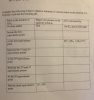 pH PP he following Table to obtain a summary of various points in the titration of a Complete the following Table to o Triprotic Acid and the resulting PH. pH is calculated by Point in the titration of НЗА No Base added Major ions present in the aqueous solution HA Use K, and an ICE table Before the first equivalence point At the first equivalence point pH = (pK 1 + PK 2)*0.5 Between the 1st and 2nd equivalence points...
 Please refer to data set D
1. For each data set, the volume of acid being analyzed is 10.00 mL and the concentration of NAOH is 0.100 M. 2nd Volume of pH at 1st eq. pt pH at pt Conc. of Volume of Data Set eq. acid (g/L) NaOH at 1st NAOH at 2nd eq.point (mL) eq.point (mL) 9.12 4.1 15.98 9.6 8.06 9.2 15.12 11.95 4.3 24.09 В 3.9 18.10 12.42 8.96 8.8 С D 21.00 14.08 27.96 9.1...
Please refer to data set D
1. For each data set, the volume of acid being analyzed is 10.00 mL and the concentration of NAOH is 0.100 M. 2nd Volume of pH at 1st eq. pt pH at pt Conc. of Volume of Data Set eq. acid (g/L) NaOH at 1st NAOH at 2nd eq.point (mL) eq.point (mL) 9.12 4.1 15.98 9.6 8.06 9.2 15.12 11.95 4.3 24.09 В 3.9 18.10 12.42 8.96 8.8 С D 21.00 14.08 27.96 9.1...
 DETERMINATION OF MOLECULAR WEIGHT OF AN UNKNOWN DIPROTIC ACID Use Data Set to answer the following questions 1. Using the data, sketch a titration curve for the titration of the acid with 0.1 M NaOH pH 0 volume of NaOH added 2. Using the first equivalence point, determine the molecular weight of the acid. Use the sequence of steps employed in the in-class exercise. Homework Molecular Weight of an Unknown Diprotic Acid 3. Using the second equivalence point, determine the...
 a) Use this plot to estimate the volume of NaOH
required to reach the equivalence point of each titration
curve.
b) Estimate the original concentration of weak acid in
solution before strong base was added.
c) Find the midpoint pH for each of the trials using
half the volume of NaOH required to reach the equivalence point for
that trial. Check if this pH is at the most flat part of the
titration curve. This is the pKa of the...
a) Use this plot to estimate the volume of NaOH
required to reach the equivalence point of each titration
curve.
b) Estimate the original concentration of weak acid in
solution before strong base was added.
c) Find the midpoint pH for each of the trials using
half the volume of NaOH required to reach the equivalence point for
that trial. Check if this pH is at the most flat part of the
titration curve. This is the pKa of the...
 1.Draw the pH titration curve for the titration of 35 mL of 0.150 M acetic acid with 0.200 M NaOH. Include the pH values and NaOH volume requested below on your pH titration curve. Also, put on the curve the species that dictates the pH at the requested pH values. For acetic acid, K = 1.8 x 10%. 1) the initial pH 2) the pH after 15.0 mL of NaOH have been added 3) the volume of NaOH at the...
 using the data table find the
following
pH pH Volume of NaOH added, ml 0.00 mL Volume of NaOH added, ml 13.00 mL 1.96 13.15 1.00 mL 2.55 14.00 mL 13.24 2.00 mL 2.88 15.00 mL 13.38 3.00 mL 3.05 16.00 mL 13.49 4.00 mL 3.25 Click or tap here to enter text. Click or tap here to enter text. 5.00 mL 3.36 Click or tap here to enter text. Click or tap here to enter text. 6.00 mL 3.49...
using the data table find the
following
pH pH Volume of NaOH added, ml 0.00 mL Volume of NaOH added, ml 13.00 mL 1.96 13.15 1.00 mL 2.55 14.00 mL 13.24 2.00 mL 2.88 15.00 mL 13.38 3.00 mL 3.05 16.00 mL 13.49 4.00 mL 3.25 Click or tap here to enter text. Click or tap here to enter text. 5.00 mL 3.36 Click or tap here to enter text. Click or tap here to enter text. 6.00 mL 3.49...
 A Weak Acid - Strong Base Titration Report Sheet Date: Name: Volume of CH3COOH (ml): Sample Code: { 10.00 mL Temperature: _22.0_ Initial Volume of NaOH (mL): 0.00 Molarity of NaOH (from label): _0.1013__ RUN 1 From LabQuest Titration Curve From 1st Derivative From Printed Titration Curve Instructor's Approval of LabQuest Data Volume of NaOH at Equivalence Pt (mL) 12.00mL 12.65mL Average Volume of NaOH at Equivalence Pt Include printed graphs of titration curve and 1st Derivation with Report Sheet...
 Question 3: Draw the titration curve (pH versus mL of NaOH added) that would be obtained from the titration of 30 mL of a 0.10 M solution of an unknown triprotic acid, H3A (Kat = 1.26 x 10⁻³; Ka2 = 5.6 x 10⁻⁶, Ka3 = 3.32 x 10⁻¹⁰) with 0.10 M NaOH. Indicate the volume needed to reach the first second, and third equivalence points and the pH at the half equivalence points for the three titration regions.
 pH PP he following Table to obtain a summary of various points in the titration of a Complete the following Table to o Triprotic Acid and the resulting PH. pH is calculated by Point in the titration of НЗА No Base added Major ions present in the aqueous solution HA Use K, and an ICE table Before the first equivalence point At the first equivalence point pH = (pK 1 + PK 2)*0.5 Between the 1st and 2nd equivalence points...
Most questions answered within 3 hours.
-
Where is the error in this code sequence?
String s1 = "Hello";
String s2 = "ello";...
asked 10 months ago -
Financial data for Joel de Paris, Inc., for last year
follow:
Joel de Paris, Inc.
Balance...
asked 10 months ago -
Consider this reaction:
Al2(SO4)3 (aq)+ BaCl3
(aq) Al2Cl6 (aq)- +
3BaSO4(s) . What is the...
asked 10 months ago -
Suppose that Savneet is considering increasing her
recent random sample from 20 car rentals to 40...
asked 10 months ago -
Trucks arrive at an unloading terminal at an average rate of 120
per hour.
Trucks arrive...
asked 10 months ago -
Why are methanol and ethanol completely soluble in water while
octanol is not very little soluble....
asked 10 months ago -
A facilities manager at a university reads in a research report
that the mean amount of...
asked 10 months ago -
When the CuSO4 is rehydrated by adding water to the anhydrous
compound, is this an endothermic...
asked 10 months ago -
A ray of sunlight is passing from diamond into crown glass; the
angle of incidence is...
asked 10 months ago -
A block of mass 0.249 kg is placed on top of a light, vertical
spring of...
asked 10 months ago -
how do the kidneys compensate in the presences of acidosis
a) trigger hyperventilate
b) reserve acid...
asked 10 months ago -
Question 501 pts
The rental rate of capital to the firm increases. Which of the
following...
asked 10 months ago