
Homework Answers
Joint distribution: P(A,B,C,D) = P(A)P(C)P(B/A)P(D/BC)
a) P(A=true, B=false, C=true, D=false)
= P(A=true)P(C=true)P(B=false/A=true)P(D=true/B=false, C=true)
= 0.7 * 0.4* (1-0.3) * (1-0.3)
= 0.1372
b) P(D=true/A=false, B=true, C=false)
= P(A=false)P(C=false)P(B=true/A=false)P(D=true/B=true, C=false)/ (summation of D over P(A=false)P(C=false)P(B=true/A=false)P(D/B=true, C=false))
= (0.6 * 0.3 * 0.9 * 0.5) /((0.6 * 0.3* 0.9* 0.5) + (0.6* 0.3* 0.9* 0.5))
= 0.5
e) P(B=false) = summation of ACD over (P(A)P(C)P(B=false/A)P(D/B=false,C))
= (0.6 * 0.3 * 0.1 * 0.2) + (0.6 * 0.7 * 0.1 * 0.2) + (0.6 * 0.3 * 0.1 * 0.8) + (0.6 * 0.7 * 0.1 * 0.8) + (0.4 * 0.3 * 0.7 * 0.2) + (0.4 * 0.7 * 0.7 * 0.2) + (0.4 * 0.3 * 0.7 * 0.8) + (0.4 * 0.7 * 0.7 * 0.8)
= 0.34
I have answered maximum number of questions. Working on the remaining questions. Please Up vote. Thank you
Add Answer to:
17. Consider the Bayesian network drawn below A P(A true) 0.4 P(B-true | A-false)0.9 D P(B-true...
Given the following Bayesian network, where all random variables have Boolean values (true or fal...
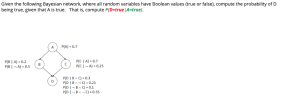 Given the following Bayesian network, where all random variables have Boolean values (true or false), compute the probability of D being true, given that A is true. That is, compute P(D-true |A-true) AP(A) 0.7 P(B IA) 0.2 P(B 1-A)-0.5 P(C I A)-0.7 PCI-A)-0.25 P(D IBAC)-0.3 P(D I-BAC)-0.1
Given the following Bayesian network, where all random variables have Boolean values (true or false), compute the probability of D being true, given that A is true. That is, compute P(D-true |A-true) AP(A)...
Given the following Bayesian network, where all random variables have Boolean values (true or false), compute the probability of D being true, given that A is true. That is, compute P(D-true |A-true) AP(A) 0.7 P(B IA) 0.2 P(B 1-A)-0.5 P(C I A)-0.7 PCI-A)-0.25 P(D IBAC)-0.3 P(D I-BAC)-0.1
Given the following Bayesian network, where all random variables have Boolean values (true or false), compute the probability of D being true, given that A is true. That is, compute P(D-true |A-true) AP(A)...
= 0.3. Consider events A and B such that P(A) = 0.7, P(B) = 0.2 and...
 = 0.3. Consider events A and B such that P(A) = 0.7, P(B) = 0.2 and P(ANB) Compute the probability that A will occur, given that B does not occur, A. 0.4 B. 0.1 C. -0.1 D. 0.5 E. none of the preceding
at you 7.54 Consider a binary mixture of a and b at T 300K and P = 40 kPa. A graph of the fugacity of species a as a fu...
 at you 7.54 Consider a binary mixture of a and b at T 300K and P = 40 kPa. A graph of the fugacity of species a as a function of mole fraction is shown below. Use Henry's law as the reference state for species a and the Lewis/Randall rule for species b. Show all your work 40 38 36 T-300 K P: 40 kPa 34 32 30 28 26 24 22 20 18 16 14 12 10 4 2...
3. Below is a Lineweaver-Burke plot of an enzyme reaction in the presence and absence of...
 3. Below is a Lineweaver-Burke plot of an enzyme reaction in the presence and absence of an inhibitor. 2.4 2.3 2.2 2.1 2 1.9 1.8 1.7 1.6 1.5 1.4 1.3 1.2 1.1 1 0.9 0.8 < 0.7 0.6 0.5 0.4 0.3 0.2 0.1 0 -0.1 -0.2 -0.3 -0.4 -0.5 -0.6 -0.7 -0.8 . . . . . -1 -0.9 -0.8 -0.7 -0.6 -0.5 -0.4 -0.3 -0.2 -0.1 O 0.1 0.2 0.3 0.4 0.5 0.6 0.7 0.8 0.9 1 1.1 1/[S]...
Two events A and B are such that P(A) = 0.4, P(B) = 0.5, and P(AUB)...
 Two events A and B are such that P(A) = 0.4, P(B) = 0.5, and P(AUB) = 0.7. (a) Find P(A n B). 0.2 (b) Find P(AUB). 0.8 (c) Find P(An B). 0.3 (d) Find P(AB). (Enter your probability as a fraction.) 1/2
Consider the more difficult classification problem shown in the chart below Question 5: Consider the more difficult cla...
 Consider the more difficult classification problem shown in the
chart below
Question 5: Consider the more difficult classification problem shown in the chart below: Class -1 0.9 O Class 1 0.8 0.6 0.4 0.3 0.2 0.1 0 0.1 0.2 0.3 0.4 0.5 0.6 0.7 0.8 0.91 i1 Figure 6: A set of two-dimensional input samples from two classes (a) As you certainly noticed, a single perceptron cannot do this classification task perfectly. Determine the minimum error that a single perceptron...
Consider the more difficult classification problem shown in the
chart below
Question 5: Consider the more difficult classification problem shown in the chart below: Class -1 0.9 O Class 1 0.8 0.6 0.4 0.3 0.2 0.1 0 0.1 0.2 0.3 0.4 0.5 0.6 0.7 0.8 0.91 i1 Figure 6: A set of two-dimensional input samples from two classes (a) As you certainly noticed, a single perceptron cannot do this classification task perfectly. Determine the minimum error that a single perceptron...
Which of the following values cannot be probabilities? 0.03, 0.49, 3/5, 0, 1.35, 1,5/3,2 B. □D,...
 Which of the following values cannot be probabilities? 0.03, 0.49, 3/5, 0, 1.35, 1,5/3,2 B. □D, -0.49 E. 3 F. 0 H. 1.35 Use the following cell phone airport data speeds (Mops) from a particular network. Find the percentlie corresponding to the data speed 1.2 Mbps 0.1 0.7 1.4 3.8 10.5 0.1 0.7 1.9 4.1 11.6 0.1 0.8 2.1 4.5 11.8 0.1 0.8 2.1 4.9 11.9 0.3 0.9 2.3 5.4 11.9 0.4 0.9 2.6 5.7 12.4 0.5 0.9 2.7 6.7...
Consider events A and B such that P(A)=0.3,P(B|A)=0.9,P(B|A¯¯¯)=0.4. Calculate P(A|B¯¯). Give your answer as a fraction...
Consider events A and B such that P(A)=0.3,P(B|A)=0.9,P(B|A¯¯¯)=0.4. Calculate P(A|B¯¯). Give your answer as a fraction in its simplest form.
If P(A)=0.7 and P(B)=0.4 and P(A and B)=0.2 then P(A and B9= Select one: O a....
 If P(A)=0.7 and P(B)=0.4 and P(A and B)=0.2 then P(A and B9= Select one: O a. 0.5 b. 0.56 O c.0.9 d. 0.2
Let the random variable X be a random number with the uniform density curve in the...
 Let the random variable X be a random number with the uniform density curve in the figure below. Area = 0.4 Area = 0.5 Area = 0.2 Height = 1 0.3 0.7 0.5 0.8 P(X<0.5 or X > 0.8) P(0.3<X<0.7) (a) (b) Find the following probabilities. P(X 2 0.35) (a) (b) P(X = 0.35) P(0.35 < X < 1.25) (c) P(0.10 < X < 0.20 or 0.6 < X < 0.9) (d) X is not in the interval 0.5 to...
 Given the following Bayesian network, where all random variables have Boolean values (true or false), compute the probability of D being true, given that A is true. That is, compute P(D-true |A-true) AP(A) 0.7 P(B IA) 0.2 P(B 1-A)-0.5 P(C I A)-0.7 PCI-A)-0.25 P(D IBAC)-0.3 P(D I-BAC)-0.1
Given the following Bayesian network, where all random variables have Boolean values (true or false), compute the probability of D being true, given that A is true. That is, compute P(D-true |A-true) AP(A)...
Given the following Bayesian network, where all random variables have Boolean values (true or false), compute the probability of D being true, given that A is true. That is, compute P(D-true |A-true) AP(A) 0.7 P(B IA) 0.2 P(B 1-A)-0.5 P(C I A)-0.7 PCI-A)-0.25 P(D IBAC)-0.3 P(D I-BAC)-0.1
Given the following Bayesian network, where all random variables have Boolean values (true or false), compute the probability of D being true, given that A is true. That is, compute P(D-true |A-true) AP(A)...
 = 0.3. Consider events A and B such that P(A) = 0.7, P(B) = 0.2 and P(ANB) Compute the probability that A will occur, given that B does not occur, A. 0.4 B. 0.1 C. -0.1 D. 0.5 E. none of the preceding
 at you 7.54 Consider a binary mixture of a and b at T 300K and P = 40 kPa. A graph of the fugacity of species a as a function of mole fraction is shown below. Use Henry's law as the reference state for species a and the Lewis/Randall rule for species b. Show all your work 40 38 36 T-300 K P: 40 kPa 34 32 30 28 26 24 22 20 18 16 14 12 10 4 2...
 3. Below is a Lineweaver-Burke plot of an enzyme reaction in the presence and absence of an inhibitor. 2.4 2.3 2.2 2.1 2 1.9 1.8 1.7 1.6 1.5 1.4 1.3 1.2 1.1 1 0.9 0.8 < 0.7 0.6 0.5 0.4 0.3 0.2 0.1 0 -0.1 -0.2 -0.3 -0.4 -0.5 -0.6 -0.7 -0.8 . . . . . -1 -0.9 -0.8 -0.7 -0.6 -0.5 -0.4 -0.3 -0.2 -0.1 O 0.1 0.2 0.3 0.4 0.5 0.6 0.7 0.8 0.9 1 1.1 1/[S]...
 Two events A and B are such that P(A) = 0.4, P(B) = 0.5, and P(AUB) = 0.7. (a) Find P(A n B). 0.2 (b) Find P(AUB). 0.8 (c) Find P(An B). 0.3 (d) Find P(AB). (Enter your probability as a fraction.) 1/2
 Consider the more difficult classification problem shown in the
chart below
Question 5: Consider the more difficult classification problem shown in the chart below: Class -1 0.9 O Class 1 0.8 0.6 0.4 0.3 0.2 0.1 0 0.1 0.2 0.3 0.4 0.5 0.6 0.7 0.8 0.91 i1 Figure 6: A set of two-dimensional input samples from two classes (a) As you certainly noticed, a single perceptron cannot do this classification task perfectly. Determine the minimum error that a single perceptron...
Consider the more difficult classification problem shown in the
chart below
Question 5: Consider the more difficult classification problem shown in the chart below: Class -1 0.9 O Class 1 0.8 0.6 0.4 0.3 0.2 0.1 0 0.1 0.2 0.3 0.4 0.5 0.6 0.7 0.8 0.91 i1 Figure 6: A set of two-dimensional input samples from two classes (a) As you certainly noticed, a single perceptron cannot do this classification task perfectly. Determine the minimum error that a single perceptron...
 Which of the following values cannot be probabilities? 0.03, 0.49, 3/5, 0, 1.35, 1,5/3,2 B. □D, -0.49 E. 3 F. 0 H. 1.35 Use the following cell phone airport data speeds (Mops) from a particular network. Find the percentlie corresponding to the data speed 1.2 Mbps 0.1 0.7 1.4 3.8 10.5 0.1 0.7 1.9 4.1 11.6 0.1 0.8 2.1 4.5 11.8 0.1 0.8 2.1 4.9 11.9 0.3 0.9 2.3 5.4 11.9 0.4 0.9 2.6 5.7 12.4 0.5 0.9 2.7 6.7...
 If P(A)=0.7 and P(B)=0.4 and P(A and B)=0.2 then P(A and B9= Select one: O a. 0.5 b. 0.56 O c.0.9 d. 0.2
 Let the random variable X be a random number with the uniform density curve in the figure below. Area = 0.4 Area = 0.5 Area = 0.2 Height = 1 0.3 0.7 0.5 0.8 P(X<0.5 or X > 0.8) P(0.3<X<0.7) (a) (b) Find the following probabilities. P(X 2 0.35) (a) (b) P(X = 0.35) P(0.35 < X < 1.25) (c) P(0.10 < X < 0.20 or 0.6 < X < 0.9) (d) X is not in the interval 0.5 to...
Most questions answered within 3 hours.
-
Where is the error in this code sequence?
String s1 = "Hello";
String s2 = "ello";...
asked 11 months ago -
Financial data for Joel de Paris, Inc., for last year
follow:
Joel de Paris, Inc.
Balance...
asked 11 months ago -
Consider this reaction:
Al2(SO4)3 (aq)+ BaCl3
(aq) Al2Cl6 (aq)- +
3BaSO4(s) . What is the...
asked 11 months ago -
Suppose that Savneet is considering increasing her
recent random sample from 20 car rentals to 40...
asked 11 months ago -
Trucks arrive at an unloading terminal at an average rate of 120
per hour.
Trucks arrive...
asked 11 months ago -
Why are methanol and ethanol completely soluble in water while
octanol is not very little soluble....
asked 11 months ago -
A facilities manager at a university reads in a research report
that the mean amount of...
asked 11 months ago -
When the CuSO4 is rehydrated by adding water to the anhydrous
compound, is this an endothermic...
asked 11 months ago -
A ray of sunlight is passing from diamond into crown glass; the
angle of incidence is...
asked 11 months ago -
A block of mass 0.249 kg is placed on top of a light, vertical
spring of...
asked 11 months ago -
how do the kidneys compensate in the presences of acidosis
a) trigger hyperventilate
b) reserve acid...
asked 11 months ago -
Question 501 pts
The rental rate of capital to the firm increases. Which of the
following...
asked 11 months ago