What is Apple's pricing strategy for the computer market?
What is Apple's pricing strategy for the computer market?
Homework Answers
Apple Inc. is an innovation and technology-oriented company, which is differentiated by other companies by its brand-value and perception. Apple has various unique featured products such as the Macbook Air, Macbook Pro, Macbook mini, etc which has attracted a lot of consumers in one way or another. High-end technology, simplicity, unique design, and a sense of luxury are some of the significant features consolidated into these products.
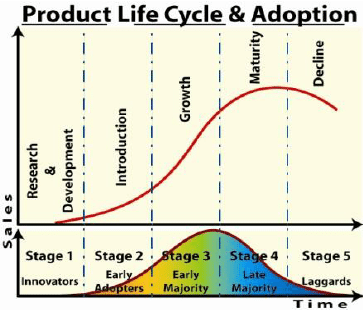
Because of this uniqueness in the product, Apple's pricing strategy is based on the skimming pricing method which means pricing the product relatively at a high cost and getting maximum profit through it. But it follows this only in the introduction stage for their products. This strategy is used when a product is in the introduction phase of the life cycle and then Apple reduces the prices slowly as the product lifecycle comes to an end. This strategy is generally used for technological products in the introduction phase in order to target Early adopter consumers in the market who are willing to pay premium price. The product life cycle and target customers at each phase are explained in the below diagram.
What is psychological pricing strategy? Why might marketers use market-penetration pricing? Explain the psychology...
 What is psychological pricing strategy? Why might marketers use market-penetration pricing? Explain the psychology behind a price of $9.99 instead of $10.00. Do you find that it works? Why or why not? 250 word minimum. Use your own words, no plagiarism.
Explain apple's expansion into a Global Market. What caused them to expand?
Explain apple's expansion into a Global Market. What caused them to expand?
Before deciding on a pricing strategy, Worldwide Widgets consults with its market intelligence team to understand...
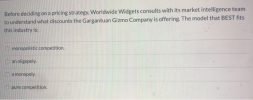 Before deciding on a pricing strategy, Worldwide Widgets consults with its market intelligence team to understand what discounts the Gargantuan Gizmo Company is offering. The model that BEST fits this industry is monopolistic competition. an oligopoly a monopoly. pure competition. The notion that individuals and firms are compelled to retaliate or punish others for engaging in noncooperative actions, but leaving the door open for future reconciliation, is BEST referred to as a(n): trembling hand strategy. grim strategy. tit-for-tat strategy, irrational...
The success of a predatory pricing strategy in an oligopolistic market depends on all of the...
The success of a predatory pricing strategy in an oligopolistic market depends on all of the following except: a. the number of firms operating in the industry prior to enactment of the policy. b. how far the predatory price is below cost. c. the period of time for which the predatory price is in effect. d. the length of time over which recoupment of profits occurs.
Which of the following factors argue for a penetration pricing strategy? A.The market potential is large,...
Which of the following factors argue for a penetration pricing strategy? A.The market potential is large, and is expected to increase over the years. B.It is highly likely that competitors will soon enter the market. C.Higher levels of sales volume are likely to bring lower production costs per unit. D.All of the above.
Which is more important -- focusing your pricing strategy on profitability or setting a pricing strategy...
Which is more important -- focusing your pricing strategy on profitability or setting a pricing strategy that addresses the customer’s perceived value? Please elaborate.
Draw a graph and explain why a two-part pricing strategy that firms with market power use...
Draw a graph and explain why a two-part pricing strategy that firms with market power use gives them a higher profit compared to profit under a single unit price rule?
Fim X's Pricing Strategy Low High Low $60,$30 Fim Y's Pricing Strategy $40,840 $30,560 High $50,$50...
 Fim X's Pricing Strategy Low High Low $60,$30 Fim Y's Pricing Strategy $40,840 $30,560 High $50,$50 The payoff matrix gives the profits associated with the strategic choices of two firms in an oligopolistic market. The first entry in each cell is Firm Y's profit and the second is Firm X's profit. If the two firms collude, what would each firm's profit be? Firm X / Firm Y I a. $40 / $40 O b. $25 / $75 O c. $50...
Additionally, how might the leveraged sales approach strengthens Apple's current sales strategy? Be specific to Apple...
Additionally, how might the leveraged sales approach strengthens Apple's current sales strategy? Be specific to Apple inc.
Describe what"betting against beta"strategy is? How is this strategy related to the Capital Asset Pricing Model?...
Describe what"betting against beta"strategy is? How is this strategy related to the Capital Asset Pricing Model? Set out and explain the determinants of its performance?
 What is psychological pricing strategy? Why might marketers use market-penetration pricing? Explain the psychology behind a price of $9.99 instead of $10.00. Do you find that it works? Why or why not? 250 word minimum. Use your own words, no plagiarism.
 Before deciding on a pricing strategy, Worldwide Widgets consults with its market intelligence team to understand what discounts the Gargantuan Gizmo Company is offering. The model that BEST fits this industry is monopolistic competition. an oligopoly a monopoly. pure competition. The notion that individuals and firms are compelled to retaliate or punish others for engaging in noncooperative actions, but leaving the door open for future reconciliation, is BEST referred to as a(n): trembling hand strategy. grim strategy. tit-for-tat strategy, irrational...
 Fim X's Pricing Strategy Low High Low $60,$30 Fim Y's Pricing Strategy $40,840 $30,560 High $50,$50 The payoff matrix gives the profits associated with the strategic choices of two firms in an oligopolistic market. The first entry in each cell is Firm Y's profit and the second is Firm X's profit. If the two firms collude, what would each firm's profit be? Firm X / Firm Y I a. $40 / $40 O b. $25 / $75 O c. $50...
Most questions answered within 3 hours.
-
Where is the error in this code sequence?
String s1 = "Hello";
String s2 = "ello";...
asked 10 months ago -
Financial data for Joel de Paris, Inc., for last year
follow:
Joel de Paris, Inc.
Balance...
asked 10 months ago -
Consider this reaction:
Al2(SO4)3 (aq)+ BaCl3
(aq) Al2Cl6 (aq)- +
3BaSO4(s) . What is the...
asked 10 months ago -
Suppose that Savneet is considering increasing her
recent random sample from 20 car rentals to 40...
asked 10 months ago -
Trucks arrive at an unloading terminal at an average rate of 120
per hour.
Trucks arrive...
asked 10 months ago -
Why are methanol and ethanol completely soluble in water while
octanol is not very little soluble....
asked 10 months ago -
A facilities manager at a university reads in a research report
that the mean amount of...
asked 10 months ago -
When the CuSO4 is rehydrated by adding water to the anhydrous
compound, is this an endothermic...
asked 10 months ago -
A ray of sunlight is passing from diamond into crown glass; the
angle of incidence is...
asked 10 months ago -
A block of mass 0.249 kg is placed on top of a light, vertical
spring of...
asked 10 months ago -
how do the kidneys compensate in the presences of acidosis
a) trigger hyperventilate
b) reserve acid...
asked 10 months ago -
Question 501 pts
The rental rate of capital to the firm increases. Which of the
following...
asked 10 months ago