


Homework Answers

Add Answer to:
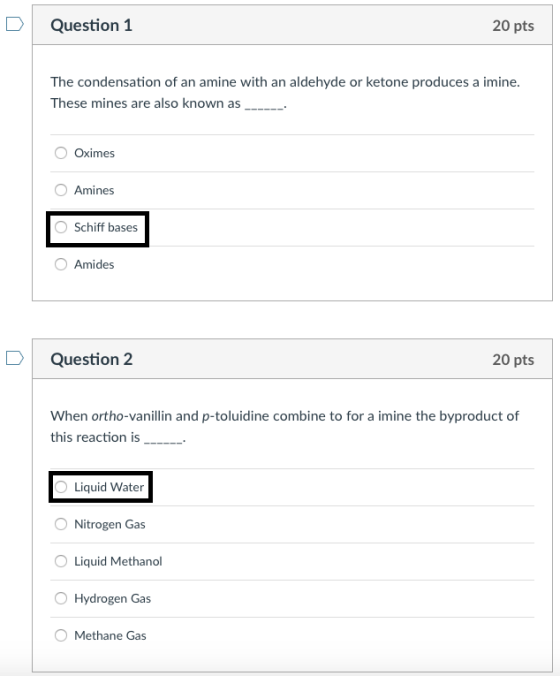
Question 1 20 pts of an amine with an aldehyde or ketone produces a imine. These...
Multistep Synthesis: Synthesis of Amine (Organic Chemistry Lab) Question 1. Explain each step of reaction mechanism....
 Multistep Synthesis: Synthesis of Amine (Organic Chemistry
Lab)
Question
1. Explain each step of reaction mechanism. (How does it
work?)
2. Discuss reason for reaction sequence. (Why must one reaction
occur before another?)
3. Explain how IR supports the major product.
Experiment Procedure
Imine Formation:
Weigh a 20 mL beaker and then add 380 mg of ortho-vanillin and
268 mg of para-toluidine. Care should be taken to add equivalent
molar amounts of the two reactants.
Observe the mixture and record...
Multistep Synthesis: Synthesis of Amine (Organic Chemistry
Lab)
Question
1. Explain each step of reaction mechanism. (How does it
work?)
2. Discuss reason for reaction sequence. (Why must one reaction
occur before another?)
3. Explain how IR supports the major product.
Experiment Procedure
Imine Formation:
Weigh a 20 mL beaker and then add 380 mg of ortho-vanillin and
268 mg of para-toluidine. Care should be taken to add equivalent
molar amounts of the two reactants.
Observe the mixture and record...
D Question 11 1 pts 1.b) A mixture of aspirin and caffeine (both are soluble in...
 D Question 11 1 pts 1.b) A mixture of aspirin and caffeine (both are soluble in organic solvent and insoluble in water) can be separated by liquid-liquid extraction method Using NaHCO3 and chloroform: True/False True False D Question 12 1 pts 1.c) in the above technique caffeine will be in the aqueous layer: True/False - True False D Question 13 1 pts 1. d) aspirin is in the organic layer: True/False True False LUTULONE D Question 14 1 pts 1....
____ 1. The diagram below represents serine, a polar, uncharged amino acid. Which functional group gives...
 ____ 1. The diagram below represents serine, a polar, uncharged
amino acid. Which functional group gives serine its
distinct property?
a. H3
b. CH2OH
c. –H
d. COO–
____ 2. The monomers shown below are monomers for which of the
following natural polymers?
a. polysaccharides
b. plastics
c. DNA
d. proteins
____ 3. Which of the following processes illustrates the production
of a protein?
a. specific code for amino acids --> amino acid chain -->
gene --> DNA --> specific...
____ 1. The diagram below represents serine, a polar, uncharged
amino acid. Which functional group gives serine its
distinct property?
a. H3
b. CH2OH
c. –H
d. COO–
____ 2. The monomers shown below are monomers for which of the
following natural polymers?
a. polysaccharides
b. plastics
c. DNA
d. proteins
____ 3. Which of the following processes illustrates the production
of a protein?
a. specific code for amino acids --> amino acid chain -->
gene --> DNA --> specific...
please identify the unknown and write a derivative Unknown compound 3 Clear liquid Physcial Properties Solubility...
 please identify the unknown and write a derivative
Unknown compound 3 Clear liquid Physcial Properties Solubility Dissolve in ethyl ether Not dissolved in water Boiling point 77 IR spectrum Transmitance 3000 1000 2000 Wavenumber cm-1) Classification Positive test in Alkaline Iron (III) Hydroxamate test test CLASSIFICATION TESTS These tests must be done together with known AND FOLLOW PROCEDURE IN YOUR TEXT CARBOXYLIC ACIDS are detected by teating aqueous solutions with limus or pH paper. Also, disolve In NaHCO with bubbles...
please identify the unknown and write a derivative
Unknown compound 3 Clear liquid Physcial Properties Solubility Dissolve in ethyl ether Not dissolved in water Boiling point 77 IR spectrum Transmitance 3000 1000 2000 Wavenumber cm-1) Classification Positive test in Alkaline Iron (III) Hydroxamate test test CLASSIFICATION TESTS These tests must be done together with known AND FOLLOW PROCEDURE IN YOUR TEXT CARBOXYLIC ACIDS are detected by teating aqueous solutions with limus or pH paper. Also, disolve In NaHCO with bubbles...
What results when a secondary alcohol is oxidized? a. a ketone d. an acid b. an...
 What results when a secondary alcohol is oxidized? a. a ketone d. an acid b. an amine e. no reaction c. an aldehyde Which of the following combinations will react spontaneously? A. 12 + Cu2+ B. Pb2+ + Ag C. Zn2+ + Mg D. Sn2+ + Ni2+ The general formula for a cycloalkane can be represented by which of the following? a. C,H, C. CH b. C.H2n+2 d. C.H21-2 In a certain reaction AH =-136 kJ and E, = 96...
 Multistep Synthesis: Synthesis of Amine (Organic Chemistry
Lab)
Question
1. Explain each step of reaction mechanism. (How does it
work?)
2. Discuss reason for reaction sequence. (Why must one reaction
occur before another?)
3. Explain how IR supports the major product.
Experiment Procedure
Imine Formation:
Weigh a 20 mL beaker and then add 380 mg of ortho-vanillin and
268 mg of para-toluidine. Care should be taken to add equivalent
molar amounts of the two reactants.
Observe the mixture and record...
Multistep Synthesis: Synthesis of Amine (Organic Chemistry
Lab)
Question
1. Explain each step of reaction mechanism. (How does it
work?)
2. Discuss reason for reaction sequence. (Why must one reaction
occur before another?)
3. Explain how IR supports the major product.
Experiment Procedure
Imine Formation:
Weigh a 20 mL beaker and then add 380 mg of ortho-vanillin and
268 mg of para-toluidine. Care should be taken to add equivalent
molar amounts of the two reactants.
Observe the mixture and record...
 D Question 11 1 pts 1.b) A mixture of aspirin and caffeine (both are soluble in organic solvent and insoluble in water) can be separated by liquid-liquid extraction method Using NaHCO3 and chloroform: True/False True False D Question 12 1 pts 1.c) in the above technique caffeine will be in the aqueous layer: True/False - True False D Question 13 1 pts 1. d) aspirin is in the organic layer: True/False True False LUTULONE D Question 14 1 pts 1....
 ____ 1. The diagram below represents serine, a polar, uncharged
amino acid. Which functional group gives serine its
distinct property?
a. H3
b. CH2OH
c. –H
d. COO–
____ 2. The monomers shown below are monomers for which of the
following natural polymers?
a. polysaccharides
b. plastics
c. DNA
d. proteins
____ 3. Which of the following processes illustrates the production
of a protein?
a. specific code for amino acids --> amino acid chain -->
gene --> DNA --> specific...
____ 1. The diagram below represents serine, a polar, uncharged
amino acid. Which functional group gives serine its
distinct property?
a. H3
b. CH2OH
c. –H
d. COO–
____ 2. The monomers shown below are monomers for which of the
following natural polymers?
a. polysaccharides
b. plastics
c. DNA
d. proteins
____ 3. Which of the following processes illustrates the production
of a protein?
a. specific code for amino acids --> amino acid chain -->
gene --> DNA --> specific...
 please identify the unknown and write a derivative
Unknown compound 3 Clear liquid Physcial Properties Solubility Dissolve in ethyl ether Not dissolved in water Boiling point 77 IR spectrum Transmitance 3000 1000 2000 Wavenumber cm-1) Classification Positive test in Alkaline Iron (III) Hydroxamate test test CLASSIFICATION TESTS These tests must be done together with known AND FOLLOW PROCEDURE IN YOUR TEXT CARBOXYLIC ACIDS are detected by teating aqueous solutions with limus or pH paper. Also, disolve In NaHCO with bubbles...
please identify the unknown and write a derivative
Unknown compound 3 Clear liquid Physcial Properties Solubility Dissolve in ethyl ether Not dissolved in water Boiling point 77 IR spectrum Transmitance 3000 1000 2000 Wavenumber cm-1) Classification Positive test in Alkaline Iron (III) Hydroxamate test test CLASSIFICATION TESTS These tests must be done together with known AND FOLLOW PROCEDURE IN YOUR TEXT CARBOXYLIC ACIDS are detected by teating aqueous solutions with limus or pH paper. Also, disolve In NaHCO with bubbles...
 What results when a secondary alcohol is oxidized? a. a ketone d. an acid b. an amine e. no reaction c. an aldehyde Which of the following combinations will react spontaneously? A. 12 + Cu2+ B. Pb2+ + Ag C. Zn2+ + Mg D. Sn2+ + Ni2+ The general formula for a cycloalkane can be represented by which of the following? a. C,H, C. CH b. C.H2n+2 d. C.H21-2 In a certain reaction AH =-136 kJ and E, = 96...
Most questions answered within 3 hours.
-
Where is the error in this code sequence?
String s1 = "Hello";
String s2 = "ello";...
asked 11 months ago -
Financial data for Joel de Paris, Inc., for last year
follow:
Joel de Paris, Inc.
Balance...
asked 11 months ago -
Consider this reaction:
Al2(SO4)3 (aq)+ BaCl3
(aq) Al2Cl6 (aq)- +
3BaSO4(s) . What is the...
asked 11 months ago -
Suppose that Savneet is considering increasing her
recent random sample from 20 car rentals to 40...
asked 11 months ago -
Trucks arrive at an unloading terminal at an average rate of 120
per hour.
Trucks arrive...
asked 11 months ago -
Why are methanol and ethanol completely soluble in water while
octanol is not very little soluble....
asked 11 months ago -
A facilities manager at a university reads in a research report
that the mean amount of...
asked 11 months ago -
When the CuSO4 is rehydrated by adding water to the anhydrous
compound, is this an endothermic...
asked 11 months ago -
A ray of sunlight is passing from diamond into crown glass; the
angle of incidence is...
asked 11 months ago -
A block of mass 0.249 kg is placed on top of a light, vertical
spring of...
asked 11 months ago -
how do the kidneys compensate in the presences of acidosis
a) trigger hyperventilate
b) reserve acid...
asked 11 months ago -
Question 501 pts
The rental rate of capital to the firm increases. Which of the
following...
asked 11 months ago