
Homework Answers
Add Answer to:
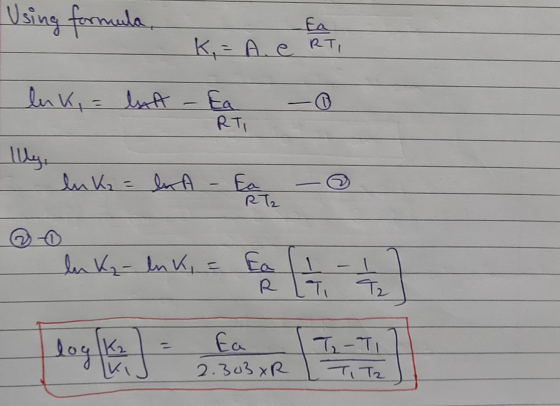
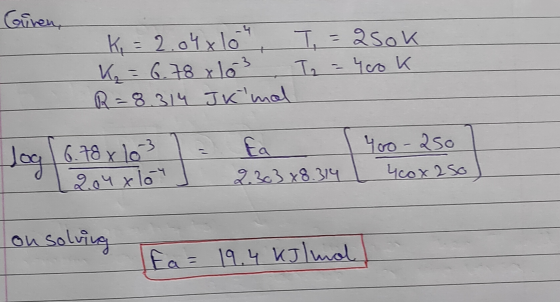
Question 16 (3 points) Given the following data for the reaction Y → B, determine the...
The frequency factor and activation energy for a chemical reaction are A = 9.23 x 10⁻¹² cm3/(molecule·s)...
The frequency factor and activation energy for a chemical reaction are A = 9.23 x 10⁻¹² cm3/(molecule·s) and Ea = 18.6 kJ/mol at 362.3 K, respectively. Determine the rate constant for this reaction at 362.3 K.
The data below was obtained for a reaction that was found to be first order. In...
 The data below was obtained for a reaction that was found to be first order. In k vs 1/T -16 -17 -18 -19 -20 In(k/s-) -21 -22 -23 y=-28047x + 65.8 -24 -25 -26 2.95E-03 3.00E-03 3.05E-03 3.15E-03 3.20E-03 3.10E-03 1/(T/K) What is the activation energy (Ea) for the rate-determining step of this reaction? Select one: a. It is not possible to calculate without knowing the reaction mechanism. O b. 28.0 kJ mol-1 O c. 3.37 kJ mol-1 O d....
The rate data of the reaction was collected at different temperatures (°C) and functions of the...
 The rate data of the reaction was collected at different temperatures (°C) and functions of the data plotted to determine the activation energy. 18 17 T 16.5 36.2 47.7 57.3 k 9.86 x 10⁴ 2.01 x 10⁶ 9.84 x 10⁶ 3.41 x 10⁷ 16 y = (-1.37 x 10^)x + 58.8 15 14 13 12 = 11 10 0.0030 0.0031 0.0032 0.0033 0.0034 0.0035 1. Clearly label the x and y axes (above) with the proper function. 2. Determine Ea...
Question #5 Here are the relevant data to determine the activation energy of the reaction. Rate...
 Question #5 Here are the relevant data to determine the activation energy of the reaction. Rate constant (units not shown) Temperature (K) .13 293 0.11 308 Use the data above to determine the activation energy of the reaction? 83 kJ/mol Submit This value is not correct. Please check your calculations and try again. Question #6 Here are your data for trial of Lab 7 (the trial at room temperature without the catalyst): [103 initial (S203 initial Initial Rate .0023 M...
1) Calculate the activation energy in kJ/mol for the following reaction if the rate constant for...
1) Calculate the activation energy in kJ/mol for the following reaction if the rate constant for the reaction increases from 93.5 M-1s-1 at 497.7 K to 1349.3 M-1s-1 at 636.7 K. do not include units, but make sure your answer is in kJ/mol! 2) A chemist constructs a plot of ln k vs. 1/T for a chemical reaction. The slope of the trendline for the data is -746 K. What is the activation energy for this reaction in kJ/mol? R...
mead CHM 112 8. The activation energy for t he reaction CIO,F(B)CIOFO) is 186 KJ/mol. If...
 mead CHM 112 8. The activation energy for t he reaction CIO,F(B)CIOFO) is 186 KJ/mol. If the value of k i s 6.76 x 10" s-1 at 322℃ what is the value of k at 50 ℃? Use: In(k2)-In(k)--Ea ( 1-1 )
3. A reaction 2A 2B + C is known to follow second-order kinetics, with k =...
 3. A reaction 2A 2B + C is known to follow second-order kinetics, with k = 7.20x10*M's' at 25.0 °C. (20 points) During one experiment, the initial concentration of A is [A]. = 0.120 M (a) Calculate the half-life (1,2), in hours, for this experiment. (b) Calculate the initial reaction rate (in M/s) for this reaction (4 points) (c) How long will it take (in hours) for the concentration of C to reach [C] = 0.0540 M (6 points) (d)...
The rate of a reaction was measured as a function of time and the data was...
 The rate of a reaction was measured as a function of time and
the data was plotted as shown in the figure below. The slope of the
plot is -5.17 × 10 K. The y-intercept is -1.69. What is the
activation energy of the reaction?
The answer is 43.0 kj/mol, probably rounded
In-k
The rate of a reaction was measured as a function of time and
the data was plotted as shown in the figure below. The slope of the
plot is -5.17 × 10 K. The y-intercept is -1.69. What is the
activation energy of the reaction?
The answer is 43.0 kj/mol, probably rounded
In-k
we - Google Given the following data, determine the rate law for the following reaction 2A+B+2C...
 we - Google Given the following data, determine the rate law for the following reaction 2A+B+2C - products Experiment 2 [A] 0.273 0.819 0.273 0.273 [B] [C] Rate (M/s) 0.763 0.400 3.0 0.763 0.400 9.0 1.526 0.400 12.0 0.763 0.800 4 6.0 Rate = k[A][B][C] Rate = k[A][B][C] Rate = K[A] [B]*C]2 Rate = K[A]2[B] [CH Rate = k[A] [B][C] Question 16 5 pts SOCl2 gas dissociates into SO2 and Cly via the following reaction: SOCI2(e) + SO2(g) + Cl2(8)...
The activation energy Ea for a particular reaction is 50.0 kJ/mol. How much faster is the...
The activation energy Ea for a particular reaction is 50.0 kJ/mol. How much faster is the reaction at 313 K than at 310 K? (R = 8.314 J/mol • K) A) 0.185 B) 1.20 C)2.00 x 10^5 D) 1.002 E) 0.83
 The data below was obtained for a reaction that was found to be first order. In k vs 1/T -16 -17 -18 -19 -20 In(k/s-) -21 -22 -23 y=-28047x + 65.8 -24 -25 -26 2.95E-03 3.00E-03 3.05E-03 3.15E-03 3.20E-03 3.10E-03 1/(T/K) What is the activation energy (Ea) for the rate-determining step of this reaction? Select one: a. It is not possible to calculate without knowing the reaction mechanism. O b. 28.0 kJ mol-1 O c. 3.37 kJ mol-1 O d....
 The rate data of the reaction was collected at different temperatures (°C) and functions of the data plotted to determine the activation energy. 18 17 T 16.5 36.2 47.7 57.3 k 9.86 x 10⁴ 2.01 x 10⁶ 9.84 x 10⁶ 3.41 x 10⁷ 16 y = (-1.37 x 10^)x + 58.8 15 14 13 12 = 11 10 0.0030 0.0031 0.0032 0.0033 0.0034 0.0035 1. Clearly label the x and y axes (above) with the proper function. 2. Determine Ea...
 Question #5 Here are the relevant data to determine the activation energy of the reaction. Rate constant (units not shown) Temperature (K) .13 293 0.11 308 Use the data above to determine the activation energy of the reaction? 83 kJ/mol Submit This value is not correct. Please check your calculations and try again. Question #6 Here are your data for trial of Lab 7 (the trial at room temperature without the catalyst): [103 initial (S203 initial Initial Rate .0023 M...
 mead CHM 112 8. The activation energy for t he reaction CIO,F(B)CIOFO) is 186 KJ/mol. If the value of k i s 6.76 x 10" s-1 at 322℃ what is the value of k at 50 ℃? Use: In(k2)-In(k)--Ea ( 1-1 )
 3. A reaction 2A 2B + C is known to follow second-order kinetics, with k = 7.20x10*M's' at 25.0 °C. (20 points) During one experiment, the initial concentration of A is [A]. = 0.120 M (a) Calculate the half-life (1,2), in hours, for this experiment. (b) Calculate the initial reaction rate (in M/s) for this reaction (4 points) (c) How long will it take (in hours) for the concentration of C to reach [C] = 0.0540 M (6 points) (d)...
 The rate of a reaction was measured as a function of time and
the data was plotted as shown in the figure below. The slope of the
plot is -5.17 × 10 K. The y-intercept is -1.69. What is the
activation energy of the reaction?
The answer is 43.0 kj/mol, probably rounded
In-k
The rate of a reaction was measured as a function of time and
the data was plotted as shown in the figure below. The slope of the
plot is -5.17 × 10 K. The y-intercept is -1.69. What is the
activation energy of the reaction?
The answer is 43.0 kj/mol, probably rounded
In-k
 we - Google Given the following data, determine the rate law for the following reaction 2A+B+2C - products Experiment 2 [A] 0.273 0.819 0.273 0.273 [B] [C] Rate (M/s) 0.763 0.400 3.0 0.763 0.400 9.0 1.526 0.400 12.0 0.763 0.800 4 6.0 Rate = k[A][B][C] Rate = k[A][B][C] Rate = K[A] [B]*C]2 Rate = K[A]2[B] [CH Rate = k[A] [B][C] Question 16 5 pts SOCl2 gas dissociates into SO2 and Cly via the following reaction: SOCI2(e) + SO2(g) + Cl2(8)...
Most questions answered within 3 hours.
-
Where is the error in this code sequence?
String s1 = "Hello";
String s2 = "ello";...
asked 10 months ago -
Financial data for Joel de Paris, Inc., for last year
follow:
Joel de Paris, Inc.
Balance...
asked 10 months ago -
Consider this reaction:
Al2(SO4)3 (aq)+ BaCl3
(aq) Al2Cl6 (aq)- +
3BaSO4(s) . What is the...
asked 10 months ago -
Suppose that Savneet is considering increasing her
recent random sample from 20 car rentals to 40...
asked 10 months ago -
Trucks arrive at an unloading terminal at an average rate of 120
per hour.
Trucks arrive...
asked 10 months ago -
Why are methanol and ethanol completely soluble in water while
octanol is not very little soluble....
asked 10 months ago -
A facilities manager at a university reads in a research report
that the mean amount of...
asked 10 months ago -
When the CuSO4 is rehydrated by adding water to the anhydrous
compound, is this an endothermic...
asked 10 months ago -
A ray of sunlight is passing from diamond into crown glass; the
angle of incidence is...
asked 10 months ago -
A block of mass 0.249 kg is placed on top of a light, vertical
spring of...
asked 10 months ago -
how do the kidneys compensate in the presences of acidosis
a) trigger hyperventilate
b) reserve acid...
asked 10 months ago -
Question 501 pts
The rental rate of capital to the firm increases. Which of the
following...
asked 10 months ago