
Homework Answers
Add Answer to:
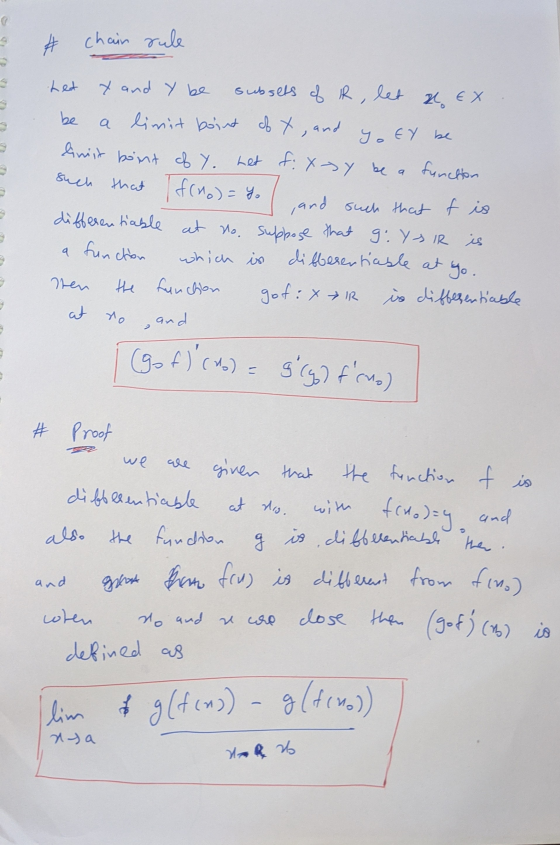
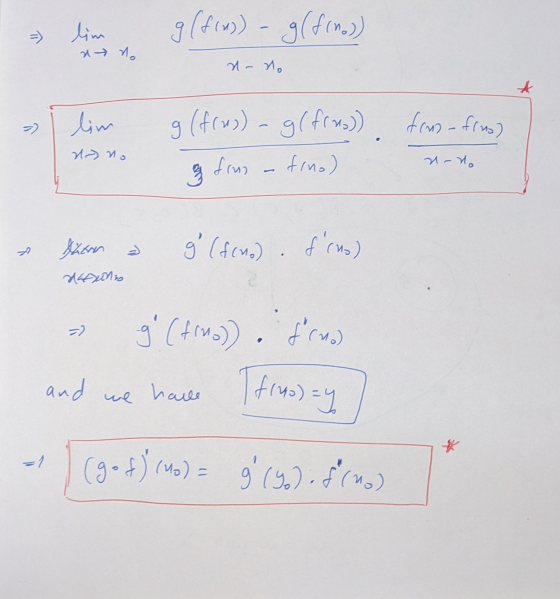
Theorem 10.1.15 (Chain rule). Let X, Y be subsets of R, let xo e X be...
Co are 5. Suppose that the functions f :R3 R, g:R R, and h:RR ously differentiable and let (xo. o...
 co are 5. Suppose that the functions f :R3 R, g:R R, and h:RR ously differentiable and let (xo. o, zo) be a point in R3 at which f(xo, yo, zo-g(xo, yo, zo)sh(xo, yo, zo)s0 and By considering the set of solutions of this system as consisting of the intersection of a surface with a path, explain why that in a neighborhood of the point (xo, yo, Zo) the system of equations f(x, y, z) g(x, y, 2)0 hCx, y,...
Let f : [a, b] → R and xo e (a,b). Assume that f is continuous...
 Let f : [a, b] → R and xo e (a,b). Assume that f is continuous
on [a,b] \{x0} and lim x approaches too x0 f(x) = L (L is finite)
exists. Show that f is Riemann integrable.
1. (20 pts) Let f : [a, b] R and to € (a,b). Assume that f is continuous on [a, b]\{ro} and limz-ro f (x) = L (L is finite) exists. Show that f is Riemann integrable. Hint: We split it into...
Let f : [a, b] → R and xo e (a,b). Assume that f is continuous
on [a,b] \{x0} and lim x approaches too x0 f(x) = L (L is finite)
exists. Show that f is Riemann integrable.
1. (20 pts) Let f : [a, b] R and to € (a,b). Assume that f is continuous on [a, b]\{ro} and limz-ro f (x) = L (L is finite) exists. Show that f is Riemann integrable. Hint: We split it into...
6. Let f [a, b R be a thrice differentiable function and xo E [a, b]. Show that da 6. Let f [a, b R be a thrice di...
 6. Let f [a, b R be a thrice differentiable function and xo E [a, b]. Show that da
6. Let f [a, b R be a thrice differentiable function and xo E [a, b]. Show that da
6. Let f [a, b R be a thrice differentiable function and xo E [a, b]. Show that da
Theorem 2.1: Let f: D-->R with x0 an accumulation point of D. Then f has a...
 Theorem 2.1: Let f: D-->R
with x0 an accumulation point of D. Then f has a limit at x0 iff
for each sequence {xn}^inf_n=1 convening to x0 with xn in D and
xn≠x0 for all n, the sequence {f(x)} converges
Exercise 2.24.8 Assume that f,g : D → R, that 20 s an accumulation point of D, and that α, β R. Assume that limr. J-F, and limrog-G. Define af +ßg to be the function D R given by (af...
Theorem 2.1: Let f: D-->R
with x0 an accumulation point of D. Then f has a limit at x0 iff
for each sequence {xn}^inf_n=1 convening to x0 with xn in D and
xn≠x0 for all n, the sequence {f(x)} converges
Exercise 2.24.8 Assume that f,g : D → R, that 20 s an accumulation point of D, and that α, β R. Assume that limr. J-F, and limrog-G. Define af +ßg to be the function D R given by (af...
+20 Problem 7. Let f :D + R, xo be an accumulation point of D and...
 +20 Problem 7. Let f :D + R, xo be an accumulation point of D and assume lim f(x) = L. Use the e-8 definition of the limit (not theorems or results from class or the text) to prove the following: (a) The function f is “bounded near xo”: there is an M ER and a 8 >0 such that for x E D, 0 < l< – xo<8 = \f(x) < M. Hint: compare with the proof that a...
Let (X, d) be a metric space, f,g:X R some functions and xo e X,q E...
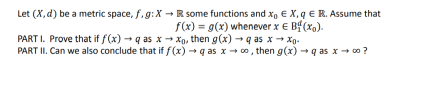 Let (X, d) be a metric space, f,g:X R some functions and xo e X,q E R. Assume that f(x) = g(x) whenever x € Bd (x.). PART I. Prove that if f(x) →q as x → Xo, then g(x) = q as x → Xo. PART II. Can we also conclude that if f(x) = q as x → 00, then g(x) →q as x → 00?
5. Let f : R -R be a differentiable function, and suppose that there is a constant A < 1 such tha...
 5. Let f : R -R be a differentiable function, and suppose that there is a constant A < 1 such that If,(t)| < A for all real t. Let xo E R, and define a sequence fan] by 2Znt31(za),n=0,1,2 Prove that the sequence {xn) is convergent, and that its limit is the unique fixed point of f.
5. Let f : R -R be a differentiable function, and suppose that there is a constant A
5. Let f : R -R be a differentiable function, and suppose that there is a constant A < 1 such that If,(t)| < A for all real t. Let xo E R, and define a sequence fan] by 2Znt31(za),n=0,1,2 Prove that the sequence {xn) is convergent, and that its limit is the unique fixed point of f.
5. Let f : R -R be a differentiable function, and suppose that there is a constant A
4. Let A, X, Y, Z be normed vector spaces and B :X Y + Z...
 4. Let A, X, Y, Z be normed vector spaces and B :X Y + Z be a bilinear map and f: A+X,9: A + Y be mappings that are differentiable at to E A. Show that the mapping 0 : A → Z, X HB(f(x), g(x)) is differentiable at Do and that dº(30)[h] = B(df (o)[N), 9(30))+ (f(x0), dg(xo)[h]) (he A).
2. Let E CRn+m. For every x ER", let Ex := {y € R™ st. (,y)...
 2. Let E CRn+m. For every x ER", let Ex := {y € R™ st. (,y) € E}. Let fel'(E). Proved that • for a.e. 2 ER", the function Ex = y + f(x,y) belongs to L'(Ex), • the function R"3o-. s(z. y) dy belongs to L (RM), • we have that sss=fen (562, )dy) ds. This is a slightly stronger version of the Fubini's Theorem that we proved in class, for instance one could define fxs and use the...
2. Let f: R R be a continuous function. Suppose that f is differentiable on R\{0} and that there exists an L e R such that lim,of,(z) = L. Prove that f is differentiable at 1-0 with f,(0) = L. (Hint:...
 2. Let f: R R be a continuous function. Suppose that f is differentiable on R\{0} and that there exists an L e R such that lim,of,(z) = L. Prove that f is differentiable at 1-0 with f,(0) = L. (Hint: Use the definition of derivative and then use mean value theorem)
2. Let f: R R be a continuous function. Suppose that f is differentiable on R\{0} and that there exists an L e R such that lim,of,(z) =...
2. Let f: R R be a continuous function. Suppose that f is differentiable on R\{0} and that there exists an L e R such that lim,of,(z) = L. Prove that f is differentiable at 1-0 with f,(0) = L. (Hint: Use the definition of derivative and then use mean value theorem)
2. Let f: R R be a continuous function. Suppose that f is differentiable on R\{0} and that there exists an L e R such that lim,of,(z) =...
 co are 5. Suppose that the functions f :R3 R, g:R R, and h:RR ously differentiable and let (xo. o, zo) be a point in R3 at which f(xo, yo, zo-g(xo, yo, zo)sh(xo, yo, zo)s0 and By considering the set of solutions of this system as consisting of the intersection of a surface with a path, explain why that in a neighborhood of the point (xo, yo, Zo) the system of equations f(x, y, z) g(x, y, 2)0 hCx, y,...
 Let f : [a, b] → R and xo e (a,b). Assume that f is continuous
on [a,b] \{x0} and lim x approaches too x0 f(x) = L (L is finite)
exists. Show that f is Riemann integrable.
1. (20 pts) Let f : [a, b] R and to € (a,b). Assume that f is continuous on [a, b]\{ro} and limz-ro f (x) = L (L is finite) exists. Show that f is Riemann integrable. Hint: We split it into...
Let f : [a, b] → R and xo e (a,b). Assume that f is continuous
on [a,b] \{x0} and lim x approaches too x0 f(x) = L (L is finite)
exists. Show that f is Riemann integrable.
1. (20 pts) Let f : [a, b] R and to € (a,b). Assume that f is continuous on [a, b]\{ro} and limz-ro f (x) = L (L is finite) exists. Show that f is Riemann integrable. Hint: We split it into...
 6. Let f [a, b R be a thrice differentiable function and xo E [a, b]. Show that da
6. Let f [a, b R be a thrice differentiable function and xo E [a, b]. Show that da
6. Let f [a, b R be a thrice differentiable function and xo E [a, b]. Show that da
 Theorem 2.1: Let f: D-->R
with x0 an accumulation point of D. Then f has a limit at x0 iff
for each sequence {xn}^inf_n=1 convening to x0 with xn in D and
xn≠x0 for all n, the sequence {f(x)} converges
Exercise 2.24.8 Assume that f,g : D → R, that 20 s an accumulation point of D, and that α, β R. Assume that limr. J-F, and limrog-G. Define af +ßg to be the function D R given by (af...
Theorem 2.1: Let f: D-->R
with x0 an accumulation point of D. Then f has a limit at x0 iff
for each sequence {xn}^inf_n=1 convening to x0 with xn in D and
xn≠x0 for all n, the sequence {f(x)} converges
Exercise 2.24.8 Assume that f,g : D → R, that 20 s an accumulation point of D, and that α, β R. Assume that limr. J-F, and limrog-G. Define af +ßg to be the function D R given by (af...
 +20 Problem 7. Let f :D + R, xo be an accumulation point of D and assume lim f(x) = L. Use the e-8 definition of the limit (not theorems or results from class or the text) to prove the following: (a) The function f is “bounded near xo”: there is an M ER and a 8 >0 such that for x E D, 0 < l< – xo<8 = \f(x) < M. Hint: compare with the proof that a...
 Let (X, d) be a metric space, f,g:X R some functions and xo e X,q E R. Assume that f(x) = g(x) whenever x € Bd (x.). PART I. Prove that if f(x) →q as x → Xo, then g(x) = q as x → Xo. PART II. Can we also conclude that if f(x) = q as x → 00, then g(x) →q as x → 00?
 5. Let f : R -R be a differentiable function, and suppose that there is a constant A < 1 such that If,(t)| < A for all real t. Let xo E R, and define a sequence fan] by 2Znt31(za),n=0,1,2 Prove that the sequence {xn) is convergent, and that its limit is the unique fixed point of f.
5. Let f : R -R be a differentiable function, and suppose that there is a constant A
5. Let f : R -R be a differentiable function, and suppose that there is a constant A < 1 such that If,(t)| < A for all real t. Let xo E R, and define a sequence fan] by 2Znt31(za),n=0,1,2 Prove that the sequence {xn) is convergent, and that its limit is the unique fixed point of f.
5. Let f : R -R be a differentiable function, and suppose that there is a constant A
 4. Let A, X, Y, Z be normed vector spaces and B :X Y + Z be a bilinear map and f: A+X,9: A + Y be mappings that are differentiable at to E A. Show that the mapping 0 : A → Z, X HB(f(x), g(x)) is differentiable at Do and that dº(30)[h] = B(df (o)[N), 9(30))+ (f(x0), dg(xo)[h]) (he A).
 2. Let E CRn+m. For every x ER", let Ex := {y € R™ st. (,y) € E}. Let fel'(E). Proved that • for a.e. 2 ER", the function Ex = y + f(x,y) belongs to L'(Ex), • the function R"3o-. s(z. y) dy belongs to L (RM), • we have that sss=fen (562, )dy) ds. This is a slightly stronger version of the Fubini's Theorem that we proved in class, for instance one could define fxs and use the...
 2. Let f: R R be a continuous function. Suppose that f is differentiable on R\{0} and that there exists an L e R such that lim,of,(z) = L. Prove that f is differentiable at 1-0 with f,(0) = L. (Hint: Use the definition of derivative and then use mean value theorem)
2. Let f: R R be a continuous function. Suppose that f is differentiable on R\{0} and that there exists an L e R such that lim,of,(z) =...
2. Let f: R R be a continuous function. Suppose that f is differentiable on R\{0} and that there exists an L e R such that lim,of,(z) = L. Prove that f is differentiable at 1-0 with f,(0) = L. (Hint: Use the definition of derivative and then use mean value theorem)
2. Let f: R R be a continuous function. Suppose that f is differentiable on R\{0} and that there exists an L e R such that lim,of,(z) =...
Most questions answered within 3 hours.
-
Where is the error in this code sequence?
String s1 = "Hello";
String s2 = "ello";...
asked 11 months ago -
Financial data for Joel de Paris, Inc., for last year
follow:
Joel de Paris, Inc.
Balance...
asked 11 months ago -
Consider this reaction:
Al2(SO4)3 (aq)+ BaCl3
(aq) Al2Cl6 (aq)- +
3BaSO4(s) . What is the...
asked 11 months ago -
Suppose that Savneet is considering increasing her
recent random sample from 20 car rentals to 40...
asked 11 months ago -
Trucks arrive at an unloading terminal at an average rate of 120
per hour.
Trucks arrive...
asked 11 months ago -
Why are methanol and ethanol completely soluble in water while
octanol is not very little soluble....
asked 11 months ago -
A facilities manager at a university reads in a research report
that the mean amount of...
asked 11 months ago -
When the CuSO4 is rehydrated by adding water to the anhydrous
compound, is this an endothermic...
asked 11 months ago -
A ray of sunlight is passing from diamond into crown glass; the
angle of incidence is...
asked 11 months ago -
A block of mass 0.249 kg is placed on top of a light, vertical
spring of...
asked 11 months ago -
how do the kidneys compensate in the presences of acidosis
a) trigger hyperventilate
b) reserve acid...
asked 11 months ago -
Question 501 pts
The rental rate of capital to the firm increases. Which of the
following...
asked 11 months ago