
Homework Answers

Add Answer to:
KHW8 Problem 4.63 3 of 3 neview The rigid bar is supported by the two short...
Chapter 3, Reserve Problem 122 The rigid bar AC is supported by two axial bars (1)...
 Chapter 3, Reserve Problem 122 The rigid bar AC is supported by two axial bars (1) and (2). Both axial bars are made of bronze [E = 100 GPa; a = 18 × 10-mm/mm/°C]. The cross-sectional area of bar (1) is A1 = 236 mm2 and the cross- sectional area of bar (2) is Az = 389 mm2. After load P has been applied and the temperature of the entire assembly has increased by 26°C, the total strain in bar...
A 3 m rigid bar AB is supported with a vertical translational spring at A and a pin at B The bar is subjected to a linearly varying distributed load with maximum intensity g Calculate the ver...
 A 3 m rigid bar AB is supported with a vertical translational spring at A and a pin at B The bar is subjected to a linearly varying distributed load with maximum intensity g Calculate the vertical deformation of the spring if the spring constant is 700 kN/m. (ans: 21.43 mm) 2. A steel cable with a nominal diameter of 25 mm is used in a construction yard to lift a bridge section weighing 38 kN. The cable has an...
The pin-connected structure shown in Fig. 5 consists of a rigid bar ABCD and two 1,500-mm-long...
 The pin-connected structure shown in Fig. 5 consists of a rigid bar ABCD and two 1,500-mm-long bars. Bar (1) is steel [E=200 GPa] with a cross-sectional area of A1 = 510 mm2. Bar (2) is an aluminium alloy [E-70 GPa] with a cross-sectional area of A2 1,300 mm2. All bars are unstressed before the load P is applied. If a concentrated load of P 200 kN acts on the structure at D determine: (a) the normal stresses in both bars...
The rigid bar shown is supported by axial bar (1) and by a pin connection at C. Axial bar (1) has...
 The rigid bar shown is supported by axial bar (1) and by a pin
connection at C. Axial bar (1) has a cross-sectional area
of A1 = 250 mm2, an elastic modulus
of E = 200 GPa, and a coefficient of thermal expansion of
α= 11.3 × 10⁻⁶/°C. The pin at C has a diameter
of 40 mm. After load P has been applied and the
temperature of the entire assembly has been increased by 10°C, the
total strain in...
The rigid bar shown is supported by axial bar (1) and by a pin
connection at C. Axial bar (1) has a cross-sectional area
of A1 = 250 mm2, an elastic modulus
of E = 200 GPa, and a coefficient of thermal expansion of
α= 11.3 × 10⁻⁶/°C. The pin at C has a diameter
of 40 mm. After load P has been applied and the
temperature of the entire assembly has been increased by 10°C, the
total strain in...
The rigid bar AC is supported by two axial bars (1) and (2). Both axial bars...
 The rigid bar AC is supported by two axial bars (1) and (2). Both axial bars are made of bronze [E = 100 GPa; a = 18 x 10-6 mm/mm/°C). The cross-sectional area of bar (1) is A1 = 226 mm- and the cross-sectional area of bar (2) is Az = 362 mm. After load P has been applied and the temperature of the entire assembly has increased by 22°C, the total strain in bar (2) is measured as 1020...
The rigid bar DEF is supported by three wires as shown in the figure below. There is a concentrat...
 The rigid bar DEF is supported by three wires as shown in the figure below. There is a concentrated load P at E. The wires are all made of steel with E 289809 MPa, a vield stress of 400 MPa, each has a cross-sectional area of 1000 mm2 and each has a length of 6m. The coefficient of thermal expansion α of the wires is 20x10-6 per℃ Write down the equation of compatibility for the elongations in the three wires....
Question 3 The structure shown in Figure Q(3) is a two-bar truss with spring support. Both bars have modulus of elasticity and cross-sectional area of E- 210 GPa and A -5.0 x10 m. Bar one has...
 Question 3 The structure shown in Figure Q(3) is a two-bar truss with spring support. Both bars have modulus of elasticity and cross-sectional area of E- 210 GPa and A -5.0 x10 m. Bar one has a length of 5 m and bar two a length of 10 m. The spring stiffness is k -2000 kN/m. CVE 4303(F) Page 2 of 4 Determine (a) the stiffness matrix for each of the three elements (15 marks) (b) the normal stresses in...
A rigid beam BCD is supported on a roller support at C (4m from B) and has two bars AB and DE attached at each end
 A rigid beam BCD is supported on a roller support at C (4m from B) and has two bars AB and DE attached at each end. The bars can carry either tension or compressive forces. The rigid beam carries a UDL of I kN/m across BC and a point load of P at D as shown in the figure above. The length of the two bars is 3000 mm. The elastic modulus of both bars is 200 GPa and the...
*Computer-Oriented Problems* 3/285. The two 0.2-kg sliders are connected by a light rigid bar of length...
 *Computer-Oriented Problems* 3/285. The two 0.2-kg sliders are
connected by a light rigid bar of length L = 0.5 m. If the system
is released from rest in the position shown with the spring
unstretched, plot the speeds of A and B as functions of the
displacement of B (with zero being the initial position). The
0.14-MPa air pressure acting on one 500=mm^2 side of slider A is
constant. The motion occurs in a vertical plane. Neglect friction.
State the...
*Computer-Oriented Problems* 3/285. The two 0.2-kg sliders are
connected by a light rigid bar of length L = 0.5 m. If the system
is released from rest in the position shown with the spring
unstretched, plot the speeds of A and B as functions of the
displacement of B (with zero being the initial position). The
0.14-MPa air pressure acting on one 500=mm^2 side of slider A is
constant. The motion occurs in a vertical plane. Neglect friction.
State the...
sos Problem 3: [2, 03-15] A rigid and uniform bar undergoing rota- tional motions in the...
 sos
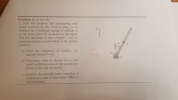
Problem 3: [2, 03-15] A rigid and uniform bar undergoing rota- tional motions in the vertical plane is re- strained by a torsional spring of stiffness k at the pivot point O, as shown in the figure. The bar has mass m and a length& and the torsional spring is unstretched in the upright position a) Find the equations of motion, lin- ke earized about 6 0: b) Determine what ke should be so that small oscillations about the...
sos
Problem 3: [2, 03-15] A rigid and uniform bar undergoing rota- tional motions in the vertical plane is re- strained by a torsional spring of stiffness k at the pivot point O, as shown in the figure. The bar has mass m and a length& and the torsional spring is unstretched in the upright position a) Find the equations of motion, lin- ke earized about 6 0: b) Determine what ke should be so that small oscillations about the...
 Chapter 3, Reserve Problem 122 The rigid bar AC is supported by two axial bars (1) and (2). Both axial bars are made of bronze [E = 100 GPa; a = 18 × 10-mm/mm/°C]. The cross-sectional area of bar (1) is A1 = 236 mm2 and the cross- sectional area of bar (2) is Az = 389 mm2. After load P has been applied and the temperature of the entire assembly has increased by 26°C, the total strain in bar...
 A 3 m rigid bar AB is supported with a vertical translational spring at A and a pin at B The bar is subjected to a linearly varying distributed load with maximum intensity g Calculate the vertical deformation of the spring if the spring constant is 700 kN/m. (ans: 21.43 mm) 2. A steel cable with a nominal diameter of 25 mm is used in a construction yard to lift a bridge section weighing 38 kN. The cable has an...
 The pin-connected structure shown in Fig. 5 consists of a rigid bar ABCD and two 1,500-mm-long bars. Bar (1) is steel [E=200 GPa] with a cross-sectional area of A1 = 510 mm2. Bar (2) is an aluminium alloy [E-70 GPa] with a cross-sectional area of A2 1,300 mm2. All bars are unstressed before the load P is applied. If a concentrated load of P 200 kN acts on the structure at D determine: (a) the normal stresses in both bars...
 The rigid bar shown is supported by axial bar (1) and by a pin
connection at C. Axial bar (1) has a cross-sectional area
of A1 = 250 mm2, an elastic modulus
of E = 200 GPa, and a coefficient of thermal expansion of
α= 11.3 × 10⁻⁶/°C. The pin at C has a diameter
of 40 mm. After load P has been applied and the
temperature of the entire assembly has been increased by 10°C, the
total strain in...
The rigid bar shown is supported by axial bar (1) and by a pin
connection at C. Axial bar (1) has a cross-sectional area
of A1 = 250 mm2, an elastic modulus
of E = 200 GPa, and a coefficient of thermal expansion of
α= 11.3 × 10⁻⁶/°C. The pin at C has a diameter
of 40 mm. After load P has been applied and the
temperature of the entire assembly has been increased by 10°C, the
total strain in...
 The rigid bar AC is supported by two axial bars (1) and (2). Both axial bars are made of bronze [E = 100 GPa; a = 18 x 10-6 mm/mm/°C). The cross-sectional area of bar (1) is A1 = 226 mm- and the cross-sectional area of bar (2) is Az = 362 mm. After load P has been applied and the temperature of the entire assembly has increased by 22°C, the total strain in bar (2) is measured as 1020...
 The rigid bar DEF is supported by three wires as shown in the figure below. There is a concentrated load P at E. The wires are all made of steel with E 289809 MPa, a vield stress of 400 MPa, each has a cross-sectional area of 1000 mm2 and each has a length of 6m. The coefficient of thermal expansion α of the wires is 20x10-6 per℃ Write down the equation of compatibility for the elongations in the three wires....
 Question 3 The structure shown in Figure Q(3) is a two-bar truss with spring support. Both bars have modulus of elasticity and cross-sectional area of E- 210 GPa and A -5.0 x10 m. Bar one has a length of 5 m and bar two a length of 10 m. The spring stiffness is k -2000 kN/m. CVE 4303(F) Page 2 of 4 Determine (a) the stiffness matrix for each of the three elements (15 marks) (b) the normal stresses in...
 *Computer-Oriented Problems* 3/285. The two 0.2-kg sliders are
connected by a light rigid bar of length L = 0.5 m. If the system
is released from rest in the position shown with the spring
unstretched, plot the speeds of A and B as functions of the
displacement of B (with zero being the initial position). The
0.14-MPa air pressure acting on one 500=mm^2 side of slider A is
constant. The motion occurs in a vertical plane. Neglect friction.
State the...
*Computer-Oriented Problems* 3/285. The two 0.2-kg sliders are
connected by a light rigid bar of length L = 0.5 m. If the system
is released from rest in the position shown with the spring
unstretched, plot the speeds of A and B as functions of the
displacement of B (with zero being the initial position). The
0.14-MPa air pressure acting on one 500=mm^2 side of slider A is
constant. The motion occurs in a vertical plane. Neglect friction.
State the...
 sos
Problem 3: [2, 03-15] A rigid and uniform bar undergoing rota- tional motions in the vertical plane is re- strained by a torsional spring of stiffness k at the pivot point O, as shown in the figure. The bar has mass m and a length& and the torsional spring is unstretched in the upright position a) Find the equations of motion, lin- ke earized about 6 0: b) Determine what ke should be so that small oscillations about the...
sos
Problem 3: [2, 03-15] A rigid and uniform bar undergoing rota- tional motions in the vertical plane is re- strained by a torsional spring of stiffness k at the pivot point O, as shown in the figure. The bar has mass m and a length& and the torsional spring is unstretched in the upright position a) Find the equations of motion, lin- ke earized about 6 0: b) Determine what ke should be so that small oscillations about the...
Most questions answered within 3 hours.
-
Where is the error in this code sequence?
String s1 = "Hello";
String s2 = "ello";...
asked 11 months ago -
Financial data for Joel de Paris, Inc., for last year
follow:
Joel de Paris, Inc.
Balance...
asked 11 months ago -
Consider this reaction:
Al2(SO4)3 (aq)+ BaCl3
(aq) Al2Cl6 (aq)- +
3BaSO4(s) . What is the...
asked 11 months ago -
Suppose that Savneet is considering increasing her
recent random sample from 20 car rentals to 40...
asked 11 months ago -
Trucks arrive at an unloading terminal at an average rate of 120
per hour.
Trucks arrive...
asked 11 months ago -
Why are methanol and ethanol completely soluble in water while
octanol is not very little soluble....
asked 11 months ago -
A facilities manager at a university reads in a research report
that the mean amount of...
asked 11 months ago -
When the CuSO4 is rehydrated by adding water to the anhydrous
compound, is this an endothermic...
asked 11 months ago -
A ray of sunlight is passing from diamond into crown glass; the
angle of incidence is...
asked 11 months ago -
A block of mass 0.249 kg is placed on top of a light, vertical
spring of...
asked 11 months ago -
how do the kidneys compensate in the presences of acidosis
a) trigger hyperventilate
b) reserve acid...
asked 11 months ago -
Question 501 pts
The rental rate of capital to the firm increases. Which of the
following...
asked 11 months ago