
Homework Answers
Add Answer to:
7. (5 points) Show that the following set is infinite by placing into a one-to-one correspondence...
4. Show that a set A is infinite if and only if it is equivalent to...
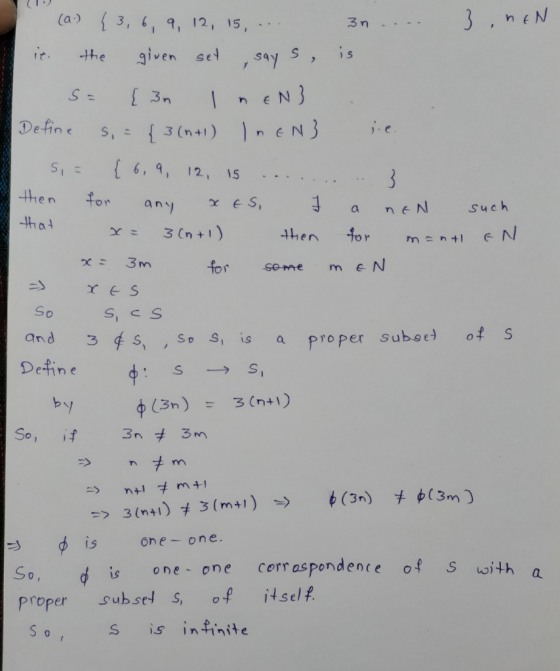
 4. Show that a set A is infinite if and only if it is equivalent to a proper subset of itself (Problem 21 on page 43).
show that the oven set has a cardinality of No by establishing a one- to-one correspondence between the elements of the given set and the clements of N 39 27 Ween the given set and the set of natural...
 show that the oven set has a cardinality of No by establishing a one- to-one correspondence between the elements of the given set and the clements of N 39 27 Ween the given set and the set of natural numbers N is given by the following general correspondence
show that the oven set has a cardinality of No by establishing a one- to-one correspondence between the elements of the given set and the clements of N 39 27 Ween the...
show that the oven set has a cardinality of No by establishing a one- to-one correspondence between the elements of the given set and the clements of N 39 27 Ween the given set and the set of natural numbers N is given by the following general correspondence
show that the oven set has a cardinality of No by establishing a one- to-one correspondence between the elements of the given set and the clements of N 39 27 Ween the...
8. Show: An infinite set of points need not be a closed set.
8. Show: An infinite set of points need not be a closed set.
Exercise 7.H. 7.Н. Show that every number in the Cantor set has a ternary (-base 3)...
 Exercise 7.H.
7.Н. Show that every number in the Cantor set has a ternary (-base 3) expan- sion using only the digits 0, 2 7.I. Show that the collection of "right hand" end points in F is denumerable. Show that if all these end points are deleted from F, then what remains can be put onto one-one correspondence with all of [0, 1). Conclude that the set F is not
Exercise 7.H.
7.Н. Show that every number in the Cantor set has a ternary (-base 3) expan- sion using only the digits 0, 2 7.I. Show that the collection of "right hand" end points in F is denumerable. Show that if all these end points are deleted from F, then what remains can be put onto one-one correspondence with all of [0, 1). Conclude that the set F is not
please show work 1. (5 points) The wave function for a particle in an infinite square...
 please show work
1. (5 points) The wave function for a particle in an infinite square well (0<xca) at t-o is given by: (x,0)-Finm). Which one of the following is the wave function at time t? (Clearly circle your choice.) 2 . 3x 2 . 3m (a) (x.1)-Vasin( )cos(Ey/A) 2 . 3tx sies-E/n) (c) Both (a) and (b) above are correct. (d) None of the above.
please show work
1. (5 points) The wave function for a particle in an infinite square well (0<xca) at t-o is given by: (x,0)-Finm). Which one of the following is the wave function at time t? (Clearly circle your choice.) 2 . 3x 2 . 3m (a) (x.1)-Vasin( )cos(Ey/A) 2 . 3tx sies-E/n) (c) Both (a) and (b) above are correct. (d) None of the above.
x?. Is f a one-to-one 3. (10 points) Define a function f on a set of...
 x?. Is f a one-to-one 3. (10 points) Define a function f on a set of real numbers by the rule f(x) correspondence (bijective)? If so find its inverse. Formally justify your answer.
4. (20 points). 5-function perturbation. Consider a particle in a one-dimensional infinite square well with boundaries...
 4. (20 points). 5-function perturbation. Consider a particle in a one-dimensional infinite square well with boundaries at x--a and x-a. We introduce the following δ-function perturbation at V'(x) 00(z). a. Compute the first-order corrections to the energies of the particle induced by the perturbation b. Recall that you solved this problem exactly in problem set 4 (Griffiths 2.43). Compare your perturbation theory result to the exact solution
complwx analysis 7. Show that the accumulation points of any set form a closed set.
 complwx analysis
7. Show that the accumulation points of any set form a closed set.
complwx analysis
7. Show that the accumulation points of any set form a closed set.
Show that each of the following subsets are not subspaces by finding a counterexample. (a) The...
 Show that each of the following subsets are not subspaces by finding a counterexample. (a) The set of polynomials of degree exactly 2, as a subset of P. (b) The set of polynomials p(q) in P, such that p(1) = 1, as a subset of P. (c) The set of sequences with non-negative terms, as a subset of S.
1. Determine how many one to one correspondences are possible between two sets, p, y, z, w v and 1,2,3,4 and 5 given the following conditions. a if in each correspondence p must match with 4. There ar...
1. Determine how many one to one correspondences are possible between two sets, p, y, z, w v and 1,2,3,4 and 5 given the following conditions. a if in each correspondence p must match with 4. There are ____possible one to one correspondence between the sets if p must match with 4. b if in each correspondence p must match with 4 and y must match with 1. There are ___possible one to one correspondence between the sets if p...
 4. Show that a set A is infinite if and only if it is equivalent to a proper subset of itself (Problem 21 on page 43).
 show that the oven set has a cardinality of No by establishing a one- to-one correspondence between the elements of the given set and the clements of N 39 27 Ween the given set and the set of natural numbers N is given by the following general correspondence
show that the oven set has a cardinality of No by establishing a one- to-one correspondence between the elements of the given set and the clements of N 39 27 Ween the...
show that the oven set has a cardinality of No by establishing a one- to-one correspondence between the elements of the given set and the clements of N 39 27 Ween the given set and the set of natural numbers N is given by the following general correspondence
show that the oven set has a cardinality of No by establishing a one- to-one correspondence between the elements of the given set and the clements of N 39 27 Ween the...
 Exercise 7.H.
7.Н. Show that every number in the Cantor set has a ternary (-base 3) expan- sion using only the digits 0, 2 7.I. Show that the collection of "right hand" end points in F is denumerable. Show that if all these end points are deleted from F, then what remains can be put onto one-one correspondence with all of [0, 1). Conclude that the set F is not
Exercise 7.H.
7.Н. Show that every number in the Cantor set has a ternary (-base 3) expan- sion using only the digits 0, 2 7.I. Show that the collection of "right hand" end points in F is denumerable. Show that if all these end points are deleted from F, then what remains can be put onto one-one correspondence with all of [0, 1). Conclude that the set F is not
 please show work
1. (5 points) The wave function for a particle in an infinite square well (0<xca) at t-o is given by: (x,0)-Finm). Which one of the following is the wave function at time t? (Clearly circle your choice.) 2 . 3x 2 . 3m (a) (x.1)-Vasin( )cos(Ey/A) 2 . 3tx sies-E/n) (c) Both (a) and (b) above are correct. (d) None of the above.
please show work
1. (5 points) The wave function for a particle in an infinite square well (0<xca) at t-o is given by: (x,0)-Finm). Which one of the following is the wave function at time t? (Clearly circle your choice.) 2 . 3x 2 . 3m (a) (x.1)-Vasin( )cos(Ey/A) 2 . 3tx sies-E/n) (c) Both (a) and (b) above are correct. (d) None of the above.
 x?. Is f a one-to-one 3. (10 points) Define a function f on a set of real numbers by the rule f(x) correspondence (bijective)? If so find its inverse. Formally justify your answer.
 4. (20 points). 5-function perturbation. Consider a particle in a one-dimensional infinite square well with boundaries at x--a and x-a. We introduce the following δ-function perturbation at V'(x) 00(z). a. Compute the first-order corrections to the energies of the particle induced by the perturbation b. Recall that you solved this problem exactly in problem set 4 (Griffiths 2.43). Compare your perturbation theory result to the exact solution
 complwx analysis
7. Show that the accumulation points of any set form a closed set.
complwx analysis
7. Show that the accumulation points of any set form a closed set.
 Show that each of the following subsets are not subspaces by finding a counterexample. (a) The set of polynomials of degree exactly 2, as a subset of P. (b) The set of polynomials p(q) in P, such that p(1) = 1, as a subset of P. (c) The set of sequences with non-negative terms, as a subset of S.
Most questions answered within 3 hours.
-
Where is the error in this code sequence?
String s1 = "Hello";
String s2 = "ello";...
asked 10 months ago -
Financial data for Joel de Paris, Inc., for last year
follow:
Joel de Paris, Inc.
Balance...
asked 10 months ago -
Consider this reaction:
Al2(SO4)3 (aq)+ BaCl3
(aq) Al2Cl6 (aq)- +
3BaSO4(s) . What is the...
asked 10 months ago -
Suppose that Savneet is considering increasing her
recent random sample from 20 car rentals to 40...
asked 10 months ago -
Trucks arrive at an unloading terminal at an average rate of 120
per hour.
Trucks arrive...
asked 10 months ago -
Why are methanol and ethanol completely soluble in water while
octanol is not very little soluble....
asked 10 months ago -
A facilities manager at a university reads in a research report
that the mean amount of...
asked 10 months ago -
When the CuSO4 is rehydrated by adding water to the anhydrous
compound, is this an endothermic...
asked 10 months ago -
A ray of sunlight is passing from diamond into crown glass; the
angle of incidence is...
asked 10 months ago -
A block of mass 0.249 kg is placed on top of a light, vertical
spring of...
asked 10 months ago -
how do the kidneys compensate in the presences of acidosis
a) trigger hyperventilate
b) reserve acid...
asked 10 months ago -
Question 501 pts
The rental rate of capital to the firm increases. Which of the
following...
asked 10 months ago