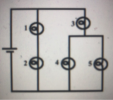
All the light bulbs in the circuit above are identical. If the current through the battery...
 All the light bulbs in the
circuit above are identical. If the current through the battery is
0.5·A and the current through bulb A is 0.2·A, find the current
through the other bulbs. F is on the right side of E it cut it off
for some reason
All the light bulbs in the
circuit above are identical. If the current through the battery is
0.5·A and the current through bulb A is 0.2·A, find the current
through the other bulbs. F is on the right side of E it cut it off
for some reason
Homework Answers
current through A = 0.2 A
The same current will flow through D
So,
current through D = 0.2 A
Remaining current through B and C = 0.5-0.2-0.2 = 0.1 A
Current through A + Current through B and C + Current through D = current through E
so,
current through E = 0.5 A
Add Answer to:
All the light bulbs in the
circuit above are identical. If the current through the battery...
Consider a circuit containing five identical light bulbs and an ideal battery. Assume that the resistance...
 Consider a circuit containing five identical light bulbs and
an ideal battery. Assume that the resistance of each light bulb
remains constant. Rank the bulbs (A through E) based on their
brightness.
Consider a circuit containing five identical light bulbs and
an ideal battery. Assume that the resistance of each light bulb
remains constant. Rank the bulbs (A through E) based on their
brightness.
Consider a circuit containing five identical light bulbs and an ideal battery
A. Consider a circuit containing five identical light bulbs and an ideal battery. Assume that the resistance of each light bulb remains constant. Rank the bulbs (A through E) based on their brightness.Rank from brightest to dimmest. To rank items as equivalent, overlap them.B. What happens to bulb C?It gets dimmer.It gets brighter.There is no change.
Consider a circuit containing five identical light bulbs and an ideal battery. Assume that the resistance...
 Consider a circuit containing five identical light bulbs and an ideal battery. Assume that the resistance of each light bulb remains constant. Rank the bulbs (A through E) based on their brightness. Rank from brightest to dimmest. To rank items as equivalent, overlap them.
Part A Consider a circuit containing five identical light bulbs and an ideal battery. Assume that...
 Part A Consider a circuit containing five identical light bulbs and an ideal battery. Assume that the resistance of each light bulb remains constant. Rank the bulbs (A through E) based on their brightness. Rank from brightest to dimmest. To rank items as equivalent, overlap them.
Question 5 1 pts Three identical light bulbs are connected to a battery as shown in...
 Question 5 1 pts Three identical light bulbs are connected to a battery as shown in the circuit below. After the switch Sis closed, S L M light bulb N grows brighter. light bulb L grows dimmer. the power supplied by the battery increases. the current through the battery decreases.
In the circuits below, all bulbs are identical, and all batteries are ideal and identical. 2....
 In the circuits below, all
bulbs are identical, and all batteries are ideal and identical.
2. Consider the circuit at right. a. 2 Is bulb 1 brighter than, dimmer than, or as bright as bulb 2? Explain. A B b. Is the current through battery A greater than, less than, or equal to the current through battery B? Explain.
In the circuits below, all
bulbs are identical, and all batteries are ideal and identical.
2. Consider the circuit at right. a. 2 Is bulb 1 brighter than, dimmer than, or as bright as bulb 2? Explain. A B b. Is the current through battery A greater than, less than, or equal to the current through battery B? Explain.
A simple series circuit consists of three identical bulbs, a battery, and a wire with a...
 A simple series circuit consists of three identical bulbs, a
battery, and a wire with a switch as shown in the diagram. When the
switch is open, all three bulbs glow with the same brightness. Then
the switch is closed. When the switch is closed, the brightness of
bulb A (increased, decreased, remained the same), and the current
through the battery (increased, decreased, remained the same).
Pick the right answer and explain your
reasons.
Switch
A simple series circuit consists of three identical bulbs, a
battery, and a wire with a switch as shown in the diagram. When the
switch is open, all three bulbs glow with the same brightness. Then
the switch is closed. When the switch is closed, the brightness of
bulb A (increased, decreased, remained the same), and the current
through the battery (increased, decreased, remained the same).
Pick the right answer and explain your
reasons.
Switch
4. Consider the identical light bulbs (e) in the circuit to the right. Circuits 1, 2,...
 4. Consider the identical light bulbs (e) in the circuit to the right. Circuits 1, 2, 3, 4 are series circuits". I? 2 Circuits 5, 6, and 8 are "parallel circuits". 4 Some circuits have one battery, others have two batteries. 6 Now close the switch. Using the "brightness" of the bulb in the simple circuit 1 as the standard for normal" brightness, answer the following questions by specifying the circuit(s) number(s) 5 7 (a) Which circuits had bulbs that...
A 12-volt battery is connected to two light bulbs, as drawn in Figure 1. Light bulb...
 A 12-volt battery is connected to two light bulbs, as drawn in
Figure 1. Light bulb 1 has resistance 3 ohms, while light bulb 2
has resistance 6 ohms. The battery has essentially no internal
resistance, and all the wires are essentially resistanceless,
too.
When a light bulb is unscrewed, no current flows through that
branch of the circuit. For instance, if light bulb 2 is unscrewed,
current flows only around the lower loop of the circuit, which
consists of...
A 12-volt battery is connected to two light bulbs, as drawn in
Figure 1. Light bulb 1 has resistance 3 ohms, while light bulb 2
has resistance 6 ohms. The battery has essentially no internal
resistance, and all the wires are essentially resistanceless,
too.
When a light bulb is unscrewed, no current flows through that
branch of the circuit. For instance, if light bulb 2 is unscrewed,
current flows only around the lower loop of the circuit, which
consists of...
A circuit was designed consisting of a battery of emf 10 V and five identical light...
 A circuit was designed consisting of a battery of emf 10 V and
five identical light bulbs as shown. The numbers 1 through 5 in the
diagram are not resistances; they're just labels. The current
through the battery is 1.0 A.
What is the power dissipated by bulb 4?
20
A circuit was designed consisting of a battery of emf 10 V and
five identical light bulbs as shown. The numbers 1 through 5 in the
diagram are not resistances; they're just labels. The current
through the battery is 1.0 A.
What is the power dissipated by bulb 4?
20
 Consider a circuit containing five identical light bulbs and
an ideal battery. Assume that the resistance of each light bulb
remains constant. Rank the bulbs (A through E) based on their
brightness.
Consider a circuit containing five identical light bulbs and
an ideal battery. Assume that the resistance of each light bulb
remains constant. Rank the bulbs (A through E) based on their
brightness.
 Consider a circuit containing five identical light bulbs and an ideal battery. Assume that the resistance of each light bulb remains constant. Rank the bulbs (A through E) based on their brightness. Rank from brightest to dimmest. To rank items as equivalent, overlap them.
 Part A Consider a circuit containing five identical light bulbs and an ideal battery. Assume that the resistance of each light bulb remains constant. Rank the bulbs (A through E) based on their brightness. Rank from brightest to dimmest. To rank items as equivalent, overlap them.
 Question 5 1 pts Three identical light bulbs are connected to a battery as shown in the circuit below. After the switch Sis closed, S L M light bulb N grows brighter. light bulb L grows dimmer. the power supplied by the battery increases. the current through the battery decreases.
 In the circuits below, all
bulbs are identical, and all batteries are ideal and identical.
2. Consider the circuit at right. a. 2 Is bulb 1 brighter than, dimmer than, or as bright as bulb 2? Explain. A B b. Is the current through battery A greater than, less than, or equal to the current through battery B? Explain.
In the circuits below, all
bulbs are identical, and all batteries are ideal and identical.
2. Consider the circuit at right. a. 2 Is bulb 1 brighter than, dimmer than, or as bright as bulb 2? Explain. A B b. Is the current through battery A greater than, less than, or equal to the current through battery B? Explain.
 A simple series circuit consists of three identical bulbs, a
battery, and a wire with a switch as shown in the diagram. When the
switch is open, all three bulbs glow with the same brightness. Then
the switch is closed. When the switch is closed, the brightness of
bulb A (increased, decreased, remained the same), and the current
through the battery (increased, decreased, remained the same).
Pick the right answer and explain your
reasons.
Switch
A simple series circuit consists of three identical bulbs, a
battery, and a wire with a switch as shown in the diagram. When the
switch is open, all three bulbs glow with the same brightness. Then
the switch is closed. When the switch is closed, the brightness of
bulb A (increased, decreased, remained the same), and the current
through the battery (increased, decreased, remained the same).
Pick the right answer and explain your
reasons.
Switch
 4. Consider the identical light bulbs (e) in the circuit to the right. Circuits 1, 2, 3, 4 are series circuits". I? 2 Circuits 5, 6, and 8 are "parallel circuits". 4 Some circuits have one battery, others have two batteries. 6 Now close the switch. Using the "brightness" of the bulb in the simple circuit 1 as the standard for normal" brightness, answer the following questions by specifying the circuit(s) number(s) 5 7 (a) Which circuits had bulbs that...
 A 12-volt battery is connected to two light bulbs, as drawn in
Figure 1. Light bulb 1 has resistance 3 ohms, while light bulb 2
has resistance 6 ohms. The battery has essentially no internal
resistance, and all the wires are essentially resistanceless,
too.
When a light bulb is unscrewed, no current flows through that
branch of the circuit. For instance, if light bulb 2 is unscrewed,
current flows only around the lower loop of the circuit, which
consists of...
A 12-volt battery is connected to two light bulbs, as drawn in
Figure 1. Light bulb 1 has resistance 3 ohms, while light bulb 2
has resistance 6 ohms. The battery has essentially no internal
resistance, and all the wires are essentially resistanceless,
too.
When a light bulb is unscrewed, no current flows through that
branch of the circuit. For instance, if light bulb 2 is unscrewed,
current flows only around the lower loop of the circuit, which
consists of...
 A circuit was designed consisting of a battery of emf 10 V and
five identical light bulbs as shown. The numbers 1 through 5 in the
diagram are not resistances; they're just labels. The current
through the battery is 1.0 A.
What is the power dissipated by bulb 4?
20
A circuit was designed consisting of a battery of emf 10 V and
five identical light bulbs as shown. The numbers 1 through 5 in the
diagram are not resistances; they're just labels. The current
through the battery is 1.0 A.
What is the power dissipated by bulb 4?
20
Most questions answered within 3 hours.
-
Where is the error in this code sequence?
String s1 = "Hello";
String s2 = "ello";...
asked 10 months ago -
Financial data for Joel de Paris, Inc., for last year
follow:
Joel de Paris, Inc.
Balance...
asked 10 months ago -
Consider this reaction:
Al2(SO4)3 (aq)+ BaCl3
(aq) Al2Cl6 (aq)- +
3BaSO4(s) . What is the...
asked 10 months ago -
Suppose that Savneet is considering increasing her
recent random sample from 20 car rentals to 40...
asked 10 months ago -
Trucks arrive at an unloading terminal at an average rate of 120
per hour.
Trucks arrive...
asked 10 months ago -
Why are methanol and ethanol completely soluble in water while
octanol is not very little soluble....
asked 10 months ago -
A facilities manager at a university reads in a research report
that the mean amount of...
asked 10 months ago -
When the CuSO4 is rehydrated by adding water to the anhydrous
compound, is this an endothermic...
asked 10 months ago -
A ray of sunlight is passing from diamond into crown glass; the
angle of incidence is...
asked 10 months ago -
A block of mass 0.249 kg is placed on top of a light, vertical
spring of...
asked 10 months ago -
how do the kidneys compensate in the presences of acidosis
a) trigger hyperventilate
b) reserve acid...
asked 10 months ago -
Question 501 pts
The rental rate of capital to the firm increases. Which of the
following...
asked 10 months ago