
Homework Answers
Add Answer to:
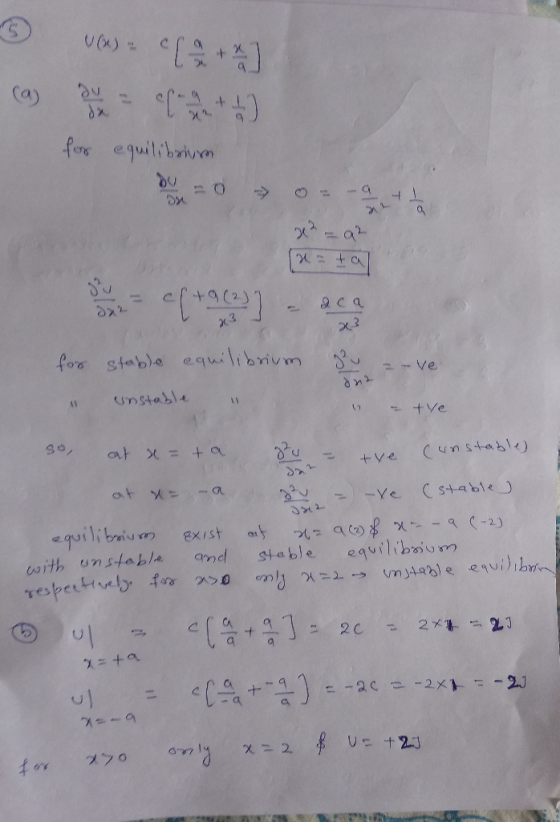
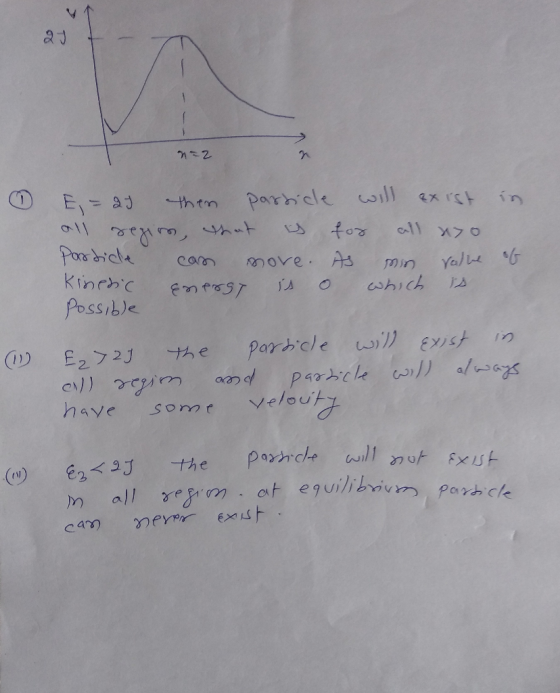
5. Consider a particle moving in the region x>0 under the influence of the potential U(x)...
A particle is constrained to move along the positive x-axis under the influence of a force...
 A particle is constrained to move along the positive x-axis under the influence of a force whose potential energy is U(x) = U_0(2 cos x/a - x/a) where U_0 and a are positive constants. Plot U versus x. A simple hand sketch is fine. Find the equilibrium point(s). For each equilibrium point, determine whether the equilibrium is stable or unstable.
A particle is introduced to a region with a potential described by U(x)--2x2 +x*+1 Joules. 3. a. ...
 A particle is introduced to a region with a potential described by U(x)--2x2 +x*+1 Joules. 3. a. (2 pts) In software, plot the potential U) Set your axis ranges: -2 SxS2 and 0s b. (5 pts) Find the equilibrium positions and determine whether they are stable or c. (8 pts) Describe the motion of the particle for total energy values E-О.0.05. 1.0, 2.0 unstable. Explain how you arrived at your answers. (all in Joules). What I am looking for here...
A 4-kg particle moves along the x-axis under the influence of a conservative force. The potential...
A 4-kg particle moves along the x-axis under the influence of a conservative force. The potential energy is given by U(x) = bx^3 , where b = 8.0 J/m^3 . What is the magnitude of the acceleration of the particle (in m/s2 ) when it is at the point x = 2 m?
A 1kg particle is in a region where the potential energy can be represented by the...
A 1kg particle is in a region where the potential energy can be represented by the function U(x) = x 2 − 5, where using x in meters will give you U in J. The particle is released from rest at x = 2.0m. (a)In which direction does it move? Why? (b)What is its velocity when it has moved 2m? (c)Where does the particle first come to rest after you release it? (d)Describe the long-term motion of the particle.
The figure shows a plot of potential energy U versus position x of a 0.280 kg particle that can t...
 The figure shows a plot of potential energy U versus
position x of a 0.280 kg particle that can travel only
along an x axis under the influence of a conservative
force. The graph has these values: UA
= 9.00 J, UC = 20.0 J and
UD = 24.0 J. The particle is released
at the point where U forms a “potential hill” of “height”
UB = 12.0 J, with kinetic energy 5.00
J. What is the speed of the...
The figure shows a plot of potential energy U versus
position x of a 0.280 kg particle that can travel only
along an x axis under the influence of a conservative
force. The graph has these values: UA
= 9.00 J, UC = 20.0 J and
UD = 24.0 J. The particle is released
at the point where U forms a “potential hill” of “height”
UB = 12.0 J, with kinetic energy 5.00
J. What is the speed of the...
A particle with total mechanical energy E is moving along the x-axis under the influence of...
A particle with total mechanical energy E is moving along the x-axis under the influence of a conservative force F(x) with potential energy U(x). At a certain point the force is zero. At that point U(x)=0 dU/dx=0 U(x)=E not enough information
U(U) x(m) 5 10 15 A particle moves under the influence of a conservative force. The...
 U(U) x(m) 5 10 15 A particle moves under the influence of a conservative force. The graph shows the potential energy U as a function of position x. Which of the following graphs best shows the force F exerted on the particle as a function of r? F(N) ->x(m) F(N) →x(m) (W)x+ F(N) (W)x+ F(N) (W)x+ F(N)
Consider a particle encountering a barrier with potential U = U.>0 between x = -a and...
 Consider a particle encountering a barrier with potential U = U.>0 between x = -a and x = a with incoming energy E > U. a) Write the symbolic wave functions before and after passing through the barrier (i.e., for x<-a and x>a; regions I and III). U1 b) Write down the Schrodinger equation for the wave function in the middle (region II) where the potential is non-zero i.e., where -a<x<a; region II). c) What solution would you try for...
A particle enters a region where the potential in joules is given by U(x) = 2x3...
 A particle enters a region where the potential in joules is given by U(x) = 2x3 + 2x2 where x is in meters. What is the x-component of the force felt by the particle if it is at x = 2 m? O 32N o -32 N 0-24N O 24N
Answers can be more than one: VII. (12pts) Consider the following potential energy: region 1: U(X)...
 Answers can be more than one:
VII. (12pts) Consider the following potential energy: region 1: U(X) = U. x < 0 region 2: U(X) = 0 0<x</ Uo region 3: U(x) = U. x>L ТЕ where U. >0. We want to consider a particle with energy E such that 0 < E<Uo. There are two possible forms for the wave function that might be used to represent the particle: (x) = 4 sin kyx+ B, coskx v(x) = 4e** +...
Answers can be more than one:
VII. (12pts) Consider the following potential energy: region 1: U(X) = U. x < 0 region 2: U(X) = 0 0<x</ Uo region 3: U(x) = U. x>L ТЕ where U. >0. We want to consider a particle with energy E such that 0 < E<Uo. There are two possible forms for the wave function that might be used to represent the particle: (x) = 4 sin kyx+ B, coskx v(x) = 4e** +...
 A particle is constrained to move along the positive x-axis under the influence of a force whose potential energy is U(x) = U_0(2 cos x/a - x/a) where U_0 and a are positive constants. Plot U versus x. A simple hand sketch is fine. Find the equilibrium point(s). For each equilibrium point, determine whether the equilibrium is stable or unstable.
 A particle is introduced to a region with a potential described by U(x)--2x2 +x*+1 Joules. 3. a. (2 pts) In software, plot the potential U) Set your axis ranges: -2 SxS2 and 0s b. (5 pts) Find the equilibrium positions and determine whether they are stable or c. (8 pts) Describe the motion of the particle for total energy values E-О.0.05. 1.0, 2.0 unstable. Explain how you arrived at your answers. (all in Joules). What I am looking for here...
 The figure shows a plot of potential energy U versus
position x of a 0.280 kg particle that can travel only
along an x axis under the influence of a conservative
force. The graph has these values: UA
= 9.00 J, UC = 20.0 J and
UD = 24.0 J. The particle is released
at the point where U forms a “potential hill” of “height”
UB = 12.0 J, with kinetic energy 5.00
J. What is the speed of the...
The figure shows a plot of potential energy U versus
position x of a 0.280 kg particle that can travel only
along an x axis under the influence of a conservative
force. The graph has these values: UA
= 9.00 J, UC = 20.0 J and
UD = 24.0 J. The particle is released
at the point where U forms a “potential hill” of “height”
UB = 12.0 J, with kinetic energy 5.00
J. What is the speed of the...
 U(U) x(m) 5 10 15 A particle moves under the influence of a conservative force. The graph shows the potential energy U as a function of position x. Which of the following graphs best shows the force F exerted on the particle as a function of r? F(N) ->x(m) F(N) →x(m) (W)x+ F(N) (W)x+ F(N) (W)x+ F(N)
 Consider a particle encountering a barrier with potential U = U.>0 between x = -a and x = a with incoming energy E > U. a) Write the symbolic wave functions before and after passing through the barrier (i.e., for x<-a and x>a; regions I and III). U1 b) Write down the Schrodinger equation for the wave function in the middle (region II) where the potential is non-zero i.e., where -a<x<a; region II). c) What solution would you try for...
 A particle enters a region where the potential in joules is given by U(x) = 2x3 + 2x2 where x is in meters. What is the x-component of the force felt by the particle if it is at x = 2 m? O 32N o -32 N 0-24N O 24N
 Answers can be more than one:
VII. (12pts) Consider the following potential energy: region 1: U(X) = U. x < 0 region 2: U(X) = 0 0<x</ Uo region 3: U(x) = U. x>L ТЕ where U. >0. We want to consider a particle with energy E such that 0 < E<Uo. There are two possible forms for the wave function that might be used to represent the particle: (x) = 4 sin kyx+ B, coskx v(x) = 4e** +...
Answers can be more than one:
VII. (12pts) Consider the following potential energy: region 1: U(X) = U. x < 0 region 2: U(X) = 0 0<x</ Uo region 3: U(x) = U. x>L ТЕ where U. >0. We want to consider a particle with energy E such that 0 < E<Uo. There are two possible forms for the wave function that might be used to represent the particle: (x) = 4 sin kyx+ B, coskx v(x) = 4e** +...
Most questions answered within 3 hours.
-
Where is the error in this code sequence?
String s1 = "Hello";
String s2 = "ello";...
asked 10 months ago -
Financial data for Joel de Paris, Inc., for last year
follow:
Joel de Paris, Inc.
Balance...
asked 10 months ago -
Consider this reaction:
Al2(SO4)3 (aq)+ BaCl3
(aq) Al2Cl6 (aq)- +
3BaSO4(s) . What is the...
asked 10 months ago -
Suppose that Savneet is considering increasing her
recent random sample from 20 car rentals to 40...
asked 10 months ago -
Trucks arrive at an unloading terminal at an average rate of 120
per hour.
Trucks arrive...
asked 10 months ago -
Why are methanol and ethanol completely soluble in water while
octanol is not very little soluble....
asked 10 months ago -
A facilities manager at a university reads in a research report
that the mean amount of...
asked 10 months ago -
When the CuSO4 is rehydrated by adding water to the anhydrous
compound, is this an endothermic...
asked 10 months ago -
A ray of sunlight is passing from diamond into crown glass; the
angle of incidence is...
asked 10 months ago -
A block of mass 0.249 kg is placed on top of a light, vertical
spring of...
asked 10 months ago -
how do the kidneys compensate in the presences of acidosis
a) trigger hyperventilate
b) reserve acid...
asked 10 months ago -
Question 501 pts
The rental rate of capital to the firm increases. Which of the
following...
asked 10 months ago