
Homework Answers
Add Answer to:
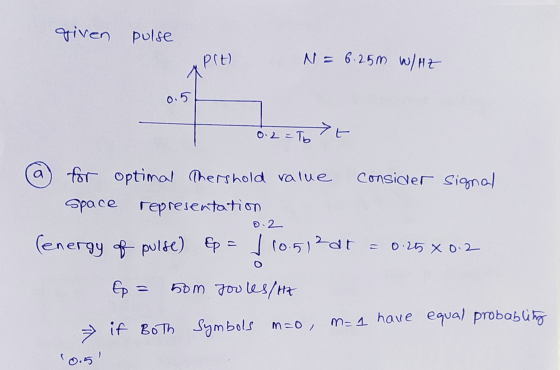
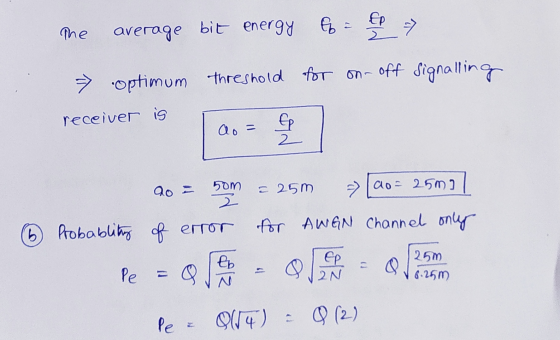
plt) 0.2 2. The hypothetical communication system uses optimum binary receiver with the on-off signaling. The...
2. The output Y of a binary communication system is a unit-variance Gaussian (Normal) random variable...
 2. The output Y of a binary communication system is a unit-variance Gaussian (Normal) random variable with mean 0 when the input X is 0, and mean 1 when the input is 1. Assume that the input is 1 with probability p. (a) Determine fr(w). : If ( c) The receiver uses the following decision rule decide that input was 1; otherwise, decide that input was 0. Show that this decision rule leads to the following threshold rule: If Y...
(2) In binary communication system, we send "0s and ""s and due to noise and channel distortion r...
 (2) In binary communication system, we send "0s and ""s and due to noise and channel distortion receiver sometimes makes errors with probability p. We also send these information bits in the form of packets (e.g., group of 10 bits) i) What is the probability of having a packet error that carries 100 bits of information? İİ) What is the probability of having at least 2 bit errors in a 100-bit packet?
(2) In binary communication system, we send "0s...
(2) In binary communication system, we send "0s and ""s and due to noise and channel distortion receiver sometimes makes errors with probability p. We also send these information bits in the form of packets (e.g., group of 10 bits) i) What is the probability of having a packet error that carries 100 bits of information? İİ) What is the probability of having at least 2 bit errors in a 100-bit packet?
(2) In binary communication system, we send "0s...
Help me please! Thank you!! 1. Consider the signal set in Figure 1 for binary data...
 Help me please! Thank you!!
1. Consider the signal set in Figure 1 for binary data transmission over a channel disturbed by AWGN. The noise is zero-mean and has two-sided PSD No/2. As usual, si(t) is used for the transmission of bit "0" and s2(t) is for the transmission of bit 1." Furthermore, the two bits are equiprobable. Si CC) s2(t) .A 0 Figure 1: A binary signal set, considered in Problem 1 Find and draw an orthonormal basis {фі...
Help me please! Thank you!!
1. Consider the signal set in Figure 1 for binary data transmission over a channel disturbed by AWGN. The noise is zero-mean and has two-sided PSD No/2. As usual, si(t) is used for the transmission of bit "0" and s2(t) is for the transmission of bit 1." Furthermore, the two bits are equiprobable. Si CC) s2(t) .A 0 Figure 1: A binary signal set, considered in Problem 1 Find and draw an orthonormal basis {фі...
Consider a binary communication system that transmits information using the pulse g(t) = A[−u(t) + 2u(t...
Consider a binary communication system that transmits information using the pulse g(t) = A[−u(t) + 2u(t − T /2) − u(t − T )] according to the mapping rule “0′′ → −g(t) “1′′ → +g(t) The “0”s and “1”s are transmitted with equal probability, and the channel is an AWGN channel, with a two-sided noise power spectral density of No/2 watts/Hz. a) Determine and sketch the filter h(t) that is matched to g(t). b) Determine and sketch the overall pulse...
Suppose a digital communication system uses a transmission power of 250 mW and a carrier frequency...
 Suppose a digital communication system uses a transmission power of 250 mW and a carrier frequency of 10,665,000 Hz. The system has a transmission range of 10 m. Assume that the thermal noise power at the receiver is 25 μW, do-1 m-Y-2. Answer the following: a. What is the received signal power? Express your result in Watts and in dBm b. What is the SNR at the receiver's antenna? Express your result in dB. Using the BER curve of Receiver...
Information bits {0,1} are sent over binary symmetric communication channel with conditional probabilities P(YX) as shown...
 Information bits {0,1} are sent over binary symmetric communication channel with conditional probabilities P(YX) as shown below. The priory probabilities of 0 and 1 are P(X=0)=0.3, P(X=1)=0.7. The error probability {=0.2. transmitter X 0 1-€ receiver Y 0 ៩ w 1-€ a) If 1 is transmitted, what are the probabilities of receiving 0 and 1? P(Y=0|X=1) and P(Y=1X=1) b) If 0 is received, what are the probabilities that 0 and 1 information bit is transmitted? P(X=0 Y=0) and P(X=1 Y=0)
3. (40 points) A binary communication system transmits signals s (0) (i = 1, 2). The...
 3. (40 points) A binary communication system transmits signals s (0) (i = 1, 2). The receiver samples the received signal r(t) = s(t)+ n(t) at T and obtain the decision statistic r =r(T) = S(T) + n(T) = a, un, where the signal component is either a = + A or a, = -A with A >0 and n is the noise component. Assume that s (6) and s(l) are equally likely to be transmitted and the decision threshold...
A digital communication system uses the signals si(t) and s2(t) shown in Fig. 1 to t equally like...
 A digital communication system uses the signals si(t) and s2(t) shown in Fig. 1 to t equally likely bits '0' and '1', respectively. The signaling duration is 4 seconds. The receiver uses a filter h(t) shown in Fig. 2 s1 (t) s2(t) 0 Figure 1: Set of signals in Problem 1 h(t) 0 Figure 2: h(t) in Problem 1 (a) Determine the parameter ri for this system. HINT: Remember that ri is equal to this convolution 81(t) * h(t) evaluated...
First, read the article on "The Delphi Method for Graduate Research." ------ Article is posted below...
First, read the article on "The Delphi Method for Graduate Research." ------ Article is posted below Include each of the following in your answer (if applicable – explain in a paragraph) Research problem: what do you want to solve using Delphi? Sample: who will participate and why? (answer in 5 -10 sentences) Round one questionnaire: include 5 hypothetical questions you would like to ask Discuss: what are possible outcomes of the findings from your study? Hint: this is the conclusion....
 2. The output Y of a binary communication system is a unit-variance Gaussian (Normal) random variable with mean 0 when the input X is 0, and mean 1 when the input is 1. Assume that the input is 1 with probability p. (a) Determine fr(w). : If ( c) The receiver uses the following decision rule decide that input was 1; otherwise, decide that input was 0. Show that this decision rule leads to the following threshold rule: If Y...
 (2) In binary communication system, we send "0s and ""s and due to noise and channel distortion receiver sometimes makes errors with probability p. We also send these information bits in the form of packets (e.g., group of 10 bits) i) What is the probability of having a packet error that carries 100 bits of information? İİ) What is the probability of having at least 2 bit errors in a 100-bit packet?
(2) In binary communication system, we send "0s...
(2) In binary communication system, we send "0s and ""s and due to noise and channel distortion receiver sometimes makes errors with probability p. We also send these information bits in the form of packets (e.g., group of 10 bits) i) What is the probability of having a packet error that carries 100 bits of information? İİ) What is the probability of having at least 2 bit errors in a 100-bit packet?
(2) In binary communication system, we send "0s...
 Help me please! Thank you!!
1. Consider the signal set in Figure 1 for binary data transmission over a channel disturbed by AWGN. The noise is zero-mean and has two-sided PSD No/2. As usual, si(t) is used for the transmission of bit "0" and s2(t) is for the transmission of bit 1." Furthermore, the two bits are equiprobable. Si CC) s2(t) .A 0 Figure 1: A binary signal set, considered in Problem 1 Find and draw an orthonormal basis {фі...
Help me please! Thank you!!
1. Consider the signal set in Figure 1 for binary data transmission over a channel disturbed by AWGN. The noise is zero-mean and has two-sided PSD No/2. As usual, si(t) is used for the transmission of bit "0" and s2(t) is for the transmission of bit 1." Furthermore, the two bits are equiprobable. Si CC) s2(t) .A 0 Figure 1: A binary signal set, considered in Problem 1 Find and draw an orthonormal basis {фі...
 Suppose a digital communication system uses a transmission power of 250 mW and a carrier frequency of 10,665,000 Hz. The system has a transmission range of 10 m. Assume that the thermal noise power at the receiver is 25 μW, do-1 m-Y-2. Answer the following: a. What is the received signal power? Express your result in Watts and in dBm b. What is the SNR at the receiver's antenna? Express your result in dB. Using the BER curve of Receiver...
 Information bits {0,1} are sent over binary symmetric communication channel with conditional probabilities P(YX) as shown below. The priory probabilities of 0 and 1 are P(X=0)=0.3, P(X=1)=0.7. The error probability {=0.2. transmitter X 0 1-€ receiver Y 0 ៩ w 1-€ a) If 1 is transmitted, what are the probabilities of receiving 0 and 1? P(Y=0|X=1) and P(Y=1X=1) b) If 0 is received, what are the probabilities that 0 and 1 information bit is transmitted? P(X=0 Y=0) and P(X=1 Y=0)
 3. (40 points) A binary communication system transmits signals s (0) (i = 1, 2). The receiver samples the received signal r(t) = s(t)+ n(t) at T and obtain the decision statistic r =r(T) = S(T) + n(T) = a, un, where the signal component is either a = + A or a, = -A with A >0 and n is the noise component. Assume that s (6) and s(l) are equally likely to be transmitted and the decision threshold...
 A digital communication system uses the signals si(t) and s2(t) shown in Fig. 1 to t equally likely bits '0' and '1', respectively. The signaling duration is 4 seconds. The receiver uses a filter h(t) shown in Fig. 2 s1 (t) s2(t) 0 Figure 1: Set of signals in Problem 1 h(t) 0 Figure 2: h(t) in Problem 1 (a) Determine the parameter ri for this system. HINT: Remember that ri is equal to this convolution 81(t) * h(t) evaluated...
Most questions answered within 3 hours.
-
Where is the error in this code sequence?
String s1 = "Hello";
String s2 = "ello";...
asked 10 months ago -
Financial data for Joel de Paris, Inc., for last year
follow:
Joel de Paris, Inc.
Balance...
asked 10 months ago -
Consider this reaction:
Al2(SO4)3 (aq)+ BaCl3
(aq) Al2Cl6 (aq)- +
3BaSO4(s) . What is the...
asked 10 months ago -
Suppose that Savneet is considering increasing her
recent random sample from 20 car rentals to 40...
asked 10 months ago -
Trucks arrive at an unloading terminal at an average rate of 120
per hour.
Trucks arrive...
asked 10 months ago -
Why are methanol and ethanol completely soluble in water while
octanol is not very little soluble....
asked 10 months ago -
A facilities manager at a university reads in a research report
that the mean amount of...
asked 10 months ago -
When the CuSO4 is rehydrated by adding water to the anhydrous
compound, is this an endothermic...
asked 10 months ago -
A ray of sunlight is passing from diamond into crown glass; the
angle of incidence is...
asked 10 months ago -
A block of mass 0.249 kg is placed on top of a light, vertical
spring of...
asked 10 months ago -
how do the kidneys compensate in the presences of acidosis
a) trigger hyperventilate
b) reserve acid...
asked 10 months ago -
Question 501 pts
The rental rate of capital to the firm increases. Which of the
following...
asked 10 months ago