
Homework Answers
Add Answer to:
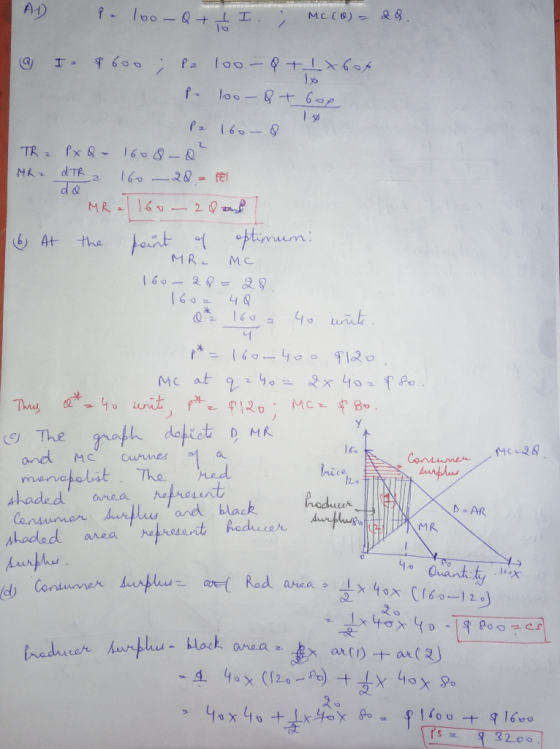
1. Suppose that a single-price monopolist faces the demand function P 100 Q where I is...
A monopolist faces the following demand curve: P = 520 - 0.7Q, its total cost is...
A monopolist faces the following demand curve: P = 520 - 0.7Q, its total cost is given by: TC = 4600 + 0.3Q2 and its marginal cost is given by: MC = 0.6Q. (a) If it is a single price monopolist, what is its profit maximizing price and quantity? Show your work. How much is the profit? How much are consumer surplus and producer surplus? (b) Suppose it is a first degree price discriminator instead of a single price monopolist....
Suppose a profit-maximizing monopolist faces a demand curve given by Q = 130 – P. a....
Suppose a profit-maximizing monopolist faces a demand curve given by Q = 130 – P. a. Write the equations for total revenue and marginal revenue. b. The firm has fixed costs of capital equal to $3500 and variable costs are estimated to be 1⁄2Q2 – 50Q. Write the equations for total cost, average total cost, and marginal cost. c. Calculate the profit-maximizing price and output for the firm. d. Calculate the firm’s profits. e. Graph the curves representing the firm’s...
7. A monopolist in the market for widgets is facing a demand curve P= 60 -...
 7. A monopolist in the market for widgets is facing a demand curve P= 60 - Q. The marginal cost of producing Q units is equal to $Q. (a) Calculate the monopolist's profit maximizing price and quantity. Calculate producer, consumer, and total surplus, and deadweight loss. (b) The government wants to impose a price ceiling that will maximize the total surplus in the market. What price ceiling should the government set? What would be the new values of consumer and...
Part E-H Assume a profit-maximizing monopolist faces a market demand given by P = (12,000 –...
Part E-H Assume a profit-maximizing monopolist faces a market demand given by P = (12,000 – 90Q)/100 and long run total and marginal cost given by LRTC = 5Q + Q2 + 40 (Note: The answer to this question must be hand-written.): a) Find the equation of the marginal revenue curve corresponding to the market demand curve. b) Find the equation for the marginal cost function. c) Find the profit-maximizing quantity of output for the monopoly and the price the...
Consider a situation where a monopolist faces the following inverse market demand curve p= 100 –...
 Consider a situation where a monopolist faces the following inverse market demand curve p= 100 – 4 and the following cost function TC = 4q+72 a) Derive the marginal revenue and marginal cost functions. b) What are the equilibrium price and quantity if this market behaved as if it were perfectly competitive? c) Calculate the Consumer Surplus, Producer Surplus and Welfare levels under perfect com- petition. d) What are the equilibrium price and quantity when the monopolist produces as a...
3. Consider a uniform-price monopolist that faces demand curve P() 14 2Q and faces a total...
 3. Consider a uniform-price monopolist that faces demand curve P() 14 2Q and faces a total cost TC() 20 (a) Calculate the profit maximizing price and quantity erw erwyat er Patt Q= (b) Determine the consumer surplus, producer surplus, and deadweight loss erwyat erwy erwyatt CS = el DWL =
A natural monopolist faces the following demand curve: P = 409 - 2Q, its total cost...
A natural monopolist faces the following demand curve: P = 409 - 2Q, its total cost is given by: TC = 12800 + 9Q (marginal cost is the slope of total cost). (a) If the government regulates the monopolist to charge a socially optimal price, what price will it charge and how many units will it sell? How much are the profit, consumer surplus and producer surplus? (b) If it is not a regulated monopolist, what is its profit maximizing...
A natural monopolist faces the following demand curve: P = 202 - 5Q, its total cost...
A natural monopolist faces the following demand curve: P = 202 - 5Q, its total cost is given by: TC = 720 + 2Q (marginal cost is the slope of total cost). (a) If the government regulates the monopolist to charge a socially optimal price, what price will it charge and how many units will it sell? How much are the profit, consumer surplus and producer surplus? (b) If it is not a regulated monopolist, what is its profit maximizing...
4. A monopolist faces a market demand defined by P 20. There are no fixed costs. 100 (1/5)Q. Her ...
 4. A monopolist faces a market demand defined by P 20. There are no fixed costs. 100 (1/5)Q. Her marginal cost is given by MC (a) Graph the market demand, the marginal revenue curve and the marginal cost curve, labeling the intercepts. (5 marks) (b) Calculate the monopolist's profit-maximizing price, output and profit. (5 marks) (c) Suppose that this market can now be divided into two separate markets and the supplier can discriminate between them. The demand curves are given...
Suppose a profit maximizing monopolist has total cost and marginal cost as follow:
 Suppose a profit maximizing monopolist has total cost and marginal
cost as follow:1. Suppose a profit-maximizing monopolist has total cost and marginal cost as follow: \(\mathrm{TC}=0.1 Q^{2}+Q+10\) and \(\mathrm{MC}=0.2 Q+1\). It faces the demand curve \(\mathrm{Q}=35-5^{\mathrm{P}} .(35\) points \()\)a) What are the price, output, and profit for this monopolist?b) Carefully draw the diagram that illustrates your answers.c) What are the equilibrium price, output, and total profit if this is a perfectly competitive market?d) Compare the results between monopoly and perfect...
Suppose a profit maximizing monopolist has total cost and marginal
cost as follow:1. Suppose a profit-maximizing monopolist has total cost and marginal cost as follow: \(\mathrm{TC}=0.1 Q^{2}+Q+10\) and \(\mathrm{MC}=0.2 Q+1\). It faces the demand curve \(\mathrm{Q}=35-5^{\mathrm{P}} .(35\) points \()\)a) What are the price, output, and profit for this monopolist?b) Carefully draw the diagram that illustrates your answers.c) What are the equilibrium price, output, and total profit if this is a perfectly competitive market?d) Compare the results between monopoly and perfect...
 7. A monopolist in the market for widgets is facing a demand curve P= 60 - Q. The marginal cost of producing Q units is equal to $Q. (a) Calculate the monopolist's profit maximizing price and quantity. Calculate producer, consumer, and total surplus, and deadweight loss. (b) The government wants to impose a price ceiling that will maximize the total surplus in the market. What price ceiling should the government set? What would be the new values of consumer and...
 Consider a situation where a monopolist faces the following inverse market demand curve p= 100 – 4 and the following cost function TC = 4q+72 a) Derive the marginal revenue and marginal cost functions. b) What are the equilibrium price and quantity if this market behaved as if it were perfectly competitive? c) Calculate the Consumer Surplus, Producer Surplus and Welfare levels under perfect com- petition. d) What are the equilibrium price and quantity when the monopolist produces as a...
 3. Consider a uniform-price monopolist that faces demand curve P() 14 2Q and faces a total cost TC() 20 (a) Calculate the profit maximizing price and quantity erw erwyat er Patt Q= (b) Determine the consumer surplus, producer surplus, and deadweight loss erwyat erwy erwyatt CS = el DWL =
 4. A monopolist faces a market demand defined by P 20. There are no fixed costs. 100 (1/5)Q. Her marginal cost is given by MC (a) Graph the market demand, the marginal revenue curve and the marginal cost curve, labeling the intercepts. (5 marks) (b) Calculate the monopolist's profit-maximizing price, output and profit. (5 marks) (c) Suppose that this market can now be divided into two separate markets and the supplier can discriminate between them. The demand curves are given...
 Suppose a profit maximizing monopolist has total cost and marginal
cost as follow:1. Suppose a profit-maximizing monopolist has total cost and marginal cost as follow: \(\mathrm{TC}=0.1 Q^{2}+Q+10\) and \(\mathrm{MC}=0.2 Q+1\). It faces the demand curve \(\mathrm{Q}=35-5^{\mathrm{P}} .(35\) points \()\)a) What are the price, output, and profit for this monopolist?b) Carefully draw the diagram that illustrates your answers.c) What are the equilibrium price, output, and total profit if this is a perfectly competitive market?d) Compare the results between monopoly and perfect...
Suppose a profit maximizing monopolist has total cost and marginal
cost as follow:1. Suppose a profit-maximizing monopolist has total cost and marginal cost as follow: \(\mathrm{TC}=0.1 Q^{2}+Q+10\) and \(\mathrm{MC}=0.2 Q+1\). It faces the demand curve \(\mathrm{Q}=35-5^{\mathrm{P}} .(35\) points \()\)a) What are the price, output, and profit for this monopolist?b) Carefully draw the diagram that illustrates your answers.c) What are the equilibrium price, output, and total profit if this is a perfectly competitive market?d) Compare the results between monopoly and perfect...
Most questions answered within 3 hours.
-
Where is the error in this code sequence?
String s1 = "Hello";
String s2 = "ello";...
asked 10 months ago -
Financial data for Joel de Paris, Inc., for last year
follow:
Joel de Paris, Inc.
Balance...
asked 10 months ago -
Consider this reaction:
Al2(SO4)3 (aq)+ BaCl3
(aq) Al2Cl6 (aq)- +
3BaSO4(s) . What is the...
asked 10 months ago -
Suppose that Savneet is considering increasing her
recent random sample from 20 car rentals to 40...
asked 10 months ago -
Trucks arrive at an unloading terminal at an average rate of 120
per hour.
Trucks arrive...
asked 10 months ago -
Why are methanol and ethanol completely soluble in water while
octanol is not very little soluble....
asked 10 months ago -
A facilities manager at a university reads in a research report
that the mean amount of...
asked 10 months ago -
When the CuSO4 is rehydrated by adding water to the anhydrous
compound, is this an endothermic...
asked 10 months ago -
A ray of sunlight is passing from diamond into crown glass; the
angle of incidence is...
asked 10 months ago -
A block of mass 0.249 kg is placed on top of a light, vertical
spring of...
asked 10 months ago -
how do the kidneys compensate in the presences of acidosis
a) trigger hyperventilate
b) reserve acid...
asked 10 months ago -
Question 501 pts
The rental rate of capital to the firm increases. Which of the
following...
asked 10 months ago