
Homework Answers


![Na = [*; 2). Na = [46_21 A = I-al -a212] [-312 -212 | 10 | 120 C = [120]](http://img.homeworklib.com/questions/380dafe0-328f-11eb-b863-23f4e95635d3.png?x-oss-process=image/resize,w_560)
Q4. 1 2 3 G 10 pts. Use MATLAB and plot the step response of the following systems G3 2s+1 figure. Gy on the same 2s+1...
 Q4. 1 2 3 G 10 pts. Use MATLAB and plot the step response of the following systems G3 2s+1 figure. Gy on the same 2s+1 2s+1 Explain the similarities (at least 1) and differences (at least 1) between these responses. E_ figure. G, G 3 10 pts. Use MATLAB and plot the impulse response of the following systems Explain the similarities and differences between these responses. on the same 25+1 10 pts. Find the time constant (Te), pole(s), DC...
1) Write a Matlab program for the following block diagram: a) to derive its closed-loop transfer function. b) to find and plot the poles-zeros of closed-loop transfer function. s+2s+3 R(s) → Y(s)...
 1) Write a Matlab program for the following block diagram: a) to derive its closed-loop transfer function. b) to find and plot the poles-zeros of closed-loop transfer function. s+2s+3 R(s) → Y(s) 2s+3 2 +2s +5 15 Automatic Control Systen
1) Write a Matlab program for the following block diagram: a) to derive its closed-loop transfer function. b) to find and plot the poles-zeros of closed-loop transfer function. s+2s+3 R(s) → Y(s) 2s+3 2 +2s +5 15 Automatic Control Systen
1) Write a Matlab program for the following block diagram: a) to derive its closed-loop transfer function. b) to find and plot the poles-zeros of closed-loop transfer function. s+2s+3 R(s) → Y(s) 2s+3 2 +2s +5 15 Automatic Control Systen
0.1s(s 50)(s 200) G(s) (s+2)(s 2s+100) Consider the transfer function above a) Draw the Bode diagrams...
 0.1s(s 50)(s 200) G(s) (s+2)(s 2s+100) Consider the transfer function above a) Draw the Bode diagrams of the system, both magnitude and phase, by hand. b) Verify your results by using MATLAB's built-in 'bode' command.
0.1s(s 50)(s 200) G(s) (s+2)(s 2s+100) Consider the transfer function above a) Draw the Bode diagrams of the system, both magnitude and phase, by hand. b) Verify your results by using MATLAB's built-in 'bode' command.
0.1s(s 50)(s 200) G(s) (s+2)(s 2s+100) Consider the transfer function above a) Draw the Bode diagrams of the system, both magnitude and phase, by hand. b) Verify your results by using MATLAB's built-in 'bode' command.
1) Plot the root locus of the system whose characteristic equation is 2) Plot the root locus of the closed loop system whose open-loop transfer function is given as 2s + 2 G(S)H(S)+7s3 +10s2 3)...
 1) Plot the root locus of the system whose characteristic equation is 2) Plot the root locus of the closed loop system whose open-loop transfer function is given as 2s + 2 G(S)H(S)+7s3 +10s2 3) Plot root locus of the closed-loop system for which feedforward transfer function is s + 1 G(S) s( ) St(s - and feedback transfer function is H(S)2 +8s +32
1) Plot the root locus of the system whose characteristic equation is 2) Plot the root...
1) Plot the root locus of the system whose characteristic equation is 2) Plot the root locus of the closed loop system whose open-loop transfer function is given as 2s + 2 G(S)H(S)+7s3 +10s2 3) Plot root locus of the closed-loop system for which feedforward transfer function is s + 1 G(S) s( ) St(s - and feedback transfer function is H(S)2 +8s +32
1) Plot the root locus of the system whose characteristic equation is 2) Plot the root...
G / 4.18/A process has the transfer function Y(s) U(s) G(s) = 2s + 1 (a) For a step change in the...
 g / 4.18/A process has the transfer function Y(s) U(s) G(s) = 2s + 1 (a) For a step change in the input U(s) 2/s, sketch the response y(t) (you do not need to solve the differential equation). Show as much detail as possible, including the steady-state value of y(t), and whether there is oscillation. (b) What is the decay ratio? 425 Can a tank with the outflow rate fixed by a constant speedl pump reach a steady state if...
3. Work the following problems: a. The transfer function of a system is: Y(s)/R(s) = 15(s+1)/(s2+9s+14)....
 3. Work the following problems: a. The transfer function of a system is: Y(s)/R(s) = 15(s+1)/(s2+9s+14). Determine y(t) when r(t) is a unit step input. b. Consider the following system: R(s)_ 0 G(s) i. Find the closed-loop transfer function Y(s)R(S) when G(s) = 10/(S2+2s+10) ii. Determine Y(s) when the input R(s) is a unit step. iii. Compute y(t).
Find the inverse Laplace transforms of (a) (b) (c) s 1 (2s +1) Y(s) = (822 5s + 8 (2s - 2) 21) Y(s) = Find the inverse Laplace transforms of (2s- 3)e-3,s 1) (2s (a) Y(s)2s+ ) (2s - 2) (c) Y(s)...
 Find the inverse Laplace transforms of
(a)
(b)
(c)
s 1 (2s +1) Y(s) = (822 5s + 8 (2s - 2) 21) Y(s) = Find the inverse Laplace transforms of (2s- 3)e-3,s 1) (2s (a) Y(s)2s+ ) (2s - 2) (c) Y(s) = (5-7)2
s 1 (2s +1)
Y(s) = (822 5s + 8 (2s - 2)
21) Y(s) =
Find the inverse Laplace transforms of (2s- 3)e-3,s 1) (2s (a) Y(s)2s+ ) (2s - 2) (c) Y(s) =...
Find the inverse Laplace transforms of
(a)
(b)
(c)
s 1 (2s +1) Y(s) = (822 5s + 8 (2s - 2) 21) Y(s) = Find the inverse Laplace transforms of (2s- 3)e-3,s 1) (2s (a) Y(s)2s+ ) (2s - 2) (c) Y(s) = (5-7)2
s 1 (2s +1)
Y(s) = (822 5s + 8 (2s - 2)
21) Y(s) =
Find the inverse Laplace transforms of (2s- 3)e-3,s 1) (2s (a) Y(s)2s+ ) (2s - 2) (c) Y(s) =...
answers to 5 and 6 D Question 5 2 pts Given the following reactions: 2S (s)+3 02 (3)- 2 SO3 (3) AH 790kJ s(s) +02 (g...
 answers to 5 and 6
D Question 5 2 pts Given the following reactions: 2S (s)+3 02 (3)- 2 SO3 (3) AH 790kJ s(s) +02 (g)-502 (g) ΔΗΡ-297 kJ What is the enthalpy value (in kJ) of the reaction in which sulfur dioxide is oxidized to sulfur trioxide? 2502 (g) + O2 (g) 2503 (g) ΔΗΡ ? D Question 6 2 pts Given the following reactions: CaCO3 (s) CaO (s) + CO2 (g) HP-178.1 kJ C (s, graphite) + O2...
answers to 5 and 6
D Question 5 2 pts Given the following reactions: 2S (s)+3 02 (3)- 2 SO3 (3) AH 790kJ s(s) +02 (g)-502 (g) ΔΗΡ-297 kJ What is the enthalpy value (in kJ) of the reaction in which sulfur dioxide is oxidized to sulfur trioxide? 2502 (g) + O2 (g) 2503 (g) ΔΗΡ ? D Question 6 2 pts Given the following reactions: CaCO3 (s) CaO (s) + CO2 (g) HP-178.1 kJ C (s, graphite) + O2...
Question 1 1 pts If vv - list(a-1,b-2) why doesn't as.vector(vv) work to coerce vw to...
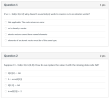 Question 1 1 pts If vv - list(a-1,b-2) why doesn't as.vector(vv) work to coerce vw to an atomic vector? Not applicable: The code returns an error. vv is already a vector atomic vectors cannot have named elements elements of an atomic vector must be of the same type. Question 2 2 pts Suppose ll<-list(a-1,b-c(2,3)). How do we replace the value 3 with the missing data code NA? 0 11[[2]][2] <-NA ﹁ ll <-as.na(II[[2]]) 0 ll[[22]] <-NA is.na([211) <-2 Question3 1...
For the transfer function given below G(S) 2s + 2 52 +53 +6 a) Find the...
 For the transfer function given below G(S) 2s + 2 52 +53 +6 a) Find the differential equation. b) Present this system in a state space representation with a diagonal state matrix. c) Present this system using pole-zero form.
 Q4. 1 2 3 G 10 pts. Use MATLAB and plot the step response of the following systems G3 2s+1 figure. Gy on the same 2s+1 2s+1 Explain the similarities (at least 1) and differences (at least 1) between these responses. E_ figure. G, G 3 10 pts. Use MATLAB and plot the impulse response of the following systems Explain the similarities and differences between these responses. on the same 25+1 10 pts. Find the time constant (Te), pole(s), DC...
 1) Write a Matlab program for the following block diagram: a) to derive its closed-loop transfer function. b) to find and plot the poles-zeros of closed-loop transfer function. s+2s+3 R(s) → Y(s) 2s+3 2 +2s +5 15 Automatic Control Systen
1) Write a Matlab program for the following block diagram: a) to derive its closed-loop transfer function. b) to find and plot the poles-zeros of closed-loop transfer function. s+2s+3 R(s) → Y(s) 2s+3 2 +2s +5 15 Automatic Control Systen
1) Write a Matlab program for the following block diagram: a) to derive its closed-loop transfer function. b) to find and plot the poles-zeros of closed-loop transfer function. s+2s+3 R(s) → Y(s) 2s+3 2 +2s +5 15 Automatic Control Systen
 0.1s(s 50)(s 200) G(s) (s+2)(s 2s+100) Consider the transfer function above a) Draw the Bode diagrams of the system, both magnitude and phase, by hand. b) Verify your results by using MATLAB's built-in 'bode' command.
0.1s(s 50)(s 200) G(s) (s+2)(s 2s+100) Consider the transfer function above a) Draw the Bode diagrams of the system, both magnitude and phase, by hand. b) Verify your results by using MATLAB's built-in 'bode' command.
0.1s(s 50)(s 200) G(s) (s+2)(s 2s+100) Consider the transfer function above a) Draw the Bode diagrams of the system, both magnitude and phase, by hand. b) Verify your results by using MATLAB's built-in 'bode' command.
 1) Plot the root locus of the system whose characteristic equation is 2) Plot the root locus of the closed loop system whose open-loop transfer function is given as 2s + 2 G(S)H(S)+7s3 +10s2 3) Plot root locus of the closed-loop system for which feedforward transfer function is s + 1 G(S) s( ) St(s - and feedback transfer function is H(S)2 +8s +32
1) Plot the root locus of the system whose characteristic equation is 2) Plot the root...
1) Plot the root locus of the system whose characteristic equation is 2) Plot the root locus of the closed loop system whose open-loop transfer function is given as 2s + 2 G(S)H(S)+7s3 +10s2 3) Plot root locus of the closed-loop system for which feedforward transfer function is s + 1 G(S) s( ) St(s - and feedback transfer function is H(S)2 +8s +32
1) Plot the root locus of the system whose characteristic equation is 2) Plot the root...
 g / 4.18/A process has the transfer function Y(s) U(s) G(s) = 2s + 1 (a) For a step change in the input U(s) 2/s, sketch the response y(t) (you do not need to solve the differential equation). Show as much detail as possible, including the steady-state value of y(t), and whether there is oscillation. (b) What is the decay ratio? 425 Can a tank with the outflow rate fixed by a constant speedl pump reach a steady state if...
 3. Work the following problems: a. The transfer function of a system is: Y(s)/R(s) = 15(s+1)/(s2+9s+14). Determine y(t) when r(t) is a unit step input. b. Consider the following system: R(s)_ 0 G(s) i. Find the closed-loop transfer function Y(s)R(S) when G(s) = 10/(S2+2s+10) ii. Determine Y(s) when the input R(s) is a unit step. iii. Compute y(t).
 Find the inverse Laplace transforms of
(a)
(b)
(c)
s 1 (2s +1) Y(s) = (822 5s + 8 (2s - 2) 21) Y(s) = Find the inverse Laplace transforms of (2s- 3)e-3,s 1) (2s (a) Y(s)2s+ ) (2s - 2) (c) Y(s) = (5-7)2
s 1 (2s +1)
Y(s) = (822 5s + 8 (2s - 2)
21) Y(s) =
Find the inverse Laplace transforms of (2s- 3)e-3,s 1) (2s (a) Y(s)2s+ ) (2s - 2) (c) Y(s) =...
Find the inverse Laplace transforms of
(a)
(b)
(c)
s 1 (2s +1) Y(s) = (822 5s + 8 (2s - 2) 21) Y(s) = Find the inverse Laplace transforms of (2s- 3)e-3,s 1) (2s (a) Y(s)2s+ ) (2s - 2) (c) Y(s) = (5-7)2
s 1 (2s +1)
Y(s) = (822 5s + 8 (2s - 2)
21) Y(s) =
Find the inverse Laplace transforms of (2s- 3)e-3,s 1) (2s (a) Y(s)2s+ ) (2s - 2) (c) Y(s) =...
 answers to 5 and 6
D Question 5 2 pts Given the following reactions: 2S (s)+3 02 (3)- 2 SO3 (3) AH 790kJ s(s) +02 (g)-502 (g) ΔΗΡ-297 kJ What is the enthalpy value (in kJ) of the reaction in which sulfur dioxide is oxidized to sulfur trioxide? 2502 (g) + O2 (g) 2503 (g) ΔΗΡ ? D Question 6 2 pts Given the following reactions: CaCO3 (s) CaO (s) + CO2 (g) HP-178.1 kJ C (s, graphite) + O2...
answers to 5 and 6
D Question 5 2 pts Given the following reactions: 2S (s)+3 02 (3)- 2 SO3 (3) AH 790kJ s(s) +02 (g)-502 (g) ΔΗΡ-297 kJ What is the enthalpy value (in kJ) of the reaction in which sulfur dioxide is oxidized to sulfur trioxide? 2502 (g) + O2 (g) 2503 (g) ΔΗΡ ? D Question 6 2 pts Given the following reactions: CaCO3 (s) CaO (s) + CO2 (g) HP-178.1 kJ C (s, graphite) + O2...
 Question 1 1 pts If vv - list(a-1,b-2) why doesn't as.vector(vv) work to coerce vw to an atomic vector? Not applicable: The code returns an error. vv is already a vector atomic vectors cannot have named elements elements of an atomic vector must be of the same type. Question 2 2 pts Suppose ll<-list(a-1,b-c(2,3)). How do we replace the value 3 with the missing data code NA? 0 11[[2]][2] <-NA ﹁ ll <-as.na(II[[2]]) 0 ll[[22]] <-NA is.na([211) <-2 Question3 1...
 For the transfer function given below G(S) 2s + 2 52 +53 +6 a) Find the differential equation. b) Present this system in a state space representation with a diagonal state matrix. c) Present this system using pole-zero form.
Most questions answered within 3 hours.
-
Where is the error in this code sequence?
String s1 = "Hello";
String s2 = "ello";...
asked 10 months ago -
Financial data for Joel de Paris, Inc., for last year
follow:
Joel de Paris, Inc.
Balance...
asked 10 months ago -
Consider this reaction:
Al2(SO4)3 (aq)+ BaCl3
(aq) Al2Cl6 (aq)- +
3BaSO4(s) . What is the...
asked 10 months ago -
Suppose that Savneet is considering increasing her
recent random sample from 20 car rentals to 40...
asked 10 months ago -
Trucks arrive at an unloading terminal at an average rate of 120
per hour.
Trucks arrive...
asked 10 months ago -
Why are methanol and ethanol completely soluble in water while
octanol is not very little soluble....
asked 10 months ago -
A facilities manager at a university reads in a research report
that the mean amount of...
asked 10 months ago -
When the CuSO4 is rehydrated by adding water to the anhydrous
compound, is this an endothermic...
asked 10 months ago -
A ray of sunlight is passing from diamond into crown glass; the
angle of incidence is...
asked 10 months ago -
A block of mass 0.249 kg is placed on top of a light, vertical
spring of...
asked 10 months ago -
how do the kidneys compensate in the presences of acidosis
a) trigger hyperventilate
b) reserve acid...
asked 10 months ago -
Question 501 pts
The rental rate of capital to the firm increases. Which of the
following...
asked 10 months ago