 Need help figuring out what the
resulting product should be?
Need help figuring out what the
resulting product should be?
Homework Answers
Solution :-
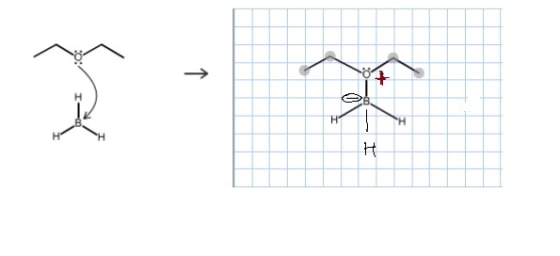
When the oxygen lone pair attacks the B and forms bond with B then oxygen have 3 bond which causes the oxygen to have positive charge and B can have negative charge.
following image shows the structure
Add Answer to:
Need help figuring out what the
resulting product should be?
Curved arrows are provide for the...
Curved arrows are provided for the following transformation. Identify the products of the transformation. Be sure...
 Curved arrows are provided for the following transformation.
Identify the products of the transformation. Be sure to draw
nonbonding electrons and charges where appropriate.
Curved arrows are provided for the following transformation.
Identify the products of the transformation. Be sure to draw
nonbonding electrons and charges where appropriate.
Curved arrows are provided for the following transformation. Identify the products of the transformation. Be sure...
 Curved arrows are provided for the following transformation. Identify the products of the transformation. Be sure to draw nonbonding electrons and charges where appropriate. HO HyC 1
Add curved arrows to the reactant side of the following SN2 reaction to indicate the flow...
 Add curved arrows to the reactant side of the following SN2
reaction to indicate the flow of electrons. Draw the product
species to show the balanced equation, including nonbonding
electrons and formal charges.
Add curved arrows to the reactant side of the following SN2 reaction to indicate the flow of electrons. Draw the product species to show the balanced equation, including nonbonding electrons and formal charges.
Add curved arrows to the reactant side of the following SN2
reaction to indicate the flow of electrons. Draw the product
species to show the balanced equation, including nonbonding
electrons and formal charges.
Add curved arrows to the reactant side of the following SN2 reaction to indicate the flow of electrons. Draw the product species to show the balanced equation, including nonbonding electrons and formal charges.
I got these structures wrong but cannot figure out what is wrong about them. Show the...
 I got these structures wrong but cannot
figure out what is wrong about them.
Show the mechanism for the following reaction conducted at -5 °C in CC14: cyclohexene + bromine yields a dibromocyclohexane Draw wedge-and-dash bond stereochemical structures – including H atoms at a chirality center – and include charges, electrons, and curved arrows. Details count. Draw one enantiomer only for any racemates. Add curved arrows to the first step. 2 • Draw each species (organic and inorganic) resulting from...
I got these structures wrong but cannot
figure out what is wrong about them.
Show the mechanism for the following reaction conducted at -5 °C in CC14: cyclohexene + bromine yields a dibromocyclohexane Draw wedge-and-dash bond stereochemical structures – including H atoms at a chirality center – and include charges, electrons, and curved arrows. Details count. Draw one enantiomer only for any racemates. Add curved arrows to the first step. 2 • Draw each species (organic and inorganic) resulting from...
2. Provide the complete mechanism (curved arrows) to show how the product is formed. Include all...
 2. Provide the complete mechanism (curved arrows) to show how the product is formed. Include all lone pairs, formal charges, curved arrows, intermediates, and products. You do not need to draw the structures of transition states. If there is a carbocation rearrangement and/or a proton transfer, be sure to include it (them) in your mechanism. (Remember to start by drawing all ionic compounds as ions/drawing out the structure of all reagents, and drawing in all lone pairs.) HCI 3. Which...
The electrophilic aromatic substitution of isopropylbenzene with FeBr3, Br2 gives 1-bromo-4-isopropylbenzene. Complete the curved-arrow mechanism below,...
 The electrophilic aromatic substitution of isopropylbenzene with
FeBr3, Br2 gives 1-bromo-4-isopropylbenzene. Complete the
curved-arrow mechanism below, beginning with formation of the
active brominating reagent. Remember to include lone pairs and
formal charges where appropriate.
The electrophilic aromatic substitution of isopropylbenzene with FeBr3, Br2 gives 1-bromo-4-isopropylbenzern Complete the curved-arrow mechanism below, beginning with formation of the active brominating reagent. Remember to include lone pairs and formal charges where appropriate. Draw the pro Overall transformation (ungraded) bromine and FeBr3 Include curved arrow(s)....
The electrophilic aromatic substitution of isopropylbenzene with
FeBr3, Br2 gives 1-bromo-4-isopropylbenzene. Complete the
curved-arrow mechanism below, beginning with formation of the
active brominating reagent. Remember to include lone pairs and
formal charges where appropriate.
The electrophilic aromatic substitution of isopropylbenzene with FeBr3, Br2 gives 1-bromo-4-isopropylbenzern Complete the curved-arrow mechanism below, beginning with formation of the active brominating reagent. Remember to include lone pairs and formal charges where appropriate. Draw the pro Overall transformation (ungraded) bromine and FeBr3 Include curved arrow(s)....
Add curved arrows to the reactant side of the following SM2 reaction to indicate the flow...
 Add curved arrows to the reactant side of the following SM2 reaction to indicate the flow of electrons. Draw the product species to show the balanced equation, including nonbonding electrons and formal charges Do draw in the leaving group as well as the main organic product, adn show the lone pairs and formal charge on the leaving group
Complete the electron-pushing mechanism for the reaction by drawing the necessary organic structures and curved arrows...
 Complete the electron-pushing mechanism for the reaction by
drawing the necessary organic structures and curved arrows for each
step. Make sure to include all nonbonding electron pairs.
Complete the mechanism for the conversion
of the following deuterated alcohol to deuterated chloroalkane via
the mesylate intermediate by adding any missing atoms, bonds,
charges, nonbonding electrons, and curved arrows. Also, select the
correct absolute stereochemistry of the starting material and the
final product. (Note the use of a generic alcohol representing the...
Complete the electron-pushing mechanism for the reaction by
drawing the necessary organic structures and curved arrows for each
step. Make sure to include all nonbonding electron pairs.
Complete the mechanism for the conversion
of the following deuterated alcohol to deuterated chloroalkane via
the mesylate intermediate by adding any missing atoms, bonds,
charges, nonbonding electrons, and curved arrows. Also, select the
correct absolute stereochemistry of the starting material and the
final product. (Note the use of a generic alcohol representing the...
Show the mechanism for the following reaction conducted at –5 °C in CCl4: cyclohexene bromine yields...
 Show the mechanism for the following reaction conducted at –5 °C
in CCl4: cyclohexene bromine yields a dibromocyclohexane Draw
structures – including charges and electrons – and add curved
arrows. Details count.
Map do cyclohexene + bromine yields a dibromocyclohexane Draw structures - including charges and electrons - and add curved arrows. Details count. Add curved arrows to the first step. 1l Draw each species (organic and inorganic) resulting from the previous step. Include charges and nonbonding electrons. Add curved...
Show the mechanism for the following reaction conducted at –5 °C
in CCl4: cyclohexene bromine yields a dibromocyclohexane Draw
structures – including charges and electrons – and add curved
arrows. Details count.
Map do cyclohexene + bromine yields a dibromocyclohexane Draw structures - including charges and electrons - and add curved arrows. Details count. Add curved arrows to the first step. 1l Draw each species (organic and inorganic) resulting from the previous step. Include charges and nonbonding electrons. Add curved...
the following reaction: Add curved arrows for the first step. Draw both the organic and inorganic...
 the following reaction: Add curved arrows for the first step. Draw both the organic and inorganic intermediate species. Include nonbonding electrons and charges, where applicable. Include hydrogen atoms Incorrect Markovnikov's rule describes where H+ adds. When H+ adds to one carbon of the alkene, the other alkene carbon becomes charged. Include both the inorganic and organic intermediates, be sure that all charges and lone pairs are drawn, and check that there are three carbon atoms present.
 Curved arrows are provided for the following transformation.
Identify the products of the transformation. Be sure to draw
nonbonding electrons and charges where appropriate.
Curved arrows are provided for the following transformation.
Identify the products of the transformation. Be sure to draw
nonbonding electrons and charges where appropriate.
 Curved arrows are provided for the following transformation. Identify the products of the transformation. Be sure to draw nonbonding electrons and charges where appropriate. HO HyC 1
 Add curved arrows to the reactant side of the following SN2
reaction to indicate the flow of electrons. Draw the product
species to show the balanced equation, including nonbonding
electrons and formal charges.
Add curved arrows to the reactant side of the following SN2 reaction to indicate the flow of electrons. Draw the product species to show the balanced equation, including nonbonding electrons and formal charges.
Add curved arrows to the reactant side of the following SN2
reaction to indicate the flow of electrons. Draw the product
species to show the balanced equation, including nonbonding
electrons and formal charges.
Add curved arrows to the reactant side of the following SN2 reaction to indicate the flow of electrons. Draw the product species to show the balanced equation, including nonbonding electrons and formal charges.
 I got these structures wrong but cannot
figure out what is wrong about them.
Show the mechanism for the following reaction conducted at -5 °C in CC14: cyclohexene + bromine yields a dibromocyclohexane Draw wedge-and-dash bond stereochemical structures – including H atoms at a chirality center – and include charges, electrons, and curved arrows. Details count. Draw one enantiomer only for any racemates. Add curved arrows to the first step. 2 • Draw each species (organic and inorganic) resulting from...
I got these structures wrong but cannot
figure out what is wrong about them.
Show the mechanism for the following reaction conducted at -5 °C in CC14: cyclohexene + bromine yields a dibromocyclohexane Draw wedge-and-dash bond stereochemical structures – including H atoms at a chirality center – and include charges, electrons, and curved arrows. Details count. Draw one enantiomer only for any racemates. Add curved arrows to the first step. 2 • Draw each species (organic and inorganic) resulting from...
 2. Provide the complete mechanism (curved arrows) to show how the product is formed. Include all lone pairs, formal charges, curved arrows, intermediates, and products. You do not need to draw the structures of transition states. If there is a carbocation rearrangement and/or a proton transfer, be sure to include it (them) in your mechanism. (Remember to start by drawing all ionic compounds as ions/drawing out the structure of all reagents, and drawing in all lone pairs.) HCI 3. Which...
 The electrophilic aromatic substitution of isopropylbenzene with
FeBr3, Br2 gives 1-bromo-4-isopropylbenzene. Complete the
curved-arrow mechanism below, beginning with formation of the
active brominating reagent. Remember to include lone pairs and
formal charges where appropriate.
The electrophilic aromatic substitution of isopropylbenzene with FeBr3, Br2 gives 1-bromo-4-isopropylbenzern Complete the curved-arrow mechanism below, beginning with formation of the active brominating reagent. Remember to include lone pairs and formal charges where appropriate. Draw the pro Overall transformation (ungraded) bromine and FeBr3 Include curved arrow(s)....
The electrophilic aromatic substitution of isopropylbenzene with
FeBr3, Br2 gives 1-bromo-4-isopropylbenzene. Complete the
curved-arrow mechanism below, beginning with formation of the
active brominating reagent. Remember to include lone pairs and
formal charges where appropriate.
The electrophilic aromatic substitution of isopropylbenzene with FeBr3, Br2 gives 1-bromo-4-isopropylbenzern Complete the curved-arrow mechanism below, beginning with formation of the active brominating reagent. Remember to include lone pairs and formal charges where appropriate. Draw the pro Overall transformation (ungraded) bromine and FeBr3 Include curved arrow(s)....
 Add curved arrows to the reactant side of the following SM2 reaction to indicate the flow of electrons. Draw the product species to show the balanced equation, including nonbonding electrons and formal charges Do draw in the leaving group as well as the main organic product, adn show the lone pairs and formal charge on the leaving group
 Complete the electron-pushing mechanism for the reaction by
drawing the necessary organic structures and curved arrows for each
step. Make sure to include all nonbonding electron pairs.
Complete the mechanism for the conversion
of the following deuterated alcohol to deuterated chloroalkane via
the mesylate intermediate by adding any missing atoms, bonds,
charges, nonbonding electrons, and curved arrows. Also, select the
correct absolute stereochemistry of the starting material and the
final product. (Note the use of a generic alcohol representing the...
Complete the electron-pushing mechanism for the reaction by
drawing the necessary organic structures and curved arrows for each
step. Make sure to include all nonbonding electron pairs.
Complete the mechanism for the conversion
of the following deuterated alcohol to deuterated chloroalkane via
the mesylate intermediate by adding any missing atoms, bonds,
charges, nonbonding electrons, and curved arrows. Also, select the
correct absolute stereochemistry of the starting material and the
final product. (Note the use of a generic alcohol representing the...
 Show the mechanism for the following reaction conducted at –5 °C
in CCl4: cyclohexene bromine yields a dibromocyclohexane Draw
structures – including charges and electrons – and add curved
arrows. Details count.
Map do cyclohexene + bromine yields a dibromocyclohexane Draw structures - including charges and electrons - and add curved arrows. Details count. Add curved arrows to the first step. 1l Draw each species (organic and inorganic) resulting from the previous step. Include charges and nonbonding electrons. Add curved...
Show the mechanism for the following reaction conducted at –5 °C
in CCl4: cyclohexene bromine yields a dibromocyclohexane Draw
structures – including charges and electrons – and add curved
arrows. Details count.
Map do cyclohexene + bromine yields a dibromocyclohexane Draw structures - including charges and electrons - and add curved arrows. Details count. Add curved arrows to the first step. 1l Draw each species (organic and inorganic) resulting from the previous step. Include charges and nonbonding electrons. Add curved...
 the following reaction: Add curved arrows for the first step. Draw both the organic and inorganic intermediate species. Include nonbonding electrons and charges, where applicable. Include hydrogen atoms Incorrect Markovnikov's rule describes where H+ adds. When H+ adds to one carbon of the alkene, the other alkene carbon becomes charged. Include both the inorganic and organic intermediates, be sure that all charges and lone pairs are drawn, and check that there are three carbon atoms present.
Most questions answered within 3 hours.
-
Where is the error in this code sequence?
String s1 = "Hello";
String s2 = "ello";...
asked 10 months ago -
Financial data for Joel de Paris, Inc., for last year
follow:
Joel de Paris, Inc.
Balance...
asked 10 months ago -
Consider this reaction:
Al2(SO4)3 (aq)+ BaCl3
(aq) Al2Cl6 (aq)- +
3BaSO4(s) . What is the...
asked 10 months ago -
Suppose that Savneet is considering increasing her
recent random sample from 20 car rentals to 40...
asked 10 months ago -
Trucks arrive at an unloading terminal at an average rate of 120
per hour.
Trucks arrive...
asked 10 months ago -
Why are methanol and ethanol completely soluble in water while
octanol is not very little soluble....
asked 10 months ago -
A facilities manager at a university reads in a research report
that the mean amount of...
asked 10 months ago -
When the CuSO4 is rehydrated by adding water to the anhydrous
compound, is this an endothermic...
asked 10 months ago -
A ray of sunlight is passing from diamond into crown glass; the
angle of incidence is...
asked 10 months ago -
A block of mass 0.249 kg is placed on top of a light, vertical
spring of...
asked 10 months ago -
how do the kidneys compensate in the presences of acidosis
a) trigger hyperventilate
b) reserve acid...
asked 10 months ago -
Question 501 pts
The rental rate of capital to the firm increases. Which of the
following...
asked 10 months ago