 Please explain!
Homework Answers
Add Answer to:
Please explain!
15. The superposition of two waves traveling in the same medium produces a standing...
no 1 and 2 Homework 3A: Standing Waves 1. Two waves propagate in one direction on...
 no 1 and 2
Homework 3A: Standing Waves 1. Two waves propagate in one direction on a stretched rope. The frequency of the waves is 120 Hz. Both have the same amplitude of 4 cm and wavelength of 0.04 m. (a) Determine the amplitude of the resultant wave if the two original waves differ in phase by Tm/3? (b) What is the phase difference between the two waves if the amplitude of the resultant wave is 0.05 cm? 2. Two...
no 1 and 2
Homework 3A: Standing Waves 1. Two waves propagate in one direction on a stretched rope. The frequency of the waves is 120 Hz. Both have the same amplitude of 4 cm and wavelength of 0.04 m. (a) Determine the amplitude of the resultant wave if the two original waves differ in phase by Tm/3? (b) What is the phase difference between the two waves if the amplitude of the resultant wave is 0.05 cm? 2. Two...
Two waves having the same frequency, wavelength, and amplitude are traveling in the same direction. If...
Two waves having the same frequency, wavelength, and amplitude are traveling in the same direction. If they differ in phase by π/2 and each has an amplitude of 0.060 m, what is the amplitude of the resultant wave? cm
Two waves traveling on a string in the same direction both have a frequency of 100...
Two waves traveling on a string in the same direction both have a frequency of 100 Hz, a wavelength of 2 cm and an amplitude of 0.02 m. What is the amplitude of the resultant wave if the original wave differ in phase by: π/6 π/3 What is the phase difference between the waves if the amplitude of the resultant wave is 0.02 m, the same as the original wave?
Two waves traveling on a string in the same direction both have a frequency of 125...
 Two waves traveling on a string in the same direction both have a frequency of 125 Hz, a wavelength of 2 cm, and an amplitude of 0.06 m. What is the amplitude of the resultant wave if the original waves differ in phase by each of the following values? (a) */6 cm (b) / cm eBook
Two waves traveling on a string in the same direction both have a frequency of 100...
Two waves traveling on a string in the same direction both have a frequency of 100 Hz, a wavelength of 2 cm, and an amplitude of 0.06 m. What is the amplitude of the resultant wave if the original waves differ in phase by each of the following values? (a) π/6 cm (b) π/3 cm
7.1 When there are two traveling waves of the same wavelength and frequency (hence the same...
 7.1 When there are two traveling waves of the same wavelength and frequency (hence the same velocity) in phase: fA (x, t) A sin(kx- ot) fs (x, t) B sin(kx ot) then it's clear that the actual wave you observe is fa B fA (x, t)+ fs (x, t (A B) sin(kx-ot) due to superposition principle. Namely, you observe the same wave form, except now the amplitude is A+ B. Now consider there are two waves of the same wavelength...
7. Consider two waves traveling in the same direction but with two slightly different angular frequencies ω- Δω and ω+ 2Δο. Let the fields have the same amplitude and polarization. a. Show the sum of...
 7. Consider two waves traveling in the same direction but with two slightly different angular frequencies ω- Δω and ω+ 2Δο. Let the fields have the same amplitude and polarization. a. Show the sum of the two waves is equivalent to a wave moving with a phase velocity vp-ωΚ but with an amplitude envelope which moves with a group velocity b. In the limit that Δω 0 the group velocity vg-do/dK. For waves traveling in a plasma we derived the...
Do two counter-propagating waves that have same wavelength but different amplitude cause standing waves? (Ans: No....
Do two counter-propagating waves that have same wavelength but different amplitude cause standing waves? (Ans: No. -- Please explain why.)
Two waves, yı = (2.9 mm) sin [(22.1 rad /m)x – (540 rad/s)t] and y2 =...
 Two waves, yı = (2.9 mm) sin [(22.1 rad /m)x – (540 rad/s)t] and y2 = (1.3 mm) sin [(22.1 rad /m)x + (540 rad /s)] travel along a stretched string. (a) Find the resultant wave y = y1+ y2 as a function of t for x = 0 and 1/2 where is the wavelength. Omit units. (b) The resultant wave is the superposition of a standing wave and a traveling wave. In which direction does the traveling wave move?...
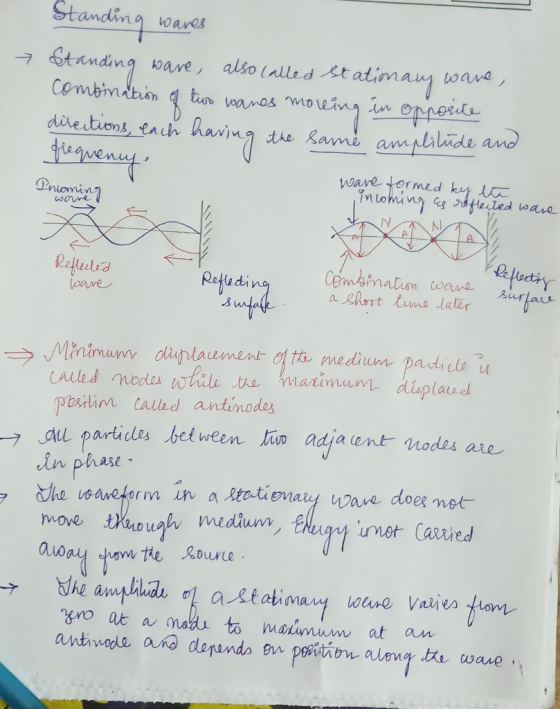
How can the standing wave have a velocity? A. It is the superposition of two traveling...
How can the standing wave have a velocity? A. It is the superposition of two traveling waves that have velocities. B. The standing wave is moving itself at a certain velocity. C. a standing wave can't have a velocity because it is standing D. a standing wave only consists of one traveling wave that is moving at a velocity
 no 1 and 2
Homework 3A: Standing Waves 1. Two waves propagate in one direction on a stretched rope. The frequency of the waves is 120 Hz. Both have the same amplitude of 4 cm and wavelength of 0.04 m. (a) Determine the amplitude of the resultant wave if the two original waves differ in phase by Tm/3? (b) What is the phase difference between the two waves if the amplitude of the resultant wave is 0.05 cm? 2. Two...
no 1 and 2
Homework 3A: Standing Waves 1. Two waves propagate in one direction on a stretched rope. The frequency of the waves is 120 Hz. Both have the same amplitude of 4 cm and wavelength of 0.04 m. (a) Determine the amplitude of the resultant wave if the two original waves differ in phase by Tm/3? (b) What is the phase difference between the two waves if the amplitude of the resultant wave is 0.05 cm? 2. Two...
 Two waves traveling on a string in the same direction both have a frequency of 125 Hz, a wavelength of 2 cm, and an amplitude of 0.06 m. What is the amplitude of the resultant wave if the original waves differ in phase by each of the following values? (a) */6 cm (b) / cm eBook
 7.1 When there are two traveling waves of the same wavelength and frequency (hence the same velocity) in phase: fA (x, t) A sin(kx- ot) fs (x, t) B sin(kx ot) then it's clear that the actual wave you observe is fa B fA (x, t)+ fs (x, t (A B) sin(kx-ot) due to superposition principle. Namely, you observe the same wave form, except now the amplitude is A+ B. Now consider there are two waves of the same wavelength...
 7. Consider two waves traveling in the same direction but with two slightly different angular frequencies ω- Δω and ω+ 2Δο. Let the fields have the same amplitude and polarization. a. Show the sum of the two waves is equivalent to a wave moving with a phase velocity vp-ωΚ but with an amplitude envelope which moves with a group velocity b. In the limit that Δω 0 the group velocity vg-do/dK. For waves traveling in a plasma we derived the...
 Two waves, yı = (2.9 mm) sin [(22.1 rad /m)x – (540 rad/s)t] and y2 = (1.3 mm) sin [(22.1 rad /m)x + (540 rad /s)] travel along a stretched string. (a) Find the resultant wave y = y1+ y2 as a function of t for x = 0 and 1/2 where is the wavelength. Omit units. (b) The resultant wave is the superposition of a standing wave and a traveling wave. In which direction does the traveling wave move?...
Most questions answered within 3 hours.
-
Where is the error in this code sequence?
String s1 = "Hello";
String s2 = "ello";...
asked 11 months ago -
Financial data for Joel de Paris, Inc., for last year
follow:
Joel de Paris, Inc.
Balance...
asked 11 months ago -
Consider this reaction:
Al2(SO4)3 (aq)+ BaCl3
(aq) Al2Cl6 (aq)- +
3BaSO4(s) . What is the...
asked 11 months ago -
Suppose that Savneet is considering increasing her
recent random sample from 20 car rentals to 40...
asked 11 months ago -
Trucks arrive at an unloading terminal at an average rate of 120
per hour.
Trucks arrive...
asked 11 months ago -
Why are methanol and ethanol completely soluble in water while
octanol is not very little soluble....
asked 11 months ago -
A facilities manager at a university reads in a research report
that the mean amount of...
asked 11 months ago -
When the CuSO4 is rehydrated by adding water to the anhydrous
compound, is this an endothermic...
asked 11 months ago -
A ray of sunlight is passing from diamond into crown glass; the
angle of incidence is...
asked 11 months ago -
A block of mass 0.249 kg is placed on top of a light, vertical
spring of...
asked 11 months ago -
how do the kidneys compensate in the presences of acidosis
a) trigger hyperventilate
b) reserve acid...
asked 11 months ago -
Question 501 pts
The rental rate of capital to the firm increases. Which of the
following...
asked 11 months ago