
Homework Answers

Add Answer to:
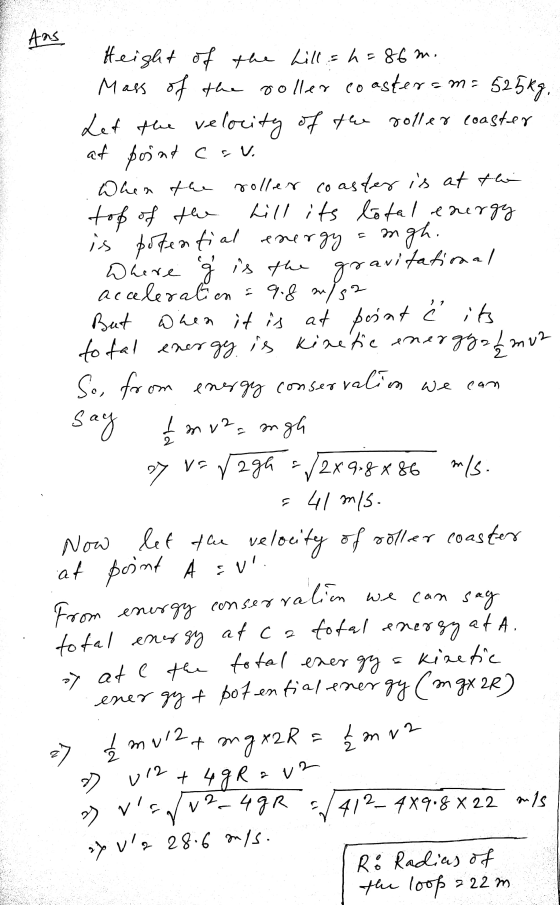
3. A roller coaster sits at the top of a hill and is preparing to enter...
I need help with problem 39 parts b,c,d Unit 7. Work and Energy In Class Packet...
 I need help with problem 39 parts b,c,d
Unit 7. Work and Energy In Class Packet Name: 36. A 2.45 kg rock is dropped from the top of a 15.5 m vertical cliff a. What is the potential energy of the rock relative to the base of the cliff before it is dropped? b. What is the kinetic energy of the rock just before it hits the ground below? c. What is the velocity of the rock at a point...
I need help with problem 39 parts b,c,d
Unit 7. Work and Energy In Class Packet Name: 36. A 2.45 kg rock is dropped from the top of a 15.5 m vertical cliff a. What is the potential energy of the rock relative to the base of the cliff before it is dropped? b. What is the kinetic energy of the rock just before it hits the ground below? c. What is the velocity of the rock at a point...
When a roller coaster went upside down at the top of a loop with a radius...
When a roller coaster went upside down at the top of a loop with a radius 8.0m, a speed of 11.2m/s was required to make the coaster feel safe. A. Assuming that air resistance and friction are negligible , what speed will the roller coaster have when it is right-side up at the bottom of the loop? B. The roller coaster begins its trip by being pulled up the lift hill by a chain lift and dropped after it reaches...
A 200-kg roller coaster reaches the top of the steepest hill with a speed of 6.20...
A 200-kg roller coaster reaches the top of the steepest hill with a speed of 6.20 km/h. It then descends the hill, which is at an angle of 20° and is 49.0 m long. What will its kinetic energy be when it reaches the bottom? Assume µk = 0.14.
A roller coaster reaches the top of the steepest hill with a speed of 6.00 km/h....
A roller coaster reaches the top of the steepest hill with a speed of 6.00 km/h. It then descends the hill, which is at an average angle of 25° and is 60.0 m long. What will its speed be when it reaches the bottom? Assume µk = 0.16.
A roller coaster reaches the top of the steepest hill with a speed of 6.1 km/h...
A roller coaster reaches the top of the steepest hill with a speed of 6.1 km/h . It then descends the hill, which is at an average angle of 41 ∘ and is 37.5 m long. Part A What will its speed be when it reaches the bottom? Assume μk = 0.18.
A 200-kg roller coaster reaches the top of the steepest hill with a speed of 5.60...
A 200-kg roller coaster reaches the top of the steepest hill with a speed of 5.60 km/h. It then descends the hill, which is at an angle of 25° and is 58.0 m long. What will its kinetic energy be when it reaches the bottom? Assume µk = 0.10. A boy pulls a 20.0-kg box with a 130-N force at 33° above a horizontal surface. If the coefficient of kinetic friction between the box and the horizontal surface is 0.29...
A roller coaster begins at rest at the top of a 38 m hill. Find the...
A roller coaster begins at rest at the top of a 38 m hill. Find the velocity at a point 8 m above the bottom of the hill. Hint: PE at point 1 = (KE+PE) at point 2
Problem 1: Looping. The looping of a roller coaster has the radius R. The roller coaster...
 Problem 1: Looping. The looping of a roller coaster has the radius R. The roller coaster starts at rest in height H over the deepest point of the looping (as shown in the figure). Neglect friction and consider the roller coaster as a mass point of mass m. Q.1) Express the total energy of the body. The reference point for the potential energy is at the center of the loop. Q.2) Find the speed of the body at the top...
1. A roller coaster has a 300 kg car. Assume the track is frictionless. a) The...
 1. A roller coaster has a 300 kg car. Assume the track is frictionless. a) The car starts at a speed 20 m/s on a horizontal track. It then goes through a circular loop. What is the speed of the car when it is at the top of the loop, h = 10 m above the horizontal track? b) What is the normal force applied from the track at the point? Does this force point upward or downward? Assume the...
Imagine a roller coaster that starts at the top of a big hill, and goes immediately...
Imagine a roller coaster that starts at the top of a big hill, and goes immediately into a loop-the-loop. If the mass of you and the cart is 50 kg, and the loop is 30 m tall, how high does the hill have to be so that you make it through the loop without falling off? Assume there is no friction. Be exact in your calculation.
 I need help with problem 39 parts b,c,d
Unit 7. Work and Energy In Class Packet Name: 36. A 2.45 kg rock is dropped from the top of a 15.5 m vertical cliff a. What is the potential energy of the rock relative to the base of the cliff before it is dropped? b. What is the kinetic energy of the rock just before it hits the ground below? c. What is the velocity of the rock at a point...
I need help with problem 39 parts b,c,d
Unit 7. Work and Energy In Class Packet Name: 36. A 2.45 kg rock is dropped from the top of a 15.5 m vertical cliff a. What is the potential energy of the rock relative to the base of the cliff before it is dropped? b. What is the kinetic energy of the rock just before it hits the ground below? c. What is the velocity of the rock at a point...
 Problem 1: Looping. The looping of a roller coaster has the radius R. The roller coaster starts at rest in height H over the deepest point of the looping (as shown in the figure). Neglect friction and consider the roller coaster as a mass point of mass m. Q.1) Express the total energy of the body. The reference point for the potential energy is at the center of the loop. Q.2) Find the speed of the body at the top...
 1. A roller coaster has a 300 kg car. Assume the track is frictionless. a) The car starts at a speed 20 m/s on a horizontal track. It then goes through a circular loop. What is the speed of the car when it is at the top of the loop, h = 10 m above the horizontal track? b) What is the normal force applied from the track at the point? Does this force point upward or downward? Assume the...
Most questions answered within 3 hours.
-
Where is the error in this code sequence?
String s1 = "Hello";
String s2 = "ello";...
asked 11 months ago -
Financial data for Joel de Paris, Inc., for last year
follow:
Joel de Paris, Inc.
Balance...
asked 11 months ago -
Consider this reaction:
Al2(SO4)3 (aq)+ BaCl3
(aq) Al2Cl6 (aq)- +
3BaSO4(s) . What is the...
asked 11 months ago -
Suppose that Savneet is considering increasing her
recent random sample from 20 car rentals to 40...
asked 11 months ago -
Trucks arrive at an unloading terminal at an average rate of 120
per hour.
Trucks arrive...
asked 11 months ago -
Why are methanol and ethanol completely soluble in water while
octanol is not very little soluble....
asked 11 months ago -
A facilities manager at a university reads in a research report
that the mean amount of...
asked 11 months ago -
When the CuSO4 is rehydrated by adding water to the anhydrous
compound, is this an endothermic...
asked 11 months ago -
A ray of sunlight is passing from diamond into crown glass; the
angle of incidence is...
asked 11 months ago -
A block of mass 0.249 kg is placed on top of a light, vertical
spring of...
asked 11 months ago -
how do the kidneys compensate in the presences of acidosis
a) trigger hyperventilate
b) reserve acid...
asked 11 months ago -
Question 501 pts
The rental rate of capital to the firm increases. Which of the
following...
asked 11 months ago