Consider the 65.0 kg ice skater being pushed by two others shown in the figure.
Consider the 65.0 kg ice skater being pushed by two others shown in the figure.
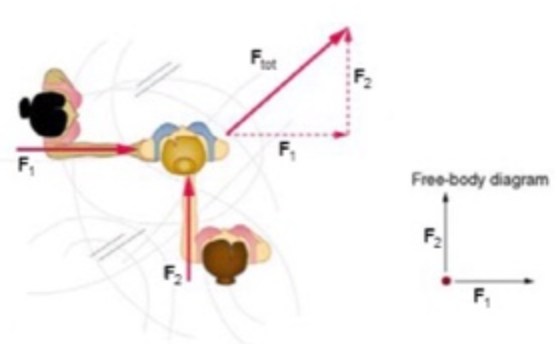
(a) Find the direction (in degrees) and magnitude (in N) of Ftot, the total force exerted on her by the others, given that the magnitudes F1 and F2 are 27.2 N and 18.2 N, respectively.
(b) What is her initial acceleration (in m/s2) if she is initially stationary and wearing steel-bladed skates that point in the direction of Ftot?
(c) What is her acceleration (in m/s2) assuming she is already moving in the direction of Ftot? Remember that friction is always in the opposite direction of motion or attempted motion between surfaces in contact.
Homework Answers
a) given that
forces F1 = 27.2 N
F2 = 18.2 N
magnitude F = sqrt(F1^2+F2^2)
F = sqrt(27.2^2+18.2^2)
F = 32.73 N
direction = tan^-1(18.2/27.2) = 33.79 degrees from the force F1
b) given mass m = 65 kg
Ftot-friction = ma
a = 1/m(32.73- *mg)
*mg)
= 0.04 for ice
surface
acceleration a = 1/65*(32.73-0.04*65*9.8)
a = 0.11 m/s^2
c) a = 1/65*(32.73-0.02*65*9.8)
a = 0.307 m/s^2
Add Answer to:
Consider the 65.0 kg ice skater being pushed by two others shown in the figure.
Consider the 65.0-kg ice skater being pushed by two others shown in the figure below. (a)...
 Consider the 65.0-kg ice skater being pushed by two others shown in the figure below. (a) Find the direction (in degrees counterclockwise from the +x-axis) and magnitude (in N) of Ftot the total force exerted on her by the others, given that the magnitudes F, and F, are 28.0 N and 15.4 N, respectively. (Assume F, points in the positive x direction.) magnitude 31.956 N direction 28.81 counterclockwise from the +x-axis (b) What is her initial acceleration in m/s2) if...
Answer part C and D please. Part C is not 0 and Part D is NOT...
 Answer part C and D please. Part C is not 0 and Part D is NOT
4.4 as answers
( %) figure. The coefficient of static friction is AnOA and kinetic is ?-002. 7 Problem 4: Consider the 67 kg ice skater being pushed by two others shown in the Randomized Variables m = 67 kg F1- 236 N F2- 173 N nt Status ere for d view Ctheespertta.com Status des F1 and F, are 236 Nad/73 N. Completed Completed...
Answer part C and D please. Part C is not 0 and Part D is NOT
4.4 as answers
( %) figure. The coefficient of static friction is AnOA and kinetic is ?-002. 7 Problem 4: Consider the 67 kg ice skater being pushed by two others shown in the Randomized Variables m = 67 kg F1- 236 N F2- 173 N nt Status ere for d view Ctheespertta.com Status des F1 and F, are 236 Nad/73 N. Completed Completed...
please do as many as you can please thanks alot VU22475 Apply Scientific Principles to Engineering...
 please do as many as you can
please
thanks alot
VU22475 Apply Scientific Principles to Engineering Problems Calculate the maximum deceleration of a car that is heading down a 8 slope (one that makes an angle of 8 with the horizontal). You may assume that the weight of the car is evenly distributed on all four tires and that the coefficient of static friction is involved - that is, the tires are not allowed to slip during the deceleration. The...
please do as many as you can
please
thanks alot
VU22475 Apply Scientific Principles to Engineering Problems Calculate the maximum deceleration of a car that is heading down a 8 slope (one that makes an angle of 8 with the horizontal). You may assume that the weight of the car is evenly distributed on all four tires and that the coefficient of static friction is involved - that is, the tires are not allowed to slip during the deceleration. The...
QUESTION 1: A 54.0-kg ice skater is moving at 4.10 m/s when she grabs the loose...
QUESTION 1: A 54.0-kg ice skater is moving at 4.10 m/s when she grabs the loose end of a rope, the opposite end of which is tied to a pole. She then moves in a circle of radius 0.820 m around the pole. (a) Determine the magnitude of the force exerted by the horizontal rope on her arms. kN (b) Compare this force with her weight. Frope W QUESTION 2: Human centrifuges are used to train military pilots and astronauts...
A 54.4 kg ice skater is moving at 3.95 m/s when she grabs the loose end...
A 54.4 kg ice skater is moving at 3.95 m/s when she grabs the loose end of a rope, the opposite end of which is tied to a pole. She then moves in a circle of radius 0.790 m around the pole. (a) Determine the force exerted by the horizontal rope on her arms. N (b) Compare this force with her weight by finding the ratio of the force to her weight.
In Example 5.7, we pushed on two blocks on a table. Suppose three blocks are in...
 In Example 5.7, we pushed on two blocks on a table. Suppose three blocks are in contact with one another on a frictionless, horizontal surface as shown in the figure below. A horizontal force F is applied to m. Take m1 -2.00 kg, m2-3.00 kg, m3 5.20 kg, and F 25.0 N (a) Draw a separate free-body diagram for each block. (b) Determine the acceleration of the blocks. magnitude direction-Select m/s2 to the right to the left (c) Find the...
Consider a bar, of length 5.5 m, shown in the figure, being acted on by three forces. The magnitudes of the first two forces are 16 N and 29 N
 Consider a bar, of length 5.5 m, shown in the figure, being acted on by three forces. The magnitudes of the first two forces are 16 N and 29 N, and the first force is acting on the end of the bar at an angle of 29° as shown. Part (a) What is the torque, in newton-meters, due to F1 on this bar relative to the left end? Use a coordinate system with positive directed out of the screen. Part (b) What...
Consider a bar, of length 3.5 m, shown in the figure, being acted on by three forces. The magnitudes of the first two forces are 16 N and 24 N, and the first force is acting on the end of the bar at an angle of 49° as shown.
 Consider a bar, of length 3.5 m, shown in the figure, being acted on by three forces. The magnitudes of the first two forces are 16 N and 24 N, and the first force is acting on the end of the bar at an angle of 49° as shown. Part (a) What is the torque, in newton-meters, due to F1 on this bar relative to the left end? Use a coordinate system with positive directed out of the screen. Part (b) What...
Consider a bar, of length 4.5 m, shown in the figure, being acted on by three forces. The magnitudes of the first two forces are 22 N and 35 N, and the first force is acting on the end of the bar at an angle of 28° as shown.
 Consider a bar, of length 4.5 m, shown in the figure, being acted on by three forces. The magnitudes of the first two forces are 22 N and 35 N, and the first force is acting on the end of the bar at an angle of 28° as shown. Part (a) What is the torque, in newton-meters, due to F1 on this bar relative to the left end? Use a coordinate system with positive directed out of the screen. Part (b) What is the torque, in...
Renee is on Spring Break and pulling her 21-kg suitcase through the airport at a constant...
Renee is on Spring Break and pulling her 21-kg suitcase through the airport at a constant speed of 0.47 m/s. She pulls on the strap with 120 N of force at an angle of 38° above the horizontal. Assume the ground to be flat, Draw a FBD showing the forces on the suitcase. Find the acceleration of the suitcase. Determine the normal force experienced by the suitcase. Determine the total resistive force (friction) experienced by the suitcase. Find the coefficient...
 Consider the 65.0-kg ice skater being pushed by two others shown in the figure below. (a) Find the direction (in degrees counterclockwise from the +x-axis) and magnitude (in N) of Ftot the total force exerted on her by the others, given that the magnitudes F, and F, are 28.0 N and 15.4 N, respectively. (Assume F, points in the positive x direction.) magnitude 31.956 N direction 28.81 counterclockwise from the +x-axis (b) What is her initial acceleration in m/s2) if...
 Answer part C and D please. Part C is not 0 and Part D is NOT
4.4 as answers
( %) figure. The coefficient of static friction is AnOA and kinetic is ?-002. 7 Problem 4: Consider the 67 kg ice skater being pushed by two others shown in the Randomized Variables m = 67 kg F1- 236 N F2- 173 N nt Status ere for d view Ctheespertta.com Status des F1 and F, are 236 Nad/73 N. Completed Completed...
Answer part C and D please. Part C is not 0 and Part D is NOT
4.4 as answers
( %) figure. The coefficient of static friction is AnOA and kinetic is ?-002. 7 Problem 4: Consider the 67 kg ice skater being pushed by two others shown in the Randomized Variables m = 67 kg F1- 236 N F2- 173 N nt Status ere for d view Ctheespertta.com Status des F1 and F, are 236 Nad/73 N. Completed Completed...
 please do as many as you can
please
thanks alot
VU22475 Apply Scientific Principles to Engineering Problems Calculate the maximum deceleration of a car that is heading down a 8 slope (one that makes an angle of 8 with the horizontal). You may assume that the weight of the car is evenly distributed on all four tires and that the coefficient of static friction is involved - that is, the tires are not allowed to slip during the deceleration. The...
please do as many as you can
please
thanks alot
VU22475 Apply Scientific Principles to Engineering Problems Calculate the maximum deceleration of a car that is heading down a 8 slope (one that makes an angle of 8 with the horizontal). You may assume that the weight of the car is evenly distributed on all four tires and that the coefficient of static friction is involved - that is, the tires are not allowed to slip during the deceleration. The...
 In Example 5.7, we pushed on two blocks on a table. Suppose three blocks are in contact with one another on a frictionless, horizontal surface as shown in the figure below. A horizontal force F is applied to m. Take m1 -2.00 kg, m2-3.00 kg, m3 5.20 kg, and F 25.0 N (a) Draw a separate free-body diagram for each block. (b) Determine the acceleration of the blocks. magnitude direction-Select m/s2 to the right to the left (c) Find the...
Most questions answered within 3 hours.
-
Where is the error in this code sequence?
String s1 = "Hello";
String s2 = "ello";...
asked 10 months ago -
Financial data for Joel de Paris, Inc., for last year
follow:
Joel de Paris, Inc.
Balance...
asked 10 months ago -
Consider this reaction:
Al2(SO4)3 (aq)+ BaCl3
(aq) Al2Cl6 (aq)- +
3BaSO4(s) . What is the...
asked 10 months ago -
Suppose that Savneet is considering increasing her
recent random sample from 20 car rentals to 40...
asked 10 months ago -
Trucks arrive at an unloading terminal at an average rate of 120
per hour.
Trucks arrive...
asked 10 months ago -
Why are methanol and ethanol completely soluble in water while
octanol is not very little soluble....
asked 10 months ago -
A facilities manager at a university reads in a research report
that the mean amount of...
asked 10 months ago -
When the CuSO4 is rehydrated by adding water to the anhydrous
compound, is this an endothermic...
asked 10 months ago -
A ray of sunlight is passing from diamond into crown glass; the
angle of incidence is...
asked 10 months ago -
A block of mass 0.249 kg is placed on top of a light, vertical
spring of...
asked 10 months ago -
how do the kidneys compensate in the presences of acidosis
a) trigger hyperventilate
b) reserve acid...
asked 10 months ago -
Question 501 pts
The rental rate of capital to the firm increases. Which of the
following...
asked 10 months ago