
Homework Answers
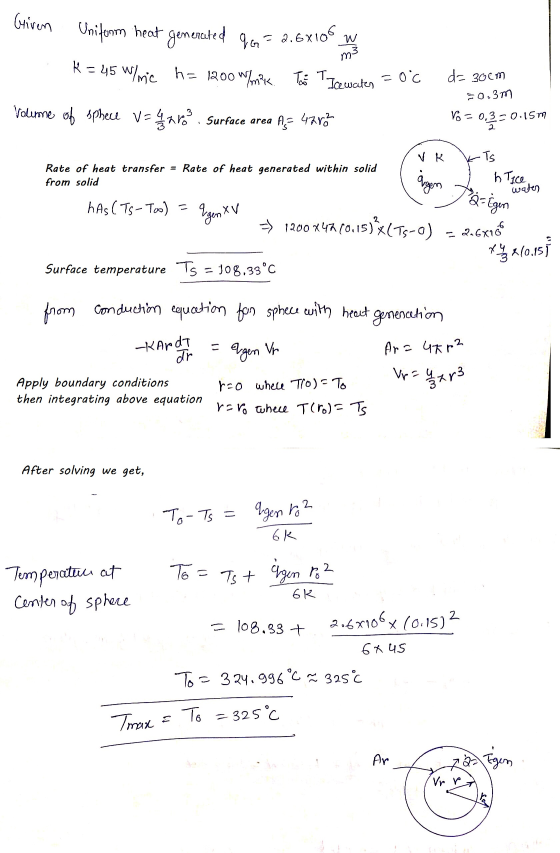
In this question we have to find the maximum temperature at center of sphere
Add Answer to:
2. Nered A spherical ball in which heat is generated uniformly (96=2.6 x10 W/m) is exposed...
H8-1: An 8-m-internal-diameter spherical tank made of 1.5-cm-thick stainless steel (k-15 W/m K) i...
 H8-1: An 8-m-internal-diameter spherical tank made of 1.5-cm-thick stainless steel (k-15 W/m K) is used to store iced water at 0°C. The tank is located in a room whose temperature is 25°C. The convection heat transfer coefficients at the inner and the outer surfaces of the tank are 80 W/m2 K and 10 W/m2 K, respectively. Radiatior heat transfer is negligible. Determine the rate of heat transfer to the iced water in the tank. room 25°0c T. Iced water 0...
2 ICED WATER IN A SPHERICAL CONTAINER (10 POINTS) Troom = 30°C Iced water O ,...
 2 ICED WATER IN A SPHERICAL CONTAINER (10 POINTS) Troom = 30°C Iced water O , D; = 5 m 1.5 cm T = 0°C A 5-m-internal-diameter spherical tank made of 1.5-cm-thick stainless steel (k = 15 W/( m K )) is used to store iced water at 0°C. The tank is located in a room whose temperature is 30°C. The walls of the room are also at 30°C. Heat transfer between the outer surface of the tank and the...
1. Heat is generated at a uniform steady rate in a long solid cylinder. The cylinder...
 1. Heat is generated at a uniform steady rate in a long solid cylinder. The cylinder loses heat from its exposed surface to surroundings at constant temperature. Show that the radial temperature profile in the cylinder can be represented by the equation: T, = Twer - 9 4k where qy is the rate of heat generation per unit volume and Tur is the maximum temperature in the profile. [30%] In a long solid cylinder of 40mm diameter heat is generated...
Heat is uniformly generated at the rate of 2x 10W/m* in a wall of thermal conductivity...
 Heat is uniformly generated at the rate of 2x 10W/m* in a wall of thermal conductivity 25 W/m-K and thickness 60 mm. The wall is exposed to convection on both sides, with different heat transfer coefficients and temperatures as shown. There are straight rectangular fins on the right-hand side of the wall, with dimensions as shown (L =20 mm) and thermal conductivity of 250 W/m-K. What is the maximum temperature that will occur in the wall? L tt-2 mm k=25...
(Chap 3- Heat conduction in cylinders and spheres) An 8-m-internal diameter spherical tank made of 1.5-cm-thick...
 (Chap 3- Heat conduction in cylinders and spheres) An 8-m-internal diameter spherical tank made of 1.5-cm-thick stainless steel (k = 15W/m-K) is used to store iced water at 0°C. The tank is located in a room whose temperature is 25°C. The walls of the room are also at 25°C. The outer surface of the tank is black (emissivity1), and heat transfer between the outer surface of the tank and the surroundings is by natural convection and radiation. The convection heat...
2-157 A long electrical resistance wire of radius r.-0.25 cm has a thermal conductivity kwire-15 W/m-K. Heat is gene...
 2-157 A long electrical resistance wire of radius r.-0.25 cm has a thermal conductivity kwire-15 W/m-K. Heat is generated uniformly in the wire as a result of resistance heating at a constant rate of 0.5 W/cm3. The wire is covered with polyethylene insulation with a thickness of 0.25 cm and thermal conductivity of ks 0.4 W/m K. The outer surface of the insulation is subjected to free convection in air at 20°C and a convection heat transfer coefficient of 2...
Problem 4: Consider the heat exchanger design illustrated. Hot air flows at speed of r0.6 m/s thr...
 Problem 4: Consider the heat exchanger design illustrated. Hot air flows at speed of r0.6 m/s through the center pipe. The center pipe has an outer diameter of D=7 cm and length 4-2 m Cold water flows at 20-25 cm3/s through a smaller helical pipe having an outer diameter d = 1 cm and wall thickness of mm. The helical pipe is wrapped around the center pipe to form a heat exchanger. The center pipe has a thermal conductivity of...
pts.) Consider a long resistance wire of radius ri-1.5 cm and thermal conductivity m'к in which...
 pts.) Consider a long resistance wire of radius ri-1.5 cm and thermal conductivity m'к in which heat is generated uniformly as a result of resistance heating at a e wire is embedded in a 1.0-cm-thick layer of ceramic whose thermal bTeam. W/m K. If the outer surface temperature of the ceramic layer is nstant rate. The nductivity is keramic-1.5 to be T,-45°C and the maximum temperature at the center is 375°C. Determine the ar generated per unit volume in (W/em)...
the hand written must be clear. Thank you Problem X2-6, Heat Transfer, Spring 2018 Heat is...
 the hand written must be clear.
Thank you
Problem X2-6, Heat Transfer, Spring 2018 Heat is being generated uniformly throughout a sphere at volumetric rate i. The radius of the sphere is R and the sphere is made of a material having thermal conductivity k . The temperature at the surface of the sphere is Assume one- dimensional steady conduction in the radial direction and do the following: a) Use the equation (2.14 b) for in spherical coordinates and the...
the hand written must be clear.
Thank you
Problem X2-6, Heat Transfer, Spring 2018 Heat is being generated uniformly throughout a sphere at volumetric rate i. The radius of the sphere is R and the sphere is made of a material having thermal conductivity k . The temperature at the surface of the sphere is Assume one- dimensional steady conduction in the radial direction and do the following: a) Use the equation (2.14 b) for in spherical coordinates and the...
Problem 2: A hot metal ball 0.00245 W/m°C; α-0151* 10-s m2/s; d 18 cm) initially at...
 Problem 2: A hot metal ball 0.00245 W/m°C; α-0151* 10-s m2/s; d 18 cm) initially at a unifom temperature of 310°C is cooled by placing it in air at 29 C is flowing at a constant 4 m/s. In order to continue on in the manufacturing process, the temperature at the center of the ball must be 70°C. (μ. = 1.872*10-5 kg m-s). The air You mav assume that the properties of air may bem odeled as V = 1.608...
 H8-1: An 8-m-internal-diameter spherical tank made of 1.5-cm-thick stainless steel (k-15 W/m K) is used to store iced water at 0°C. The tank is located in a room whose temperature is 25°C. The convection heat transfer coefficients at the inner and the outer surfaces of the tank are 80 W/m2 K and 10 W/m2 K, respectively. Radiatior heat transfer is negligible. Determine the rate of heat transfer to the iced water in the tank. room 25°0c T. Iced water 0...
 2 ICED WATER IN A SPHERICAL CONTAINER (10 POINTS) Troom = 30°C Iced water O , D; = 5 m 1.5 cm T = 0°C A 5-m-internal-diameter spherical tank made of 1.5-cm-thick stainless steel (k = 15 W/( m K )) is used to store iced water at 0°C. The tank is located in a room whose temperature is 30°C. The walls of the room are also at 30°C. Heat transfer between the outer surface of the tank and the...
 1. Heat is generated at a uniform steady rate in a long solid cylinder. The cylinder loses heat from its exposed surface to surroundings at constant temperature. Show that the radial temperature profile in the cylinder can be represented by the equation: T, = Twer - 9 4k where qy is the rate of heat generation per unit volume and Tur is the maximum temperature in the profile. [30%] In a long solid cylinder of 40mm diameter heat is generated...
 Heat is uniformly generated at the rate of 2x 10W/m* in a wall of thermal conductivity 25 W/m-K and thickness 60 mm. The wall is exposed to convection on both sides, with different heat transfer coefficients and temperatures as shown. There are straight rectangular fins on the right-hand side of the wall, with dimensions as shown (L =20 mm) and thermal conductivity of 250 W/m-K. What is the maximum temperature that will occur in the wall? L tt-2 mm k=25...
 (Chap 3- Heat conduction in cylinders and spheres) An 8-m-internal diameter spherical tank made of 1.5-cm-thick stainless steel (k = 15W/m-K) is used to store iced water at 0°C. The tank is located in a room whose temperature is 25°C. The walls of the room are also at 25°C. The outer surface of the tank is black (emissivity1), and heat transfer between the outer surface of the tank and the surroundings is by natural convection and radiation. The convection heat...
 2-157 A long electrical resistance wire of radius r.-0.25 cm has a thermal conductivity kwire-15 W/m-K. Heat is generated uniformly in the wire as a result of resistance heating at a constant rate of 0.5 W/cm3. The wire is covered with polyethylene insulation with a thickness of 0.25 cm and thermal conductivity of ks 0.4 W/m K. The outer surface of the insulation is subjected to free convection in air at 20°C and a convection heat transfer coefficient of 2...
 Problem 4: Consider the heat exchanger design illustrated. Hot air flows at speed of r0.6 m/s through the center pipe. The center pipe has an outer diameter of D=7 cm and length 4-2 m Cold water flows at 20-25 cm3/s through a smaller helical pipe having an outer diameter d = 1 cm and wall thickness of mm. The helical pipe is wrapped around the center pipe to form a heat exchanger. The center pipe has a thermal conductivity of...
 pts.) Consider a long resistance wire of radius ri-1.5 cm and thermal conductivity m'к in which heat is generated uniformly as a result of resistance heating at a e wire is embedded in a 1.0-cm-thick layer of ceramic whose thermal bTeam. W/m K. If the outer surface temperature of the ceramic layer is nstant rate. The nductivity is keramic-1.5 to be T,-45°C and the maximum temperature at the center is 375°C. Determine the ar generated per unit volume in (W/em)...
 the hand written must be clear.
Thank you
Problem X2-6, Heat Transfer, Spring 2018 Heat is being generated uniformly throughout a sphere at volumetric rate i. The radius of the sphere is R and the sphere is made of a material having thermal conductivity k . The temperature at the surface of the sphere is Assume one- dimensional steady conduction in the radial direction and do the following: a) Use the equation (2.14 b) for in spherical coordinates and the...
the hand written must be clear.
Thank you
Problem X2-6, Heat Transfer, Spring 2018 Heat is being generated uniformly throughout a sphere at volumetric rate i. The radius of the sphere is R and the sphere is made of a material having thermal conductivity k . The temperature at the surface of the sphere is Assume one- dimensional steady conduction in the radial direction and do the following: a) Use the equation (2.14 b) for in spherical coordinates and the...
 Problem 2: A hot metal ball 0.00245 W/m°C; α-0151* 10-s m2/s; d 18 cm) initially at a unifom temperature of 310°C is cooled by placing it in air at 29 C is flowing at a constant 4 m/s. In order to continue on in the manufacturing process, the temperature at the center of the ball must be 70°C. (μ. = 1.872*10-5 kg m-s). The air You mav assume that the properties of air may bem odeled as V = 1.608...
Most questions answered within 3 hours.
-
Where is the error in this code sequence?
String s1 = "Hello";
String s2 = "ello";...
asked 11 months ago -
Financial data for Joel de Paris, Inc., for last year
follow:
Joel de Paris, Inc.
Balance...
asked 11 months ago -
Consider this reaction:
Al2(SO4)3 (aq)+ BaCl3
(aq) Al2Cl6 (aq)- +
3BaSO4(s) . What is the...
asked 11 months ago -
Suppose that Savneet is considering increasing her
recent random sample from 20 car rentals to 40...
asked 11 months ago -
Trucks arrive at an unloading terminal at an average rate of 120
per hour.
Trucks arrive...
asked 11 months ago -
Why are methanol and ethanol completely soluble in water while
octanol is not very little soluble....
asked 11 months ago -
A facilities manager at a university reads in a research report
that the mean amount of...
asked 11 months ago -
When the CuSO4 is rehydrated by adding water to the anhydrous
compound, is this an endothermic...
asked 11 months ago -
A ray of sunlight is passing from diamond into crown glass; the
angle of incidence is...
asked 11 months ago -
A block of mass 0.249 kg is placed on top of a light, vertical
spring of...
asked 11 months ago -
how do the kidneys compensate in the presences of acidosis
a) trigger hyperventilate
b) reserve acid...
asked 11 months ago -
Question 501 pts
The rental rate of capital to the firm increases. Which of the
following...
asked 11 months ago