![(b) Consider the following algorithm for (i = n; i >-1; i i/2) for j in range [1, i] Constant Number of Operations Derive the run time of the above algorithm (as a function of n). You must formally derive the run-times (merely stating run times or high level explanation of run time do not suffice)](http://img.homeworklib.com/questions/49371060-346c-11eb-81d8-a1086fb10e9b.png?x-oss-process=image/resize,w_560)
Homework Answers
Hi, Please find my answer.
Please let me know in case of any issue.

Add Answer to:
(b) Consider the following algorithm for (i = n; i >-1; i i/2) for j in...
consider this segment of an algorithm: for i := 1 ton n for j:=1 to n...
consider this segment of an algorithm: for i := 1 ton n for j:=1 to n top:=ij+j+10 a. find a function f(n) that counts the number of multiplication and additions performed in this segment. b. Give a big O estimate for the number of additions and multiplications used in the segment
Algorithm Analysis: Study the following sorting algorithm. SORT( A[1...n]) bound <- Length(A) -1 for i...
Algorithm Analysis: Study the following sorting algorithm. SORT( A[1...n]) bound <- Length(A) -1 for i <- 1 to Length(A) newbound <- 0 for j <- 0 to bound if A[j] > A[j + 1] swap( A[j], A[j + 1] ) newbound = j -1 bound <- newbound (a) Use the longer approach described in lecture 3 week 1 that we used in analyzing Insertion-Sort to compute the running time T(n) of the above SORT algorithm. You may...
Consider the following algorithm. ALGORITHM Enigma(A[0.n - 1]) //Input: An array A[0.n - 1] of integer...
 Consider the following algorithm. ALGORITHM Enigma(A[0.n - 1]) //Input: An array A[0.n - 1] of integer numbers for i leftarrow 0 to n - 2 do for j leftarrow i +1 to n - 1 do if A[i] = = A[j] return false return true a) What does this algorithm do? b) Compute the running time of this algorithm.
Analyze the running time of the following algorithms asymptotically. (a) Algorithm for-loop(n): P = 1 for...
 Analyze the running time of the following algorithms asymptotically. (a) Algorithm for-loop(n): P = 1 for i = 1 to 5n^2 do p = p times i return p (b) Algorithm for-loop(n): s = 0 for i = 1 to n do for j = I to n do s = s + i return s (c) Algorithm WhileLoop(n): x = 0; j = 2; while (j = n){x = x+ 1; j =j times 2;}
Consider the following pseudocode: Algorithm RecursiveFunction (a, b) // a and b are integers if (as1...
 Consider the following pseudocode: Algorithm RecursiveFunction (a, b) // a and b are integers if (as1 ) return b; else return RecursiveFunction (a-2, a/2); endif a. What is the time complexity of the RecursiveFunction pseudocode shown above? b What is the space complexity of the RecursiveFunction pseudocode shown above? n(n+1) C. What is the time complexity of the following algorithm (Note that 21-, i = n(n+1)(2n+1). and Σ.,1 ): Provide both T(n) and order, Ofn)). int A=0; for (int i=0;i<n;i++)...
1. Suppose that d ≥ 2 is an integer constant. In a d-ary tree, each node...
1. Suppose that d ≥ 2 is an integer constant. In a d-ary tree, each node has at most d nonempty subtrees. For example, the trees discussed along with heaps had d = 2. We can represent a nearly complete d-ary tree with n nodes using an array whose indexes range from 0 to n−1. (This is different from Cormen’s arrays, whose indexes range from 1 to n.) Suppose that i is the index of a node in the...
Question No.1 [CLO 1][7 marks] 1. Consider the following pseudocode: Algorithm IterativeFunction (a, b) // a...
 Question No.1 [CLO 1][7 marks] 1. Consider the following pseudocode: Algorithm IterativeFunction (a, b) // a and b are integers while (a>0) B- a/2 A a-2 end while return b; i. What is the time complexity of the IterativeFunction pseudocode shown above? ii. What is the space complexity of the IterativeFunction pseudocode shown above? 2. What is the time complexity of the following algorithm (Note that n(n+1) 2,2 n(n+1)(2n+1) 2 and ): Provide both T(n) and order, e(f(n)). int A=0;...
fundamental algorithm AllLessThan1 (int C A, B) return bool for (i-1 to |AI) for (j-1 to B if (A[1] >=B[j]) ret...
 fundamental algorithm
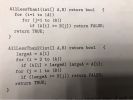
AllLessThan1 (int C A, B) return bool for (i-1 to |AI) for (j-1 to B if (A[1] >=B[j]) return FALSE ; return TRUE; AllLessThan2 (int[] A,B) return bool largeAA[1] for (i 2 to |AI) if (A[i] > largeA) largeA A[i]; for (j = 1 to IBD if (largeA >= B[j]) return FALSE; return TRUE; C. For any particular arrays A, B, let ti(A, B) and t2(A, B) be the running times of the two algo- rithms for inputs...
fundamental algorithm
AllLessThan1 (int C A, B) return bool for (i-1 to |AI) for (j-1 to B if (A[1] >=B[j]) return FALSE ; return TRUE; AllLessThan2 (int[] A,B) return bool largeAA[1] for (i 2 to |AI) if (A[i] > largeA) largeA A[i]; for (j = 1 to IBD if (largeA >= B[j]) return FALSE; return TRUE; C. For any particular arrays A, B, let ti(A, B) and t2(A, B) be the running times of the two algo- rithms for inputs...
(V). Given the following algorithm, answer relevant questions. Algorithm 1 An algorithm 1: procedure WHATISTHIS(21,22,...,n: a...
 (V). Given the following algorithm, answer relevant questions. Algorithm 1 An algorithm 1: procedure WHATISTHIS(21,22,...,n: a list of n integers) for i = 2 to n do c= j=i-1 while (j > 0) do if ra; then break end if 4j+1 = a; j= j-1 end while j+1 = 1 end for 14: return 0.02. 1, 15: end procedure Answer the following questions: (1) Run the algorithm with input (41, 02, 03, 04) = (3, 0, 1,6). Record the values...
Given the following code, find their big(O) for I in range of n: for j...
Given the following code, find their big(O) for I in range of n: for j in range of n: for k in range of 10000: print(“test”) If an algorithm takes n3+1000n2+1000n2+9999 time, what is the Big O for this algorithm? Proof: O(nK) < O (2n), need to do some research on polynomial time and exponential time.
 Consider the following algorithm. ALGORITHM Enigma(A[0.n - 1]) //Input: An array A[0.n - 1] of integer numbers for i leftarrow 0 to n - 2 do for j leftarrow i +1 to n - 1 do if A[i] = = A[j] return false return true a) What does this algorithm do? b) Compute the running time of this algorithm.
 Analyze the running time of the following algorithms asymptotically. (a) Algorithm for-loop(n): P = 1 for i = 1 to 5n^2 do p = p times i return p (b) Algorithm for-loop(n): s = 0 for i = 1 to n do for j = I to n do s = s + i return s (c) Algorithm WhileLoop(n): x = 0; j = 2; while (j = n){x = x+ 1; j =j times 2;}
 Consider the following pseudocode: Algorithm RecursiveFunction (a, b) // a and b are integers if (as1 ) return b; else return RecursiveFunction (a-2, a/2); endif a. What is the time complexity of the RecursiveFunction pseudocode shown above? b What is the space complexity of the RecursiveFunction pseudocode shown above? n(n+1) C. What is the time complexity of the following algorithm (Note that 21-, i = n(n+1)(2n+1). and Σ.,1 ): Provide both T(n) and order, Ofn)). int A=0; for (int i=0;i<n;i++)...
 Question No.1 [CLO 1][7 marks] 1. Consider the following pseudocode: Algorithm IterativeFunction (a, b) // a and b are integers while (a>0) B- a/2 A a-2 end while return b; i. What is the time complexity of the IterativeFunction pseudocode shown above? ii. What is the space complexity of the IterativeFunction pseudocode shown above? 2. What is the time complexity of the following algorithm (Note that n(n+1) 2,2 n(n+1)(2n+1) 2 and ): Provide both T(n) and order, e(f(n)). int A=0;...
 fundamental algorithm
AllLessThan1 (int C A, B) return bool for (i-1 to |AI) for (j-1 to B if (A[1] >=B[j]) return FALSE ; return TRUE; AllLessThan2 (int[] A,B) return bool largeAA[1] for (i 2 to |AI) if (A[i] > largeA) largeA A[i]; for (j = 1 to IBD if (largeA >= B[j]) return FALSE; return TRUE; C. For any particular arrays A, B, let ti(A, B) and t2(A, B) be the running times of the two algo- rithms for inputs...
fundamental algorithm
AllLessThan1 (int C A, B) return bool for (i-1 to |AI) for (j-1 to B if (A[1] >=B[j]) return FALSE ; return TRUE; AllLessThan2 (int[] A,B) return bool largeAA[1] for (i 2 to |AI) if (A[i] > largeA) largeA A[i]; for (j = 1 to IBD if (largeA >= B[j]) return FALSE; return TRUE; C. For any particular arrays A, B, let ti(A, B) and t2(A, B) be the running times of the two algo- rithms for inputs...
 (V). Given the following algorithm, answer relevant questions. Algorithm 1 An algorithm 1: procedure WHATISTHIS(21,22,...,n: a list of n integers) for i = 2 to n do c= j=i-1 while (j > 0) do if ra; then break end if 4j+1 = a; j= j-1 end while j+1 = 1 end for 14: return 0.02. 1, 15: end procedure Answer the following questions: (1) Run the algorithm with input (41, 02, 03, 04) = (3, 0, 1,6). Record the values...
Most questions answered within 3 hours.
-
Where is the error in this code sequence?
String s1 = "Hello";
String s2 = "ello";...
asked 11 months ago -
Financial data for Joel de Paris, Inc., for last year
follow:
Joel de Paris, Inc.
Balance...
asked 11 months ago -
Consider this reaction:
Al2(SO4)3 (aq)+ BaCl3
(aq) Al2Cl6 (aq)- +
3BaSO4(s) . What is the...
asked 11 months ago -
Suppose that Savneet is considering increasing her
recent random sample from 20 car rentals to 40...
asked 11 months ago -
Trucks arrive at an unloading terminal at an average rate of 120
per hour.
Trucks arrive...
asked 11 months ago -
Why are methanol and ethanol completely soluble in water while
octanol is not very little soluble....
asked 11 months ago -
A facilities manager at a university reads in a research report
that the mean amount of...
asked 11 months ago -
When the CuSO4 is rehydrated by adding water to the anhydrous
compound, is this an endothermic...
asked 11 months ago -
A ray of sunlight is passing from diamond into crown glass; the
angle of incidence is...
asked 11 months ago -
A block of mass 0.249 kg is placed on top of a light, vertical
spring of...
asked 11 months ago -
how do the kidneys compensate in the presences of acidosis
a) trigger hyperventilate
b) reserve acid...
asked 11 months ago -
Question 501 pts
The rental rate of capital to the firm increases. Which of the
following...
asked 11 months ago