Important Info: Ka reaction: HC2H3O2(aq) + H2O(l) <-->C2H3O2 (aq) +H3O+(aq) HC2H3O(aq) +OH-(aq) -> C2H3O2-(aq) + H2O...
Important Info:
Ka reaction: HC2H3O2(aq) + H2O(l) <-->C2H3O2 (aq) +H3O+(aq)
HC2H3O(aq) +OH-(aq) -> C2H3O2-(aq) + H2O (l)
A 1.0 L buffer solution is 0.280 M in HC2H302 (acetic acid) and 0.320 M in NaC2H302 (sodium acetate). Calculate the pH of the budder and he Ka for HC2H3O2 IS 1.8 X 10⁻⁵
Calculate the pH of te solution above after the addition of 0.0400 moles of solid NaOH. Assume no volume change upon the addition of base.
Homework Answers
Request Answer!
We need at least 10 more requests to produce the answer.
0 / 10 have requested this problem solution
The more requests, the faster the answer.
Add Answer to:
Important Info:
Ka reaction: HC2H3O2(aq) +
H2O(l) <-->C2H3O2
(aq) +H3O+(aq)
HC2H3O(aq)
+OH-(aq) ->
C2H3O2-(aq)
+ H2O...
CHEM 1151K Make-up HW 3 22. What is the pH of a buffer prepared with 1.0...
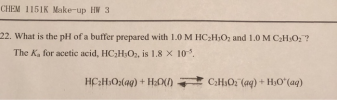 CHEM 1151K Make-up HW 3 22. What is the pH of a buffer prepared with 1.0 M HC2H302 and 1.0 M C2H3O2? The Ka for acetic acid, HC2H3O2, is 1.8 × 10⁻⁵. HC2H3O2(aq) + H2O(/) CHAD-(aq) + H3O+(aq)
Now, for a complete equilibrium problem Consider the following general reaction: HC2H3O2 (aq) + H2O (l) ⇌...
Now, for a complete equilibrium problem Consider the following general reaction: HC2H3O2 (aq) + H2O (l) ⇌ H3O+ (aq) + C2H3O2–(aq) Kc = 1.8 x 10⁻⁵ (at 25 ºC) If a solution initially contains (7.9x10^-1) M of HC2H3O2, (and no H3O+ or C2H3O2– ), what is the equilibrium concentration of H3O+ (aq) in the mixture? In the appropriate blanks, provide the equilibrium [H3O+ (aq)], in the solution, in M, to two significant figures and to the appropriate power
HC2H3O2(aq) + H2O() C2H3O2-(aq) + H3O+(aq) In the example equilibrium system, a drop of methyl orange...
 HC2H3O2(aq) +
H2O()
C2H3O2-(aq) +
H3O+(aq)
In the example equilibrium system, a drop of methyl orange indicator was added. For this indicator, the solution will be red in high concentrations of HO+, and the solution will turn yellow in low concentrations of H,O+ Initially the equilibrium solution was orange. What color is expected after the addition of the NaC,H,O2? Explain your reasoning. a. b. Initially, the equilibrium solution was orange. What color is expected after the addition of a strong...
HC2H3O2(aq) +
H2O()
C2H3O2-(aq) +
H3O+(aq)
In the example equilibrium system, a drop of methyl orange indicator was added. For this indicator, the solution will be red in high concentrations of HO+, and the solution will turn yellow in low concentrations of H,O+ Initially the equilibrium solution was orange. What color is expected after the addition of the NaC,H,O2? Explain your reasoning. a. b. Initially, the equilibrium solution was orange. What color is expected after the addition of a strong...
A 1.0-L buffer solution contains 0.100 mol HC2H3O2 and 0.100 mol NaC2H3O2. The value of Ka...
A 1.0-L buffer solution contains 0.100 mol HC2H3O2 and 0.100 mol NaC2H3O2. The value of Ka for HC2H3O2 is 1.8×10⁻⁵. Part A Calculate the pH of the solution, upon addition of 0.095 mol of NaOH to the original buffer. addition of 0.095 mol of NaOH to the original buffer.
A 1.0-L buffer solution contains 0.100 mol HC2H3O2 and 0.100 mol NaC2H3O2. The value of Ka...
A 1.0-L buffer solution contains 0.100 mol HC2H3O2 and 0.100 mol NaC2H3O2. The value of Ka for HC2H3O2 is 1.8×10^−5. Calculate the pH of the solution upon addition of 25.8 mL of 1.00 MHCl to the original buffer.
Consider the following reaction: HC2H3O2(aq)+H2O(l)⇌H3O+(aq)+C2H3O−2(aq) Kc=1.8×10⁻⁵ at 25∘C If a solution initially contains 0.180 M HC2H3O2,...
Consider the following reaction: HC2H3O2(aq)+H2O(l)⇌H3O+(aq)+C2H3O−2(aq) Kc=1.8×10⁻⁵ at 25∘C If a solution initially contains 0.180 M HC2H3O2, what is the equilibrium concentration of H3O+ at 25∘C? Express your answer using two significant figures.
at .2M and 10 mL pH= 2.78 at .02M and 1mL pH=3.32 a) Determine the [H3O+]eq...
at .2M and 10 mL pH= 2.78 at .02M and 1mL pH=3.32 a) Determine the [H3O+]eq from the pH values for each solution. b) Construct ICE tables and use the initial molarity of [HC2H3O2] for each diluted solution, the equilibrium concentration for [H3O+]eq and the equation below to determine [C2H3O2–]eq and [HC2H3O2]eq. HC2H3O2(aq) + H2O (l)--> H3O+(aq) + C2H3O2–(aq) c. Write the Ka expression for the acid dissociation reaction and substitute the calculated equilibrium concentrations in to determine the Ka...
A 1.0-L buffer solution contains 0.100 molHC2H3O2 and 0.100 molNaC2H3O2. The value of Ka for HC2H3O2...
A 1.0-L buffer solution contains 0.100 molHC2H3O2 and 0.100 molNaC2H3O2. The value of Ka for HC2H3O2 is 1.8×10⁻⁵. Calculate the pH of the solution upon addition of 50.1 mL of 1.00 MHCl to the original buffer?
A 1.0-L buffer solution contains 0.100 mol HC2H3O2 and 0.100 mol NaC2H3O2. The value of Ka for HC2H3O2 is 1.8×10⁻⁵. Ca...
A 1.0-L buffer solution contains 0.100 mol HC2H3O2 and 0.100 mol NaC2H3O2. The value of Ka for HC2H3O2 is 1.8×10⁻⁵. Calculate the pH of the solution, upon addition of 0.070 mol of NaOH to the original buffer. Express your answer using two decimal places.
please show all work neatly 5. (2 pts) Consider the following acids and their dissociation constants HPO4-2(aq) + H2O.. H3O"(aq) + PO4-3(aq) Ka-2.2x 10.13 HCOOH(aq) H20 H3O (a) HCOO (aq) Ka =...
 please show all work neatly
5. (2 pts) Consider the following acids and their dissociation constants HPO4-2(aq) + H2O.. H3O"(aq) + PO4-3(aq) Ka-2.2x 10.13 HCOOH(aq) H20 H3O (a) HCOO (aq) Ka = 1.8x10⁻⁴ a. Which is the weaker acid, HPO42 or HCOOH? b. What is the conjugate base of, HPO42 or c. Which acid has the weaker conjugate base? d. Which acid produces more ions? 6. (2 pts) Write a balanced equation for the neutralization of H3PO4(aq) and NaOH(aq) (3...
please show all work neatly
5. (2 pts) Consider the following acids and their dissociation constants HPO4-2(aq) + H2O.. H3O"(aq) + PO4-3(aq) Ka-2.2x 10.13 HCOOH(aq) H20 H3O (a) HCOO (aq) Ka = 1.8x10⁻⁴ a. Which is the weaker acid, HPO42 or HCOOH? b. What is the conjugate base of, HPO42 or c. Which acid has the weaker conjugate base? d. Which acid produces more ions? 6. (2 pts) Write a balanced equation for the neutralization of H3PO4(aq) and NaOH(aq) (3...
 CHEM 1151K Make-up HW 3 22. What is the pH of a buffer prepared with 1.0 M HC2H302 and 1.0 M C2H3O2? The Ka for acetic acid, HC2H3O2, is 1.8 × 10⁻⁵. HC2H3O2(aq) + H2O(/) CHAD-(aq) + H3O+(aq)
 HC2H3O2(aq) +
H2O()
C2H3O2-(aq) +
H3O+(aq)
In the example equilibrium system, a drop of methyl orange indicator was added. For this indicator, the solution will be red in high concentrations of HO+, and the solution will turn yellow in low concentrations of H,O+ Initially the equilibrium solution was orange. What color is expected after the addition of the NaC,H,O2? Explain your reasoning. a. b. Initially, the equilibrium solution was orange. What color is expected after the addition of a strong...
HC2H3O2(aq) +
H2O()
C2H3O2-(aq) +
H3O+(aq)
In the example equilibrium system, a drop of methyl orange indicator was added. For this indicator, the solution will be red in high concentrations of HO+, and the solution will turn yellow in low concentrations of H,O+ Initially the equilibrium solution was orange. What color is expected after the addition of the NaC,H,O2? Explain your reasoning. a. b. Initially, the equilibrium solution was orange. What color is expected after the addition of a strong...
 please show all work neatly
5. (2 pts) Consider the following acids and their dissociation constants HPO4-2(aq) + H2O.. H3O"(aq) + PO4-3(aq) Ka-2.2x 10.13 HCOOH(aq) H20 H3O (a) HCOO (aq) Ka = 1.8x10⁻⁴ a. Which is the weaker acid, HPO42 or HCOOH? b. What is the conjugate base of, HPO42 or c. Which acid has the weaker conjugate base? d. Which acid produces more ions? 6. (2 pts) Write a balanced equation for the neutralization of H3PO4(aq) and NaOH(aq) (3...
please show all work neatly
5. (2 pts) Consider the following acids and their dissociation constants HPO4-2(aq) + H2O.. H3O"(aq) + PO4-3(aq) Ka-2.2x 10.13 HCOOH(aq) H20 H3O (a) HCOO (aq) Ka = 1.8x10⁻⁴ a. Which is the weaker acid, HPO42 or HCOOH? b. What is the conjugate base of, HPO42 or c. Which acid has the weaker conjugate base? d. Which acid produces more ions? 6. (2 pts) Write a balanced equation for the neutralization of H3PO4(aq) and NaOH(aq) (3...
Most questions answered within 3 hours.
-
Where is the error in this code sequence?
String s1 = "Hello";
String s2 = "ello";...
asked 10 months ago -
Financial data for Joel de Paris, Inc., for last year
follow:
Joel de Paris, Inc.
Balance...
asked 10 months ago -
Consider this reaction:
Al2(SO4)3 (aq)+ BaCl3
(aq) Al2Cl6 (aq)- +
3BaSO4(s) . What is the...
asked 10 months ago -
Suppose that Savneet is considering increasing her
recent random sample from 20 car rentals to 40...
asked 10 months ago -
Trucks arrive at an unloading terminal at an average rate of 120
per hour.
Trucks arrive...
asked 10 months ago -
Why are methanol and ethanol completely soluble in water while
octanol is not very little soluble....
asked 10 months ago -
A facilities manager at a university reads in a research report
that the mean amount of...
asked 10 months ago -
When the CuSO4 is rehydrated by adding water to the anhydrous
compound, is this an endothermic...
asked 10 months ago -
A ray of sunlight is passing from diamond into crown glass; the
angle of incidence is...
asked 10 months ago -
A block of mass 0.249 kg is placed on top of a light, vertical
spring of...
asked 10 months ago -
how do the kidneys compensate in the presences of acidosis
a) trigger hyperventilate
b) reserve acid...
asked 10 months ago -
Question 501 pts
The rental rate of capital to the firm increases. Which of the
following...
asked 10 months ago