
Homework Answers
Add Answer to:
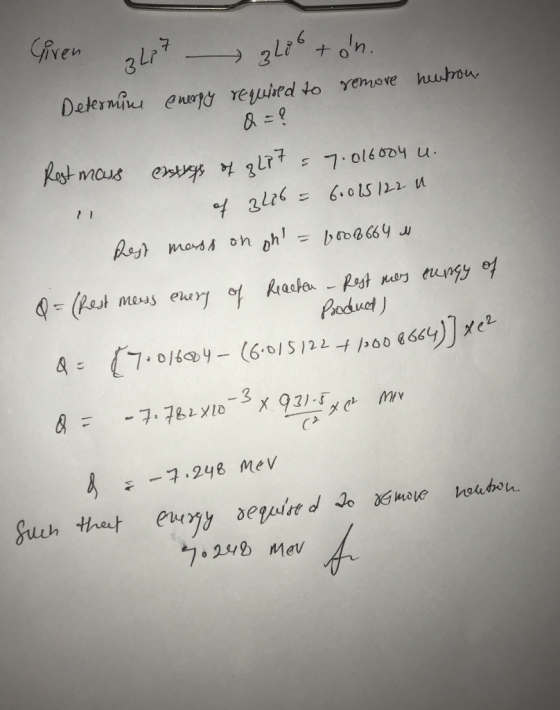
(1 pt) Determine the energy that is needed to remove a neutron from Ju to produce...
What minimum energy is needed to remove a neutron from 40Ca and convert it to 39Ca?
What minimum energy is needed to remove a neutron from 40Ca and convert it to 39Ca?
Calculate the binding energy (in MeV) of the last neutron in the 136C nucleus. (Hint: You...
Calculate the binding energy (in MeV) of the last neutron in the 136C nucleus. (Hint: You should compare the mass of 136C with the mass of 126C plus the mass of the last neutron. The mass of 126C = 12.000000 u, whereas the mass of 136C = 13.003355 u.) ______________:MeV
The energy needed to remove the first electron from an atom is the first ionization energy. The energy needed to remove...
The energy needed to remove the first electron from an atom is the first ionization energy. The energy needed to remove the second electron from an atom is the second ionization energy. The definition of third and fourth ionization energy is similar. which of the atoms below would you expect to have the largest 3rd ionization energy? Please include explanation. a) Na b) P c) Mg d) Al e) Si
What is the energy needed to take one neutron or one proton out from the nucleus...
 What is the energy needed to take one neutron or one proton out from the nucleus of^14N? Explain the reason for the difference.
An energy of 30.6 eV is needed to remove an electron from the n = 2...
An energy of 30.6 eV is needed to remove an electron from the n = 2 state of a lithium atom. If a single photon accomplishes this task, what wavelength is needed? (h = 6.63 × 10⁻³⁴ J⋅s, c = 3.00 × 10⁸ m/s, 1 eV = 1.6 × 10⁻¹⁹ J, and 1 nm = 10−9 m)
Explain the large increase in ionization energy needed to remove the third electron from beryllium compared...
Explain the large increase in ionization energy needed to remove the third electron from beryllium compared with that needed for the second electron. Removal of the third electron requires more energy because it must be removed from a 2+ beryllium ion, which has a(n) _____ ( Stable or Unstable) electron configuration, the same configuration as .
6. Neutron cross section depends on: 1. 2. 3. 4. on the neutron energy and the...
 6. Neutron cross section depends on: 1. 2. 3. 4. on the neutron energy and the number of electrons on the type of material only on the size of the nucleus only none of the above 7. An isotope based neutron source is 1. 2. 3. 4. a mixture of rich neutron elements a combination of any isotopes an element with long half life a light element mixed with unstable heavy element 8. A gaseous detector is a device to:...
1. Out of the following, which electron will be the easiest to remove from Li, justify...
1. Out of the following, which electron will be the easiest to remove from Li, justify your answer H2, He2, Li2, Be2, B2, C2, N2, O2, F2, Ne2 2. How much energy will it take to remove that electron from Li according to Koopman's theorem?
The ionization energy of an atom is the energy required to remove an electron from the...
 The ionization energy of an atom is the energy required to remove an electron from the atom in the gaseous state. Arrange the following elements in order of decreasing ionization energy. Rank from highest to lowest ionization energy. To rank items as equivalent, overlap them. View Available Hint(s) Reset Help Highest ionization energy Lowest ionization energy barium barium manganese manganese nickel nickel silicon silicon oxygen oxygen The correct ranking cannot be determined.
bee fast 1. The work needed to remove an electron from the surface of sodium is...
 bee fast
1. The work needed to remove an electron from the surface of sodium is 2.3 eV. Find the maximum wavelength of light that will cause photoelectrons to be emitted from sodium. What will be the speed of emitted electrons if light with wavelength 300 nm is used? 2. How much energy is required to remove an electron from the basic state of hydrogen, thereby producing an ion H'? 3. What is the de Broglie wavelength of a 2000-kg...
bee fast
1. The work needed to remove an electron from the surface of sodium is 2.3 eV. Find the maximum wavelength of light that will cause photoelectrons to be emitted from sodium. What will be the speed of emitted electrons if light with wavelength 300 nm is used? 2. How much energy is required to remove an electron from the basic state of hydrogen, thereby producing an ion H'? 3. What is the de Broglie wavelength of a 2000-kg...
 What is the energy needed to take one neutron or one proton out from the nucleus of^14N? Explain the reason for the difference.
 6. Neutron cross section depends on: 1. 2. 3. 4. on the neutron energy and the number of electrons on the type of material only on the size of the nucleus only none of the above 7. An isotope based neutron source is 1. 2. 3. 4. a mixture of rich neutron elements a combination of any isotopes an element with long half life a light element mixed with unstable heavy element 8. A gaseous detector is a device to:...
 The ionization energy of an atom is the energy required to remove an electron from the atom in the gaseous state. Arrange the following elements in order of decreasing ionization energy. Rank from highest to lowest ionization energy. To rank items as equivalent, overlap them. View Available Hint(s) Reset Help Highest ionization energy Lowest ionization energy barium barium manganese manganese nickel nickel silicon silicon oxygen oxygen The correct ranking cannot be determined.
 bee fast
1. The work needed to remove an electron from the surface of sodium is 2.3 eV. Find the maximum wavelength of light that will cause photoelectrons to be emitted from sodium. What will be the speed of emitted electrons if light with wavelength 300 nm is used? 2. How much energy is required to remove an electron from the basic state of hydrogen, thereby producing an ion H'? 3. What is the de Broglie wavelength of a 2000-kg...
bee fast
1. The work needed to remove an electron from the surface of sodium is 2.3 eV. Find the maximum wavelength of light that will cause photoelectrons to be emitted from sodium. What will be the speed of emitted electrons if light with wavelength 300 nm is used? 2. How much energy is required to remove an electron from the basic state of hydrogen, thereby producing an ion H'? 3. What is the de Broglie wavelength of a 2000-kg...
Most questions answered within 3 hours.
-
Where is the error in this code sequence?
String s1 = "Hello";
String s2 = "ello";...
asked 10 months ago -
Financial data for Joel de Paris, Inc., for last year
follow:
Joel de Paris, Inc.
Balance...
asked 10 months ago -
Consider this reaction:
Al2(SO4)3 (aq)+ BaCl3
(aq) Al2Cl6 (aq)- +
3BaSO4(s) . What is the...
asked 10 months ago -
Suppose that Savneet is considering increasing her
recent random sample from 20 car rentals to 40...
asked 10 months ago -
Trucks arrive at an unloading terminal at an average rate of 120
per hour.
Trucks arrive...
asked 10 months ago -
Why are methanol and ethanol completely soluble in water while
octanol is not very little soluble....
asked 10 months ago -
A facilities manager at a university reads in a research report
that the mean amount of...
asked 10 months ago -
When the CuSO4 is rehydrated by adding water to the anhydrous
compound, is this an endothermic...
asked 10 months ago -
A ray of sunlight is passing from diamond into crown glass; the
angle of incidence is...
asked 10 months ago -
A block of mass 0.249 kg is placed on top of a light, vertical
spring of...
asked 10 months ago -
how do the kidneys compensate in the presences of acidosis
a) trigger hyperventilate
b) reserve acid...
asked 10 months ago -
Question 501 pts
The rental rate of capital to the firm increases. Which of the
following...
asked 10 months ago