
Homework Answers


Add Answer to:
Suppose that the production function of Textile is identical to that of Soybean in each country....
55. If good A costs $10 per unit in country A and $12 per unit in country B, and if transport costs between A and B...
 55. If good A costs $10 per unit in country A and $12 per unit in country B, and if transport costs between A and B for the good are $3 per unit, an economist would say that a. the good will be exported from A to B. b. the good will be exported from B to A. c. intra-industry trade will occur in the good. d. the good will be a "nontraded good." 56. An implication of the Heckscher-Ohlin...
will have a production possibility In the Heckscher-Ohlin model, the country with the relative abundance of...
 will have a production possibility In the Heckscher-Ohlin model, the country with the relative abundance of frontier that is biased toward the production of the good. Select one: O A. land; labor intensive O B. land; capital intensive C. labor; capital intensive O D. labor; labor intensive In the Heckscher-Ohlin, gains from international trade come from Select one: A. the increased wages. O B. the improvement in technology. C. the increasing on the consumption choices available to consumers. D. the...
These questions are about international trade. I want to know the answers. 5 Heckscher-Ohlin Model. Suppose...
 These questions are about international trade.
I want to know the answers.
5 Heckscher-Ohlin Model. Suppose the production of cloth is labour intensive and the production of food is land intensive and suppose the United States (US) is labour abundant and Canada is land abundant. (a) Show how the US production possibility frontier (PPF) differs from the Canadian PPF. Briefly explain. (Use the general version of the PPF's) (b) Which country will have the lower price of cloth Pc relative...
These questions are about international trade.
I want to know the answers.
5 Heckscher-Ohlin Model. Suppose the production of cloth is labour intensive and the production of food is land intensive and suppose the United States (US) is labour abundant and Canada is land abundant. (a) Show how the US production possibility frontier (PPF) differs from the Canadian PPF. Briefly explain. (Use the general version of the PPF's) (b) Which country will have the lower price of cloth Pc relative...
KFrance and Italy only trade with each other; (each country is only capable of producing 2...
 KFrance and Italy only trade with each other; (each country is only capable of producing 2 goods, Wine and Bread; (the production of Bread is relatively capital intensive, and the production of Wine is relatively labor intensive, and (France is relatively abundant in capital, while Italy.is relatively abundant in labor. All assumptions from our class about the Heckscher-Ohlin model hold, in particular the fact that both countries have identical homothetic preferences, constant returns to scale in production, the countries are...
1-Home produces 2 goods X and Y . Home country has two factors of production, Labor...
1-Home produces 2 goods X and Y . Home country has two factors of production, Labor and Capital. All consumers at Home have preferences over two goods that can be represented by the utility function U(X,) =XY . The factor requirements per unit of output of the two goods are also fixed and they are shown in the following table: Good X Good Y Labour 1/3 2/3 Capital 2/3 1/3 Home country has 360 units of Labour and 600 units...
Assume that only two countries, A and B, exist. Consider the following endowments: LA 45 KA...
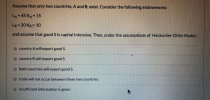 Assume that only two countries, A and B, exist. Consider the following endowments: LA 45 KA 15 Le-20 Ke 10 and assume that good S is capital intensive. Then, under the assumptions of Heckscher-Ohlin Model: O country A will export good S. O country B will export good S. O both countries will export good S O trade will not occur between these two countries O Insufficient information is given.
47. If relatively capital-abundant country A opens trade with relatively labor-abundant country B and the trade...
 47. If relatively capital-abundant country A opens trade with relatively labor-abundant country B and the trade takes place in accordance with the Heckscher-Ohlin theorem, what would be the consequence for factor prices (w/r) in the two countries? a. (w/r) rises in A and falls in B b. (w/r) rises in A and also rises in B c. (w/r) falls in A and rises in B d. (w/r) falls in A and also falls in B 48. Which one of the...
1. This problem uses the Heckscher-Ohlin model to predict the direction of trade. Consider the production...
1. This problem uses the Heckscher-Ohlin model to predict the direction of trade. Consider the production of handmade rugs and assembly line robots in Canada and India. a. Which country would you expect to be relatively labor-abundant, and which is capital-abundant? Why? b. Which industry would you expect to be relatively labor-intensive, and which is capital-intensive? Why? c. Given your answers to (a) and (b), draw production possibilities frontiers for each country. Assuming that consumer preferences are the same in...
Thank you so much. Heckscher-Ohlin Model 2. There are two countries, Home and Foreign. There are...
 Thank you so much.
Heckscher-Ohlin Model 2. There are two countries, Home and Foreign. There are two goods: beer (6) and corn (C), which are produced in both countries using capital (K) and labor (L). In both countries, it takes 2 units of labor and 1 unit of capital to make beer (a Lb = 2, akb = 1); and it takes 5 units of labor and 5 units of capital to make corn (ale = 5, ako = 5)....
Thank you so much.
Heckscher-Ohlin Model 2. There are two countries, Home and Foreign. There are two goods: beer (6) and corn (C), which are produced in both countries using capital (K) and labor (L). In both countries, it takes 2 units of labor and 1 unit of capital to make beer (a Lb = 2, akb = 1); and it takes 5 units of labor and 5 units of capital to make corn (ale = 5, ako = 5)....
Specialization and trade When a country has a comparative advantage in the production of a good,...
 Specialization and trade When a country has a comparative advantage in the production of a good, it means that it can produce this good at a lower opportunity cost than its trading partner. Then the country will specialize in the production of this good and trade it for other good The following graphs show the production possibilities frontiers (PPFs) for Freedonia and Lamponia. Both countries produce grain a tea, each initially (Qie., before specialization and trade) producing 24 million pounds...
 55. If good A costs $10 per unit in country A and $12 per unit in country B, and if transport costs between A and B for the good are $3 per unit, an economist would say that a. the good will be exported from A to B. b. the good will be exported from B to A. c. intra-industry trade will occur in the good. d. the good will be a "nontraded good." 56. An implication of the Heckscher-Ohlin...
 will have a production possibility In the Heckscher-Ohlin model, the country with the relative abundance of frontier that is biased toward the production of the good. Select one: O A. land; labor intensive O B. land; capital intensive C. labor; capital intensive O D. labor; labor intensive In the Heckscher-Ohlin, gains from international trade come from Select one: A. the increased wages. O B. the improvement in technology. C. the increasing on the consumption choices available to consumers. D. the...
 These questions are about international trade.
I want to know the answers.
5 Heckscher-Ohlin Model. Suppose the production of cloth is labour intensive and the production of food is land intensive and suppose the United States (US) is labour abundant and Canada is land abundant. (a) Show how the US production possibility frontier (PPF) differs from the Canadian PPF. Briefly explain. (Use the general version of the PPF's) (b) Which country will have the lower price of cloth Pc relative...
These questions are about international trade.
I want to know the answers.
5 Heckscher-Ohlin Model. Suppose the production of cloth is labour intensive and the production of food is land intensive and suppose the United States (US) is labour abundant and Canada is land abundant. (a) Show how the US production possibility frontier (PPF) differs from the Canadian PPF. Briefly explain. (Use the general version of the PPF's) (b) Which country will have the lower price of cloth Pc relative...
 KFrance and Italy only trade with each other; (each country is only capable of producing 2 goods, Wine and Bread; (the production of Bread is relatively capital intensive, and the production of Wine is relatively labor intensive, and (France is relatively abundant in capital, while Italy.is relatively abundant in labor. All assumptions from our class about the Heckscher-Ohlin model hold, in particular the fact that both countries have identical homothetic preferences, constant returns to scale in production, the countries are...
 Assume that only two countries, A and B, exist. Consider the following endowments: LA 45 KA 15 Le-20 Ke 10 and assume that good S is capital intensive. Then, under the assumptions of Heckscher-Ohlin Model: O country A will export good S. O country B will export good S. O both countries will export good S O trade will not occur between these two countries O Insufficient information is given.
 47. If relatively capital-abundant country A opens trade with relatively labor-abundant country B and the trade takes place in accordance with the Heckscher-Ohlin theorem, what would be the consequence for factor prices (w/r) in the two countries? a. (w/r) rises in A and falls in B b. (w/r) rises in A and also rises in B c. (w/r) falls in A and rises in B d. (w/r) falls in A and also falls in B 48. Which one of the...
 Thank you so much.
Heckscher-Ohlin Model 2. There are two countries, Home and Foreign. There are two goods: beer (6) and corn (C), which are produced in both countries using capital (K) and labor (L). In both countries, it takes 2 units of labor and 1 unit of capital to make beer (a Lb = 2, akb = 1); and it takes 5 units of labor and 5 units of capital to make corn (ale = 5, ako = 5)....
Thank you so much.
Heckscher-Ohlin Model 2. There are two countries, Home and Foreign. There are two goods: beer (6) and corn (C), which are produced in both countries using capital (K) and labor (L). In both countries, it takes 2 units of labor and 1 unit of capital to make beer (a Lb = 2, akb = 1); and it takes 5 units of labor and 5 units of capital to make corn (ale = 5, ako = 5)....
 Specialization and trade When a country has a comparative advantage in the production of a good, it means that it can produce this good at a lower opportunity cost than its trading partner. Then the country will specialize in the production of this good and trade it for other good The following graphs show the production possibilities frontiers (PPFs) for Freedonia and Lamponia. Both countries produce grain a tea, each initially (Qie., before specialization and trade) producing 24 million pounds...
Most questions answered within 3 hours.
-
Where is the error in this code sequence?
String s1 = "Hello";
String s2 = "ello";...
asked 10 months ago -
Financial data for Joel de Paris, Inc., for last year
follow:
Joel de Paris, Inc.
Balance...
asked 10 months ago -
Consider this reaction:
Al2(SO4)3 (aq)+ BaCl3
(aq) Al2Cl6 (aq)- +
3BaSO4(s) . What is the...
asked 10 months ago -
Suppose that Savneet is considering increasing her
recent random sample from 20 car rentals to 40...
asked 10 months ago -
Trucks arrive at an unloading terminal at an average rate of 120
per hour.
Trucks arrive...
asked 10 months ago -
Why are methanol and ethanol completely soluble in water while
octanol is not very little soluble....
asked 10 months ago -
A facilities manager at a university reads in a research report
that the mean amount of...
asked 10 months ago -
When the CuSO4 is rehydrated by adding water to the anhydrous
compound, is this an endothermic...
asked 10 months ago -
A ray of sunlight is passing from diamond into crown glass; the
angle of incidence is...
asked 10 months ago -
A block of mass 0.249 kg is placed on top of a light, vertical
spring of...
asked 10 months ago -
how do the kidneys compensate in the presences of acidosis
a) trigger hyperventilate
b) reserve acid...
asked 10 months ago -
Question 501 pts
The rental rate of capital to the firm increases. Which of the
following...
asked 10 months ago