
Homework Answers
Add Answer to:
The motion of a string with fixed ends in a viscous medium is described by: together...
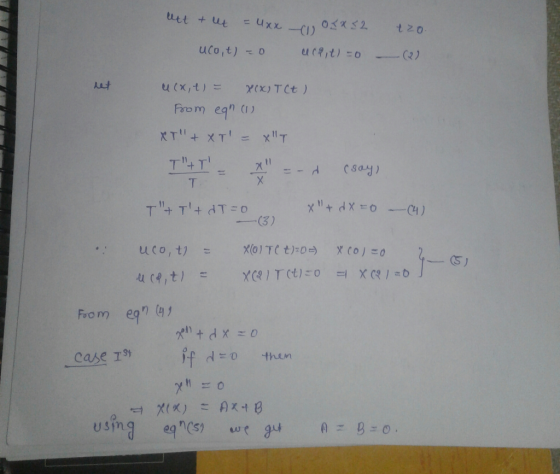
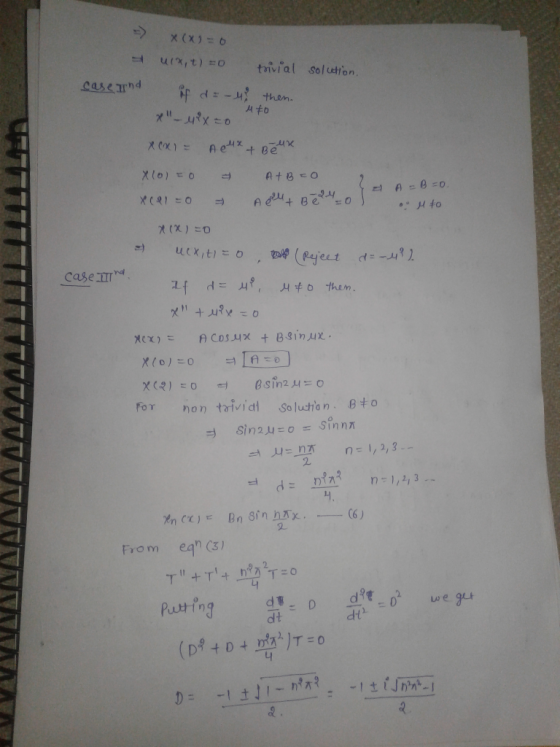
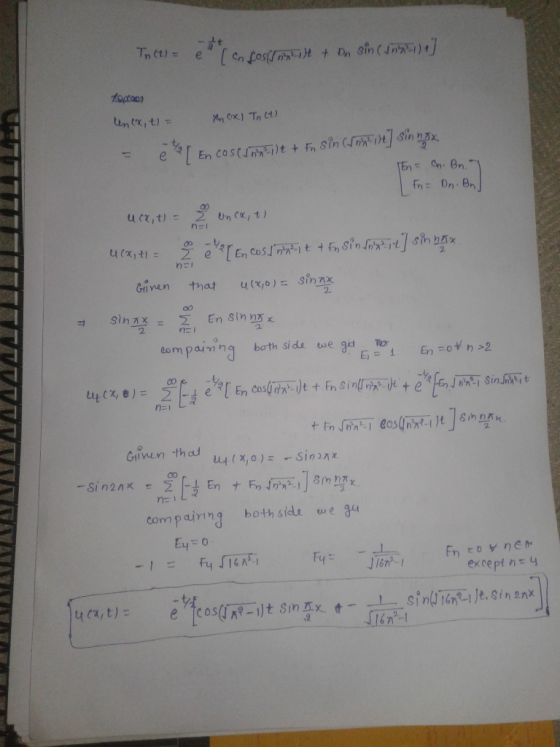
The motion of a string with fixed ends in a viscous medium is described by: together with boundary conditions: u(0,t) 0 and u(2, t)0 and initially: u(z,0-sin(nz/2) and ut(z, 0)--sin(2πχ). (a) If u(x,...
 The motion of a string with fixed ends in a viscous medium is described by: together with boundary conditions: u(0,t) 0 and u(2, t)0 and initially: u(z,0-sin(nz/2) and ut(z, 0)--sin(2πχ). (a) If u(x, t) - X(x)T(t) find the ordinary differential equations satisfied by X and T e ordinary different (c) Determine u(x, t).
The motion of a string with fixed ends in a viscous medium is described by: together with boundary conditions: u(0,t) 0 and u(2, t)0 and initially: u(z,0-sin(nz/2)...
The motion of a string with fixed ends in a viscous medium is described by: together with boundary conditions: u(0,t) 0 and u(2, t)0 and initially: u(z,0-sin(nz/2) and ut(z, 0)--sin(2πχ). (a) If u(x, t) - X(x)T(t) find the ordinary differential equations satisfied by X and T e ordinary different (c) Determine u(x, t).
The motion of a string with fixed ends in a viscous medium is described by: together with boundary conditions: u(0,t) 0 and u(2, t)0 and initially: u(z,0-sin(nz/2)...
Problem 1. Consider the vibration of a string with two ends fixed. In addition, assume that the s...
 parts a,b, c
Problem 1. Consider the vibration of a string with two ends fixed. In addition, assume that the string is initially at rest. The initial boundary value problem (IBVP) is written as u(0,t) -u(1,t) u(x,0) = f(x), 0 ut (z, 0-0, 0 < x < 1. The solution of this IBVP using the method of separation of variables is given by n-l a) Find the coefficients bn. b) Show that this wave function can be written as the...
parts a,b, c
Problem 1. Consider the vibration of a string with two ends fixed. In addition, assume that the string is initially at rest. The initial boundary value problem (IBVP) is written as u(0,t) -u(1,t) u(x,0) = f(x), 0 ut (z, 0-0, 0 < x < 1. The solution of this IBVP using the method of separation of variables is given by n-l a) Find the coefficients bn. b) Show that this wave function can be written as the...
Consider an elastic string of length L whose ends are held fixed. The string is set in motion fro...
 Answer needed in form summation from n=1 to infinity:
Consider an elastic string of length L whose ends are held fixed. The string is set in motion from its equilibrium position with an initial velocity ut(x, 0) = g(x). Let L-12 and a = 1 in parts (b) and (c). (A computer algebra system is recommended.) 8x 2 (a) Find the displacement u(x, t) for the given g(x). (Use a to represent an arbitrary constant.)
Consider an elastic string of...
Answer needed in form summation from n=1 to infinity:
Consider an elastic string of length L whose ends are held fixed. The string is set in motion from its equilibrium position with an initial velocity ut(x, 0) = g(x). Let L-12 and a = 1 in parts (b) and (c). (A computer algebra system is recommended.) 8x 2 (a) Find the displacement u(x, t) for the given g(x). (Use a to represent an arbitrary constant.)
Consider an elastic string of...
nonhomogeneous vibrating string problem for u(x with homogeneous boundary conditions t > 0 u(0, t) u(r,t) = 0, 0, = and the initial conditions 0stst tr(z,0)=0, u(z, 0) sin(2x), = Find the solu...
 nonhomogeneous vibrating string problem for u(x with homogeneous boundary conditions t > 0 u(0, t) u(r,t) = 0, 0, = and the initial conditions 0stst tr(z,0)=0, u(z, 0) sin(2x), = Find the solution u(x,t) to the IBVP using an eigenfunction expansion: u(z, t) = Σ an(t) sin(nz) n-1
nonhomogeneous vibrating string problem for u(x with homogeneous boundary conditions t > 0 u(0, t) u(r,t) = 0, 0, = and the initial conditions 0stst tr(z,0)=0, u(z, 0) sin(2x), = Find the...
nonhomogeneous vibrating string problem for u(x with homogeneous boundary conditions t > 0 u(0, t) u(r,t) = 0, 0, = and the initial conditions 0stst tr(z,0)=0, u(z, 0) sin(2x), = Find the solution u(x,t) to the IBVP using an eigenfunction expansion: u(z, t) = Σ an(t) sin(nz) n-1
nonhomogeneous vibrating string problem for u(x with homogeneous boundary conditions t > 0 u(0, t) u(r,t) = 0, 0, = and the initial conditions 0stst tr(z,0)=0, u(z, 0) sin(2x), = Find the...
Use the solution of the vibrating string with fixed ends obtained with separation of variables to...
 Use the solution of the vibrating string with fixed ends obtained with separation of variables to solve the following initial boundary value problem on the interval [0,1], and sketch the solution for t 0, t= 1/2 and t 1. ial diffe au u ot2 x x<1, t>0, u(x, 0) f(x)-sin zx, (x, 0) 0, u(0,)=u(1,t)= 0
Consider the partial differential equation together with the boundary conditions u(0, t) 0 and u(1,t)0 for t20 and the initial condition u(z,0) = z(1-2) for 0 < x < 1. (a) If n is a positive in...
 Consider the partial differential equation together with the boundary conditions u(0, t) 0 and u(1,t)0 for t20 and the initial condition u(z,0) = z(1-2) for 0 < x < 1. (a) If n is a positive integer, show that the function , sin(x), satisfies the given partial differential equation and boundary conditions. (b) The general solution of the partial differential equation that satisfies the boundary conditions is Write down (but do not evaluate) an integral that can be used to...
Problem 2. A string of a guitar is fixed at the two ends, x = 0...
 Problem 2. A string of a guitar is fixed at the two ends, x = 0 and r = a. The string is set in motion with initial position f(x) = (h/a)., 0 <r <a, where h > 0, and then it is released with no initial velocity. The displacement u of the string is described by the PDE au 1 au ar2 2 212 0<x<a, t> 0. (i) State the boundary value initial value problem that u satisfies. (ii)...
)Consider the wave equation for a vibrating string of semi-infnite length with a fixed end at z = 0, t > 0 a(0,t) = 0, and initial conditions 0 < x < oo u(z,0) = 1-cos(nz), ut(x,0) = 0,...
 )Consider the wave equation for a vibrating string of semi-infnite length with a fixed end at z = 0, t > 0 a(0,t) = 0, and initial conditions 0 < x < oo u(z,0) = 1-cos(nz), ut(x,0) = 0, Complete the table below with the values of u(0.5, t) at the specified time instants 0.5 0.5 x 0.5 0.5 0.5 2 0.5 0.75 t 0.25 u(x,t)
)Consider the wave equation for a vibrating string of semi-infnite length with a fixed...
)Consider the wave equation for a vibrating string of semi-infnite length with a fixed end at z = 0, t > 0 a(0,t) = 0, and initial conditions 0 < x < oo u(z,0) = 1-cos(nz), ut(x,0) = 0, Complete the table below with the values of u(0.5, t) at the specified time instants 0.5 0.5 x 0.5 0.5 0.5 2 0.5 0.75 t 0.25 u(x,t)
)Consider the wave equation for a vibrating string of semi-infnite length with a fixed...
5. Imagine a string that is fixed at both ends (e.g. a guitar string). When plucked, the string forms a standing wave. The vertical displacement u of the string varies with position r and time t. Sup...
 5. Imagine a string that is fixed at both ends (e.g. a guitar string). When plucked, the string forms a standing wave. The vertical displacement u of the string varies with position r and time t. Suppose u(x,t) = 2 sin(nx) sin(mt/2), for 0 x 1 and t 0. Convince yourself of the following: If we freeze the string in time, it will form a sine curve. Alternatively, if we instead focus on a single position, we will see the...
1. If Ea) 2. The Fourier series expansion of the function f() which is defined over one period by , 1<zc2 is f(...
 1. If Ea) 2. The Fourier series expansion of the function f() which is defined over one period by , 1<zc2 is f(z) = ao + Find the coefficients an and simplify you answer. 1 z sin ax cos ar Jzcos az dz = Hint: f(x) cos(n") dz and a.-Th 3. The propagation of waves along a particular string is governed by the following bound- ary value problem u(0,t) 0 ue(8,t)0 u(x,0) = f(x) u(x,0) g(x) Use the separation of...
 The motion of a string with fixed ends in a viscous medium is described by: together with boundary conditions: u(0,t) 0 and u(2, t)0 and initially: u(z,0-sin(nz/2) and ut(z, 0)--sin(2πχ). (a) If u(x, t) - X(x)T(t) find the ordinary differential equations satisfied by X and T e ordinary different (c) Determine u(x, t).
The motion of a string with fixed ends in a viscous medium is described by: together with boundary conditions: u(0,t) 0 and u(2, t)0 and initially: u(z,0-sin(nz/2)...
The motion of a string with fixed ends in a viscous medium is described by: together with boundary conditions: u(0,t) 0 and u(2, t)0 and initially: u(z,0-sin(nz/2) and ut(z, 0)--sin(2πχ). (a) If u(x, t) - X(x)T(t) find the ordinary differential equations satisfied by X and T e ordinary different (c) Determine u(x, t).
The motion of a string with fixed ends in a viscous medium is described by: together with boundary conditions: u(0,t) 0 and u(2, t)0 and initially: u(z,0-sin(nz/2)...
 parts a,b, c
Problem 1. Consider the vibration of a string with two ends fixed. In addition, assume that the string is initially at rest. The initial boundary value problem (IBVP) is written as u(0,t) -u(1,t) u(x,0) = f(x), 0 ut (z, 0-0, 0 < x < 1. The solution of this IBVP using the method of separation of variables is given by n-l a) Find the coefficients bn. b) Show that this wave function can be written as the...
parts a,b, c
Problem 1. Consider the vibration of a string with two ends fixed. In addition, assume that the string is initially at rest. The initial boundary value problem (IBVP) is written as u(0,t) -u(1,t) u(x,0) = f(x), 0 ut (z, 0-0, 0 < x < 1. The solution of this IBVP using the method of separation of variables is given by n-l a) Find the coefficients bn. b) Show that this wave function can be written as the...
 Answer needed in form summation from n=1 to infinity:
Consider an elastic string of length L whose ends are held fixed. The string is set in motion from its equilibrium position with an initial velocity ut(x, 0) = g(x). Let L-12 and a = 1 in parts (b) and (c). (A computer algebra system is recommended.) 8x 2 (a) Find the displacement u(x, t) for the given g(x). (Use a to represent an arbitrary constant.)
Consider an elastic string of...
Answer needed in form summation from n=1 to infinity:
Consider an elastic string of length L whose ends are held fixed. The string is set in motion from its equilibrium position with an initial velocity ut(x, 0) = g(x). Let L-12 and a = 1 in parts (b) and (c). (A computer algebra system is recommended.) 8x 2 (a) Find the displacement u(x, t) for the given g(x). (Use a to represent an arbitrary constant.)
Consider an elastic string of...
 nonhomogeneous vibrating string problem for u(x with homogeneous boundary conditions t > 0 u(0, t) u(r,t) = 0, 0, = and the initial conditions 0stst tr(z,0)=0, u(z, 0) sin(2x), = Find the solution u(x,t) to the IBVP using an eigenfunction expansion: u(z, t) = Σ an(t) sin(nz) n-1
nonhomogeneous vibrating string problem for u(x with homogeneous boundary conditions t > 0 u(0, t) u(r,t) = 0, 0, = and the initial conditions 0stst tr(z,0)=0, u(z, 0) sin(2x), = Find the...
nonhomogeneous vibrating string problem for u(x with homogeneous boundary conditions t > 0 u(0, t) u(r,t) = 0, 0, = and the initial conditions 0stst tr(z,0)=0, u(z, 0) sin(2x), = Find the solution u(x,t) to the IBVP using an eigenfunction expansion: u(z, t) = Σ an(t) sin(nz) n-1
nonhomogeneous vibrating string problem for u(x with homogeneous boundary conditions t > 0 u(0, t) u(r,t) = 0, 0, = and the initial conditions 0stst tr(z,0)=0, u(z, 0) sin(2x), = Find the...
 Use the solution of the vibrating string with fixed ends obtained with separation of variables to solve the following initial boundary value problem on the interval [0,1], and sketch the solution for t 0, t= 1/2 and t 1. ial diffe au u ot2 x x<1, t>0, u(x, 0) f(x)-sin zx, (x, 0) 0, u(0,)=u(1,t)= 0
 Consider the partial differential equation together with the boundary conditions u(0, t) 0 and u(1,t)0 for t20 and the initial condition u(z,0) = z(1-2) for 0 < x < 1. (a) If n is a positive integer, show that the function , sin(x), satisfies the given partial differential equation and boundary conditions. (b) The general solution of the partial differential equation that satisfies the boundary conditions is Write down (but do not evaluate) an integral that can be used to...
 Problem 2. A string of a guitar is fixed at the two ends, x = 0 and r = a. The string is set in motion with initial position f(x) = (h/a)., 0 <r <a, where h > 0, and then it is released with no initial velocity. The displacement u of the string is described by the PDE au 1 au ar2 2 212 0<x<a, t> 0. (i) State the boundary value initial value problem that u satisfies. (ii)...
 )Consider the wave equation for a vibrating string of semi-infnite length with a fixed end at z = 0, t > 0 a(0,t) = 0, and initial conditions 0 < x < oo u(z,0) = 1-cos(nz), ut(x,0) = 0, Complete the table below with the values of u(0.5, t) at the specified time instants 0.5 0.5 x 0.5 0.5 0.5 2 0.5 0.75 t 0.25 u(x,t)
)Consider the wave equation for a vibrating string of semi-infnite length with a fixed...
)Consider the wave equation for a vibrating string of semi-infnite length with a fixed end at z = 0, t > 0 a(0,t) = 0, and initial conditions 0 < x < oo u(z,0) = 1-cos(nz), ut(x,0) = 0, Complete the table below with the values of u(0.5, t) at the specified time instants 0.5 0.5 x 0.5 0.5 0.5 2 0.5 0.75 t 0.25 u(x,t)
)Consider the wave equation for a vibrating string of semi-infnite length with a fixed...
 5. Imagine a string that is fixed at both ends (e.g. a guitar string). When plucked, the string forms a standing wave. The vertical displacement u of the string varies with position r and time t. Suppose u(x,t) = 2 sin(nx) sin(mt/2), for 0 x 1 and t 0. Convince yourself of the following: If we freeze the string in time, it will form a sine curve. Alternatively, if we instead focus on a single position, we will see the...
 1. If Ea) 2. The Fourier series expansion of the function f() which is defined over one period by , 1<zc2 is f(z) = ao + Find the coefficients an and simplify you answer. 1 z sin ax cos ar Jzcos az dz = Hint: f(x) cos(n") dz and a.-Th 3. The propagation of waves along a particular string is governed by the following bound- ary value problem u(0,t) 0 ue(8,t)0 u(x,0) = f(x) u(x,0) g(x) Use the separation of...
Most questions answered within 3 hours.
-
Where is the error in this code sequence?
String s1 = "Hello";
String s2 = "ello";...
asked 11 months ago -
Financial data for Joel de Paris, Inc., for last year
follow:
Joel de Paris, Inc.
Balance...
asked 11 months ago -
Consider this reaction:
Al2(SO4)3 (aq)+ BaCl3
(aq) Al2Cl6 (aq)- +
3BaSO4(s) . What is the...
asked 11 months ago -
Suppose that Savneet is considering increasing her
recent random sample from 20 car rentals to 40...
asked 11 months ago -
Trucks arrive at an unloading terminal at an average rate of 120
per hour.
Trucks arrive...
asked 11 months ago -
Why are methanol and ethanol completely soluble in water while
octanol is not very little soluble....
asked 11 months ago -
A facilities manager at a university reads in a research report
that the mean amount of...
asked 11 months ago -
When the CuSO4 is rehydrated by adding water to the anhydrous
compound, is this an endothermic...
asked 11 months ago -
A ray of sunlight is passing from diamond into crown glass; the
angle of incidence is...
asked 11 months ago -
A block of mass 0.249 kg is placed on top of a light, vertical
spring of...
asked 11 months ago -
how do the kidneys compensate in the presences of acidosis
a) trigger hyperventilate
b) reserve acid...
asked 11 months ago -
Question 501 pts
The rental rate of capital to the firm increases. Which of the
following...
asked 11 months ago