
Homework Answers
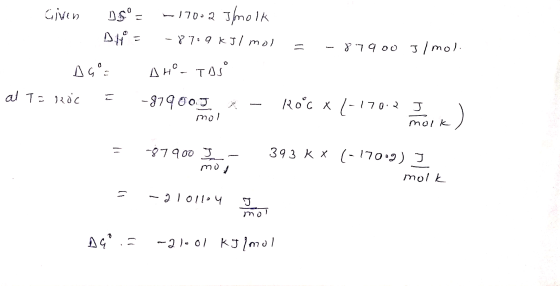
∆S° and ∆H ° are given so ∆G° can be calculated as-
Add Answer to:
5) The reaction PC13(g) + Cl2(g) → PC15(g) has a AS of -170.2 J/molK and a...
Calculate AH for the reaction PC13(1) + Cl2(g) → PC15(s) given the following data: Equation ΔΗ...
 Calculate AH for the reaction PC13(1) + Cl2(g) → PC15(s) given the following data: Equation ΔΗ P4(s) + 6 Cl2(g) → 4 PC13(1) -1280 kJ P4(s) + 10 C12(g) → 4 PC1:($) -1774 kJ pt pt AH= 1 pt
The equilibrium constant. Kp. for the following reaction is 0.497 at 500 K. PC15(E)=PC13(E) + C12(E)...
 The equilibrium constant. Kp. for the following reaction is 0.497 at 500 K. PC15(E)=PC13(E) + C12(E) If AH° for this reaction is 87.9 kJ, what is the value of K, at 417 K? Kp = Submit Answer Retry Entire Group 9 more group attempts remaining The equilibrium constant. Kp. for the following reaction is 6.25 at 298 K. 2NO(g) + Brz(9) FINOBr(g) If AH® for this reaction is -16.1 kJ, what is the value of K, at 201 K? Kp...
Phosphorus pentachloride decomposes according to the chemical equation PC15(g) PC13(g) + Cl2 (g) Kc = 1.80...
 Phosphorus pentachloride decomposes according to the chemical equation PC15(g) PC13(g) + Cl2 (g) Kc = 1.80 at 250° C A 0.475 mol sample of PCI, (g) is injected into an empty 4.90 L reaction vessel held at 250° C. Calculate the concentrations of PCI, (g) and PCI,(g) at equilibrium. [PCls] [PCl3]
Consider the following reaction where K. = 83.3 at 500 K: PC13(g) + Cl2(g) = PC15(8)...
 Consider the following reaction where K. = 83.3 at 500 K: PC13(g) + Cl2(g) = PC15(8) A reaction mixture was found to contain 2.76x10⁻² moles of PC13(g), 4.46x10⁻² moles of Cl2(g) and 0.133 moles of PC13(g), in a 1.00 Liter container. Indicate True (T) or False (F) for each of the following: (- 1. In order to reach equilibrium PC15(g) must be consumed. 2. In order to reach equilibrium K, must increase. 3. In order to reach equilibrium PC1z must...
ampere The reaction, PCls (g) 5 PC13(g) + Cl2(g), has Kc = 4.20 x 10². If...
 ampere The reaction, PCls (g) 5 PC13(g) + Cl2(g), has Kc = 4.20 x 10². If 0.1050 mol of PCL5, 0.0450 mol of Cl2 and 0.0450 mol of PCl3 is placed in a 0.5000-L flask at 250°C, what are the equilibrium concentrations of PCl3 and Cl, if equilibrium (PCI5] = 0.2065 M? A) [PC13] = 0.00350 M; (Cl2] = 0.00350 M B) [PC13] = 0.0900 M; [Cl2] = 0.0900 M -=51,85 (66450) (19450) C) [PC13] = 0.2100 M; [Cl2] =...
3. (20 pts) a. Consider the following reaction: PC15(g) z PC13(g) + Cl2(g) Using the following...
 3. (20 pts) a. Consider the following reaction: PC15(g) z PC13(g) + Cl2(g) Using the following data find the AH°, 45°, and AG° at 534 K. Kºp 0.245 1.99 4.96 9.35 T(K) 485 534 556 574 b. For the reaction above state whether the equilibrium shifts to the left or the right (or neither) when the following changes are made in an equilibrium mixture at 25 °C. 1. Tis decreased at constant P 2. Vis decreased at constant T Some...
How could I solve this? 5. For the reaction: PCI;(g) + Cl2(g) + PC13(g). If Kp...
 How could I solve this?
5. For the reaction: PCI;(g) + Cl2(g) + PC13(g). If Kp =1.05 at 250°C. What is the value of Kc?
How could I solve this?
5. For the reaction: PCI;(g) + Cl2(g) + PC13(g). If Kp =1.05 at 250°C. What is the value of Kc?
7. Use the reaction enthalpies given below to determine AHºrxn for the following reaction: 8. Use...
 7. Use the reaction enthalpies given below to determine AHºrxn for the following reaction: 8. Use the AHºf information provided to calculate AHºrxn for the following: P4(g) + 10 C12(g) + 4PC15(s) AHørxn = ? SO2Cl2(g) + 2 H2O(l) → 2 HCI(g) + H2804 Given: PC15(s) - PC13(g) + Cl2(g) P4(g) + 6 Cl2(g) - 4 PC13(g) AHørxn- +157 kJ Hºrxn=-1207 kJ AHºf (kJ/mol) SO2Cl2(g) H2O(1) HCl(g) H2S040) -364 -286 -92 -814 Voboty A) -2100. kJ B) -1835 kJ C)...
5. Given the data below, what is AHⓇ for the following reaction? CH4(g) + 3Cl2(g) →...
 5. Given the data below, what is AHⓇ for the following reaction? CH4(g) + 3Cl2(g) → CHCl3(g) + 3HCl(g) AHOICH4(9)] = -75 kJ/mol AHOICHCl3(9)] = -103 kJ/mol AH HCl(9)] = -92 kJ/mol A-304 kJ B-120 kJ C +322 kJ D +120 kJ E none of these
A reaction has an enthalpy change of - 71 kJ mol" and an entropy change of...
 A reaction has an enthalpy change of - 71 kJ mol" and an entropy change of -58 JK-mol-. At what temperature does this exothermic reaction cease to be spontaneous? 422°C 673°c 826°C O 951°C What is the molar reaction enthalpy for the reaction below: N2H4(0) +CHNO(0) 4CHẠO(g) +Ng(g) + 3H (g) given the following thermodynamic data? 2NH3(9) ► N2H4(l) + H2(9) A,Hm = 22.5 kJ mol-1 2NH3(9) N2(g) + 3H2(9) A Hm = 57.5 kJ mol-1 CH,0(9) + H2(g) +...
 Calculate AH for the reaction PC13(1) + Cl2(g) → PC15(s) given the following data: Equation ΔΗ P4(s) + 6 Cl2(g) → 4 PC13(1) -1280 kJ P4(s) + 10 C12(g) → 4 PC1:($) -1774 kJ pt pt AH= 1 pt
 The equilibrium constant. Kp. for the following reaction is 0.497 at 500 K. PC15(E)=PC13(E) + C12(E) If AH° for this reaction is 87.9 kJ, what is the value of K, at 417 K? Kp = Submit Answer Retry Entire Group 9 more group attempts remaining The equilibrium constant. Kp. for the following reaction is 6.25 at 298 K. 2NO(g) + Brz(9) FINOBr(g) If AH® for this reaction is -16.1 kJ, what is the value of K, at 201 K? Kp...
 Phosphorus pentachloride decomposes according to the chemical equation PC15(g) PC13(g) + Cl2 (g) Kc = 1.80 at 250° C A 0.475 mol sample of PCI, (g) is injected into an empty 4.90 L reaction vessel held at 250° C. Calculate the concentrations of PCI, (g) and PCI,(g) at equilibrium. [PCls] [PCl3]
 Consider the following reaction where K. = 83.3 at 500 K: PC13(g) + Cl2(g) = PC15(8) A reaction mixture was found to contain 2.76x10⁻² moles of PC13(g), 4.46x10⁻² moles of Cl2(g) and 0.133 moles of PC13(g), in a 1.00 Liter container. Indicate True (T) or False (F) for each of the following: (- 1. In order to reach equilibrium PC15(g) must be consumed. 2. In order to reach equilibrium K, must increase. 3. In order to reach equilibrium PC1z must...
 ampere The reaction, PCls (g) 5 PC13(g) + Cl2(g), has Kc = 4.20 x 10². If 0.1050 mol of PCL5, 0.0450 mol of Cl2 and 0.0450 mol of PCl3 is placed in a 0.5000-L flask at 250°C, what are the equilibrium concentrations of PCl3 and Cl, if equilibrium (PCI5] = 0.2065 M? A) [PC13] = 0.00350 M; (Cl2] = 0.00350 M B) [PC13] = 0.0900 M; [Cl2] = 0.0900 M -=51,85 (66450) (19450) C) [PC13] = 0.2100 M; [Cl2] =...
 3. (20 pts) a. Consider the following reaction: PC15(g) z PC13(g) + Cl2(g) Using the following data find the AH°, 45°, and AG° at 534 K. Kºp 0.245 1.99 4.96 9.35 T(K) 485 534 556 574 b. For the reaction above state whether the equilibrium shifts to the left or the right (or neither) when the following changes are made in an equilibrium mixture at 25 °C. 1. Tis decreased at constant P 2. Vis decreased at constant T Some...
 How could I solve this?
5. For the reaction: PCI;(g) + Cl2(g) + PC13(g). If Kp =1.05 at 250°C. What is the value of Kc?
How could I solve this?
5. For the reaction: PCI;(g) + Cl2(g) + PC13(g). If Kp =1.05 at 250°C. What is the value of Kc?
 7. Use the reaction enthalpies given below to determine AHºrxn for the following reaction: 8. Use the AHºf information provided to calculate AHºrxn for the following: P4(g) + 10 C12(g) + 4PC15(s) AHørxn = ? SO2Cl2(g) + 2 H2O(l) → 2 HCI(g) + H2804 Given: PC15(s) - PC13(g) + Cl2(g) P4(g) + 6 Cl2(g) - 4 PC13(g) AHørxn- +157 kJ Hºrxn=-1207 kJ AHºf (kJ/mol) SO2Cl2(g) H2O(1) HCl(g) H2S040) -364 -286 -92 -814 Voboty A) -2100. kJ B) -1835 kJ C)...
 5. Given the data below, what is AHⓇ for the following reaction? CH4(g) + 3Cl2(g) → CHCl3(g) + 3HCl(g) AHOICH4(9)] = -75 kJ/mol AHOICHCl3(9)] = -103 kJ/mol AH HCl(9)] = -92 kJ/mol A-304 kJ B-120 kJ C +322 kJ D +120 kJ E none of these
 A reaction has an enthalpy change of - 71 kJ mol" and an entropy change of -58 JK-mol-. At what temperature does this exothermic reaction cease to be spontaneous? 422°C 673°c 826°C O 951°C What is the molar reaction enthalpy for the reaction below: N2H4(0) +CHNO(0) 4CHẠO(g) +Ng(g) + 3H (g) given the following thermodynamic data? 2NH3(9) ► N2H4(l) + H2(9) A,Hm = 22.5 kJ mol-1 2NH3(9) N2(g) + 3H2(9) A Hm = 57.5 kJ mol-1 CH,0(9) + H2(g) +...
Most questions answered within 3 hours.
-
Where is the error in this code sequence?
String s1 = "Hello";
String s2 = "ello";...
asked 11 months ago -
Financial data for Joel de Paris, Inc., for last year
follow:
Joel de Paris, Inc.
Balance...
asked 11 months ago -
Consider this reaction:
Al2(SO4)3 (aq)+ BaCl3
(aq) Al2Cl6 (aq)- +
3BaSO4(s) . What is the...
asked 11 months ago -
Suppose that Savneet is considering increasing her
recent random sample from 20 car rentals to 40...
asked 11 months ago -
Trucks arrive at an unloading terminal at an average rate of 120
per hour.
Trucks arrive...
asked 11 months ago -
Why are methanol and ethanol completely soluble in water while
octanol is not very little soluble....
asked 11 months ago -
A facilities manager at a university reads in a research report
that the mean amount of...
asked 11 months ago -
When the CuSO4 is rehydrated by adding water to the anhydrous
compound, is this an endothermic...
asked 11 months ago -
A ray of sunlight is passing from diamond into crown glass; the
angle of incidence is...
asked 11 months ago -
A block of mass 0.249 kg is placed on top of a light, vertical
spring of...
asked 11 months ago -
how do the kidneys compensate in the presences of acidosis
a) trigger hyperventilate
b) reserve acid...
asked 11 months ago -
Question 501 pts
The rental rate of capital to the firm increases. Which of the
following...
asked 11 months ago