
Homework Answers
Add Answer to:
The ions entering the mass spectrometer have the same charges. After being accelerated through a potential...
In a mass spectrometer chlorine ions of mass 35u and charge +5e are emitted from a source and accelerated thro...
In a mass spectrometer chlorine ions of mass 35u and charge +5e are emitted from a source and accelerated through a potential difference of 250 kV. They then enter a region with a magnetic field which is perpendicular to their original direction of motion. The chlorine ions exit the spectrometer after being bent along a path with radius of curvature 3.5 m. What is the value of the magnetic field? (u = 1.66 ´ 10–27 kg, e = 1.6 ´...
Tipler6 26.P.042. Before entering a mass spectrometer, ions pass through a velocity selector consisting of parallel...
Tipler6 26.P.042. Before entering a mass spectrometer, ions pass through a velocity selector consisting of parallel plates separated by 1.5 mm and having a potential difference of 150 V. The magnetic field between the plates is 0.42 T. The magnetic field in the mass spectrometer is 1.2 T. (a) Find the speed of the ions entering the mass spectrometer. ___ m/s (b) Find the difference in the diameters of the orbits of singly ionized 238U and 235U. (The mass of...
Singly charged uranium-238 ions are accelerated through a potential difference of 3.10 kV and enter a...
Singly charged uranium-238 ions are accelerated through a potential difference of 3.10 kV and enter a uniform magnetic field of magnitude 1.38 T directed perpendicular to their velocities. (a) Determine the radius of their circular path. (Give your answer to three significant figures.) (b) Repeat this calculation for uranium-235 ions. (Give your answer to three significant figures.)
2. The Mass Spectrometer (8 pts): Sodium ions (charge te) are accelerated from rest at plate A th...
 2. The Mass Spectrometer (8 pts): Sodium ions (charge te) are accelerated from rest at plate A through a voltage difference of Δν-1 kV to plate B. Some of the ions pass through a small slit in plate B to enter into a region of uniform magnetic field (the shaded region in the diagram) (a) Which plate is at a higher potential, A or B? Calculate the speed of the Na+ ions when they reach the slit in 5 plate...
AV An Iron-Nickel sample from a meteorite was placed into a velocity selector and mass spectrometer....
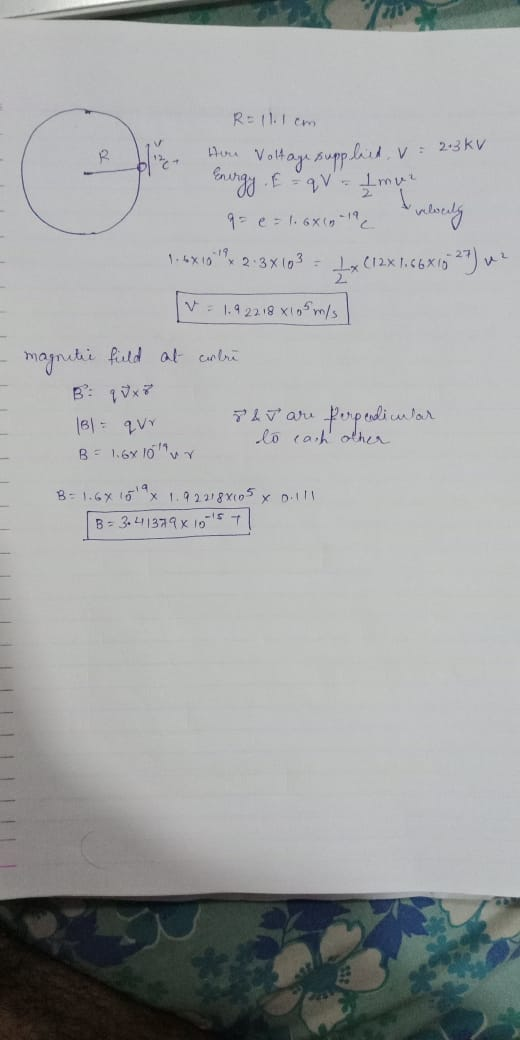
 AV An Iron-Nickel sample from a meteorite was placed into a velocity selector and mass spectrometer. Experimenters expect 3 primary isotopes: 56Fe, 58Ni, & boni. Positive ions are accelerated by an applied potential (AV) of 3300 Volts which is the same potential difference used to create the electric field in the velocity selector, where d is 1.1 cm. 1. On the figure provided, in the velocity selector region, (A) draw the direction of the electric field. (B) Draw the necessary...
An Iron-Nickel sample from a meteorite was placed into a velocity selector and mass spectrometer. Experimenters...
 An Iron-Nickel sample from a meteorite was placed into a
velocity selector and mass spectrometer. Experimenters expect 3
primary isotopes: 56Fe, 58Ni, & 60Ni. Positive ions are
accelerated by an applied potential (ΔV) of 3300 Volts which is the
same potential difference used to create the electric field in the
velocity selector, where d is 1.1 cm.
Need 3 and 4.
An Iron-Nickel sample from a meteorite was placed into a velocity selector and mass spectrometer. Experimenters expect 3 primary...
An Iron-Nickel sample from a meteorite was placed into a
velocity selector and mass spectrometer. Experimenters expect 3
primary isotopes: 56Fe, 58Ni, & 60Ni. Positive ions are
accelerated by an applied potential (ΔV) of 3300 Volts which is the
same potential difference used to create the electric field in the
velocity selector, where d is 1.1 cm.
Need 3 and 4.
An Iron-Nickel sample from a meteorite was placed into a velocity selector and mass spectrometer. Experimenters expect 3 primary...
(Figure 1) shows a mass spectrometer, an analytical instrument used to identify the various molecules in...
(Figure 1) shows a mass spectrometer, an analytical instrument used to identify the various molecules in a sample by measuring their charge-to-mass ratio q/m. The sample is ionized, the positive ions are accelerated (starting from rest) through a potential difference ΔV, and they then enter a region of uniform magnetic field. The field bends the ions into circular trajectories, but after just half a circle they either strike the wall or pass through a small opening to a detector. As...
A singly charged positive ion has a mass of 2.50*10^-26 kg. After being accelerated through a...
A singly charged positive ion has a mass of 2.50*10^-26 kg. After being accelerated through a potential difference of 250V, the ion enters a magnetic field of 0.500 T, in a direction perpendicular to the field. Calculate the radius of the path of the ion in the field.
The figure below shows a mass spectrometer, an analytical instrument used to identify the various molecules...
The figure below shows a mass spectrometer, an analytical instrument used to identify the various molecules in a sample by measuring their charge-to-mass ratio e/m. The sample is ionized, the positive ions are accelerated (starting from rest) through a potential difference ΔV, and they then enter a region of uniform magnetic field. The field bends the ions into circular trajectories, but after just half a circle they either strike the wall or pass through a small opening to a detector....
A proton enters a region of constant magnetic field, perpendicular to the fie and after being...
 A proton enters a region of constant magnetic field, perpendicular to the fie and after being accelerated from rest by an electric field through an electric potential difference of - 350 V. Determine the magnitude of the magnetic field, if the proton travels in a circular path with a radius of 21 cm. mt As shown in the figure below, when a charged particle enters a region of magnetic field traveling in a direction perpendicular to the field, it will...
 2. The Mass Spectrometer (8 pts): Sodium ions (charge te) are accelerated from rest at plate A through a voltage difference of Δν-1 kV to plate B. Some of the ions pass through a small slit in plate B to enter into a region of uniform magnetic field (the shaded region in the diagram) (a) Which plate is at a higher potential, A or B? Calculate the speed of the Na+ ions when they reach the slit in 5 plate...
 AV An Iron-Nickel sample from a meteorite was placed into a velocity selector and mass spectrometer. Experimenters expect 3 primary isotopes: 56Fe, 58Ni, & boni. Positive ions are accelerated by an applied potential (AV) of 3300 Volts which is the same potential difference used to create the electric field in the velocity selector, where d is 1.1 cm. 1. On the figure provided, in the velocity selector region, (A) draw the direction of the electric field. (B) Draw the necessary...
 An Iron-Nickel sample from a meteorite was placed into a
velocity selector and mass spectrometer. Experimenters expect 3
primary isotopes: 56Fe, 58Ni, & 60Ni. Positive ions are
accelerated by an applied potential (ΔV) of 3300 Volts which is the
same potential difference used to create the electric field in the
velocity selector, where d is 1.1 cm.
Need 3 and 4.
An Iron-Nickel sample from a meteorite was placed into a velocity selector and mass spectrometer. Experimenters expect 3 primary...
An Iron-Nickel sample from a meteorite was placed into a
velocity selector and mass spectrometer. Experimenters expect 3
primary isotopes: 56Fe, 58Ni, & 60Ni. Positive ions are
accelerated by an applied potential (ΔV) of 3300 Volts which is the
same potential difference used to create the electric field in the
velocity selector, where d is 1.1 cm.
Need 3 and 4.
An Iron-Nickel sample from a meteorite was placed into a velocity selector and mass spectrometer. Experimenters expect 3 primary...
 A proton enters a region of constant magnetic field, perpendicular to the fie and after being accelerated from rest by an electric field through an electric potential difference of - 350 V. Determine the magnitude of the magnetic field, if the proton travels in a circular path with a radius of 21 cm. mt As shown in the figure below, when a charged particle enters a region of magnetic field traveling in a direction perpendicular to the field, it will...
Most questions answered within 3 hours.
-
Where is the error in this code sequence?
String s1 = "Hello";
String s2 = "ello";...
asked 10 months ago -
Financial data for Joel de Paris, Inc., for last year
follow:
Joel de Paris, Inc.
Balance...
asked 10 months ago -
Consider this reaction:
Al2(SO4)3 (aq)+ BaCl3
(aq) Al2Cl6 (aq)- +
3BaSO4(s) . What is the...
asked 10 months ago -
Suppose that Savneet is considering increasing her
recent random sample from 20 car rentals to 40...
asked 10 months ago -
Trucks arrive at an unloading terminal at an average rate of 120
per hour.
Trucks arrive...
asked 10 months ago -
Why are methanol and ethanol completely soluble in water while
octanol is not very little soluble....
asked 10 months ago -
A facilities manager at a university reads in a research report
that the mean amount of...
asked 10 months ago -
When the CuSO4 is rehydrated by adding water to the anhydrous
compound, is this an endothermic...
asked 10 months ago -
A ray of sunlight is passing from diamond into crown glass; the
angle of incidence is...
asked 10 months ago -
A block of mass 0.249 kg is placed on top of a light, vertical
spring of...
asked 10 months ago -
how do the kidneys compensate in the presences of acidosis
a) trigger hyperventilate
b) reserve acid...
asked 10 months ago -
Question 501 pts
The rental rate of capital to the firm increases. Which of the
following...
asked 10 months ago