
Homework Answers
Add Answer to:
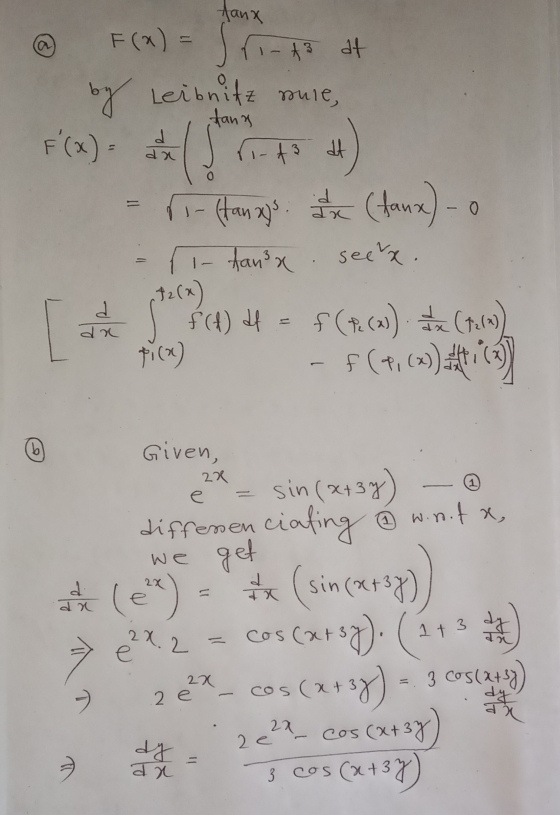
(a) Let F() = tan(z) V1 - tdt. Find F"(x). Tv da titolo lo anterioribus Em...
Problem 6 Using Stokes' Theorem, we equate F dr curl F dA. Find curl F- PreviousS...
 Problem 6 Using Stokes' Theorem, we equate F dr curl F dA. Find curl F- PreviousS us Problem ListNext Noting that the surface is given by (1 point) Calculate the circulation, Fdr7in z - 16-x2 - y2, find two ways, directly and using Stokes' Theorem. dA The vector field F = 6y1-6y and C is the boundary of S, the part of the surface dy dx With R giving the region in the xy-plane enclosed by the surface, this gives...
Let F(x, y, z) = sin yi + (x cos y + cos z)j – ysin...
 Let F(x, y, z) = sin yi + (x cos y + cos z)j – ysin zk be a vector field in R3. (a) Verify that F is a conservative vector field. (b) Find a potential function f such that F = Vf. (C) Use the fundamental theorem of line integrals to evaluate ScF. dr along the curve C: r(t) = sin ti + tj + 2tk, 0 < t < A/2.
Questions. Please show all work. 1. Consider the vector field F(x, y, z) (-y, x-z, 3x + z)and the surface S, which is the part of the sphere x2 + y2 + z2 = 25 above the plane z = 3. Let C be the...
 Questions. Please show all work. 1. Consider the vector field F(x, y, z) (-y, x-z, 3x + z)and the surface S, which is the part of the sphere x2 + y2 + z2 = 25 above the plane z = 3. Let C be the boundary of S with counterclockwise orientation when looking down from the z-axis. Verify Stokes' Theorem as follows. (a) (i) Sketch the surface S and the curve C. Indicate the orientation of C (ii) Use the...
Let F 9xi + yj + zk . S is the part of the surface z...
 Let F 9xi + yj + zk . S is the part of the surface z = -4x - 2y + 12 in the first octant oriented upward. ey 4,2,1 Find dA X * хр / Set up the iterated integral for flux 3 6 2x F.dA dy dx
Let F 9xi + yj + zk . S is the part of the surface z = -4x - 2y + 12 in the first octant oriented upward. ey 4,2,1 Find...
Let F 9xi + yj + zk . S is the part of the surface z = -4x - 2y + 12 in the first octant oriented upward. ey 4,2,1 Find dA X * хр / Set up the iterated integral for flux 3 6 2x F.dA dy dx
Let F 9xi + yj + zk . S is the part of the surface z = -4x - 2y + 12 in the first octant oriented upward. ey 4,2,1 Find...
2. Find the intervals on which the following function is continuous. tan r B( ) = V4-12 3. Find the derivatives o...
 2. Find the intervals on which the following function is continuous. tan r B( ) = V4-12 3. Find the derivatives of the following functions (a) f(z)= /5x +1 (b) gla) = (2r -3)(a2 +2) (c) y = In (x + Vx2 - 1) 4. Find the intervals on which the following function is decreasing. f(z) = 36x +3r2 - 2r 5. Evaluate the following integrals. r dr (a) sec2 tan (b) dar 3 (c) da 5x+1 1. Sketch the...
1.) Let f(x, y, z) = xy?z3 – sin(xy) +erz? – tan(y, 3. Determine the following....
 1.) Let f(x, y, z) = xy?z3 – sin(xy) +erz? – tan(y, 3. Determine the following. (a) e (b) (c) azonos
pi over 2 is not correct either Let F(x, y, z) = z tan-(y2)i + z3...
 pi over 2 is not correct either
Let F(x, y, z) = z tan-(y2)i + z3 In(x2 + 2)j + zk. Find the flux of F across S, the part of the paraboloid x2 + y2 + z = 5 that lies above the plane z = 4 and is oriented upward.
pi over 2 is not correct either
Let F(x, y, z) = z tan-(y2)i + z3 In(x2 + 2)j + zk. Find the flux of F across S, the part of the paraboloid x2 + y2 + z = 5 that lies above the plane z = 4 and is oriented upward.
4. (a Let (sin( x cos( ) dr + (x cos(x + y) - 2) dy....
 4. (a Let (sin( x cos( ) dr + (x cos(x + y) - 2) dy. dz= Show that dz is an exact differential and determine the corresponding function f(x,y) Hence solve the differential equation = z sin( Cos( y) 2 x cos( y) dy 10] (b) Find the solution of the differential equation d2y dy 2 y e dx dæ2 initial conditions th that satisfi 1 (0) [15] and y(0) 0
4. (a Let (sin( x cos( ) dr...
4. (a Let (sin( x cos( ) dr + (x cos(x + y) - 2) dy. dz= Show that dz is an exact differential and determine the corresponding function f(x,y) Hence solve the differential equation = z sin( Cos( y) 2 x cos( y) dy 10] (b) Find the solution of the differential equation d2y dy 2 y e dx dæ2 initial conditions th that satisfi 1 (0) [15] and y(0) 0
4. (a Let (sin( x cos( ) dr...
Q6 [10+1+3=14 Marks] Let F be a force field given by F(x, y) = y2 sin(xy?)...
 Q6 [10+1+3=14 Marks] Let F be a force field given by F(x, y) = y2 sin(xy?) i + 2xy sin(xy?)j. (a) Show that F. dr is exact by finding a potential function f. (b) Is I = S, y2 sin(xy2) dx + 2xy sin(xy?) dy independent of path C? Justify your answer. (c) Use I to find the work done by the force field F that moves a body along any curve from (0,0) to (5,1).
(1 point) Let F(x, y, z) = 1z- xi + (x2 + tan(z)j + (1x²z +...
 (1 point) Let F(x, y, z) = 1z- xi + (x2 + tan(z)j + (1x²z + 3y2)k. Use the Divergence Theorem to evaluate /s F. ds where S is the top half of the sphere x2 + y2 + z2 = 1 oriented upwards. SSsF. dS =
 Problem 6 Using Stokes' Theorem, we equate F dr curl F dA. Find curl F- PreviousS us Problem ListNext Noting that the surface is given by (1 point) Calculate the circulation, Fdr7in z - 16-x2 - y2, find two ways, directly and using Stokes' Theorem. dA The vector field F = 6y1-6y and C is the boundary of S, the part of the surface dy dx With R giving the region in the xy-plane enclosed by the surface, this gives...
 Let F(x, y, z) = sin yi + (x cos y + cos z)j – ysin zk be a vector field in R3. (a) Verify that F is a conservative vector field. (b) Find a potential function f such that F = Vf. (C) Use the fundamental theorem of line integrals to evaluate ScF. dr along the curve C: r(t) = sin ti + tj + 2tk, 0 < t < A/2.
 Questions. Please show all work. 1. Consider the vector field F(x, y, z) (-y, x-z, 3x + z)and the surface S, which is the part of the sphere x2 + y2 + z2 = 25 above the plane z = 3. Let C be the boundary of S with counterclockwise orientation when looking down from the z-axis. Verify Stokes' Theorem as follows. (a) (i) Sketch the surface S and the curve C. Indicate the orientation of C (ii) Use the...
 Let F 9xi + yj + zk . S is the part of the surface z = -4x - 2y + 12 in the first octant oriented upward. ey 4,2,1 Find dA X * хр / Set up the iterated integral for flux 3 6 2x F.dA dy dx
Let F 9xi + yj + zk . S is the part of the surface z = -4x - 2y + 12 in the first octant oriented upward. ey 4,2,1 Find...
Let F 9xi + yj + zk . S is the part of the surface z = -4x - 2y + 12 in the first octant oriented upward. ey 4,2,1 Find dA X * хр / Set up the iterated integral for flux 3 6 2x F.dA dy dx
Let F 9xi + yj + zk . S is the part of the surface z = -4x - 2y + 12 in the first octant oriented upward. ey 4,2,1 Find...
 2. Find the intervals on which the following function is continuous. tan r B( ) = V4-12 3. Find the derivatives of the following functions (a) f(z)= /5x +1 (b) gla) = (2r -3)(a2 +2) (c) y = In (x + Vx2 - 1) 4. Find the intervals on which the following function is decreasing. f(z) = 36x +3r2 - 2r 5. Evaluate the following integrals. r dr (a) sec2 tan (b) dar 3 (c) da 5x+1 1. Sketch the...
 1.) Let f(x, y, z) = xy?z3 – sin(xy) +erz? – tan(y, 3. Determine the following. (a) e (b) (c) azonos
 pi over 2 is not correct either
Let F(x, y, z) = z tan-(y2)i + z3 In(x2 + 2)j + zk. Find the flux of F across S, the part of the paraboloid x2 + y2 + z = 5 that lies above the plane z = 4 and is oriented upward.
pi over 2 is not correct either
Let F(x, y, z) = z tan-(y2)i + z3 In(x2 + 2)j + zk. Find the flux of F across S, the part of the paraboloid x2 + y2 + z = 5 that lies above the plane z = 4 and is oriented upward.
 4. (a Let (sin( x cos( ) dr + (x cos(x + y) - 2) dy. dz= Show that dz is an exact differential and determine the corresponding function f(x,y) Hence solve the differential equation = z sin( Cos( y) 2 x cos( y) dy 10] (b) Find the solution of the differential equation d2y dy 2 y e dx dæ2 initial conditions th that satisfi 1 (0) [15] and y(0) 0
4. (a Let (sin( x cos( ) dr...
4. (a Let (sin( x cos( ) dr + (x cos(x + y) - 2) dy. dz= Show that dz is an exact differential and determine the corresponding function f(x,y) Hence solve the differential equation = z sin( Cos( y) 2 x cos( y) dy 10] (b) Find the solution of the differential equation d2y dy 2 y e dx dæ2 initial conditions th that satisfi 1 (0) [15] and y(0) 0
4. (a Let (sin( x cos( ) dr...
 Q6 [10+1+3=14 Marks] Let F be a force field given by F(x, y) = y2 sin(xy?) i + 2xy sin(xy?)j. (a) Show that F. dr is exact by finding a potential function f. (b) Is I = S, y2 sin(xy2) dx + 2xy sin(xy?) dy independent of path C? Justify your answer. (c) Use I to find the work done by the force field F that moves a body along any curve from (0,0) to (5,1).
 (1 point) Let F(x, y, z) = 1z- xi + (x2 + tan(z)j + (1x²z + 3y2)k. Use the Divergence Theorem to evaluate /s F. ds where S is the top half of the sphere x2 + y2 + z2 = 1 oriented upwards. SSsF. dS =
Most questions answered within 3 hours.
-
Where is the error in this code sequence?
String s1 = "Hello";
String s2 = "ello";...
asked 11 months ago -
Financial data for Joel de Paris, Inc., for last year
follow:
Joel de Paris, Inc.
Balance...
asked 11 months ago -
Consider this reaction:
Al2(SO4)3 (aq)+ BaCl3
(aq) Al2Cl6 (aq)- +
3BaSO4(s) . What is the...
asked 11 months ago -
Suppose that Savneet is considering increasing her
recent random sample from 20 car rentals to 40...
asked 11 months ago -
Trucks arrive at an unloading terminal at an average rate of 120
per hour.
Trucks arrive...
asked 11 months ago -
Why are methanol and ethanol completely soluble in water while
octanol is not very little soluble....
asked 11 months ago -
A facilities manager at a university reads in a research report
that the mean amount of...
asked 11 months ago -
When the CuSO4 is rehydrated by adding water to the anhydrous
compound, is this an endothermic...
asked 11 months ago -
A ray of sunlight is passing from diamond into crown glass; the
angle of incidence is...
asked 11 months ago -
A block of mass 0.249 kg is placed on top of a light, vertical
spring of...
asked 11 months ago -
how do the kidneys compensate in the presences of acidosis
a) trigger hyperventilate
b) reserve acid...
asked 11 months ago -
Question 501 pts
The rental rate of capital to the firm increases. Which of the
following...
asked 11 months ago