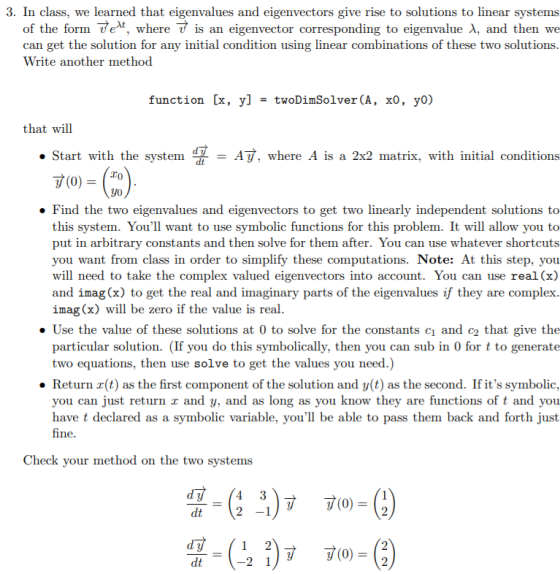
function [x, y] = twoDimSolver(A, x0, y0)
Homework Answers
Request Answer!
We need at least 10 more requests to produce the answer.
0 / 10 have requested this problem solution
The more requests, the faster the answer.
U = (x – x0)^α ⋅ (y – y0)^β, where x0, y0 are constants, best interpreted...
U = (x – x0)^α ⋅ (y – y0)^β, where x0, y0 are constants, best interpreted as minimum consumption quantities, and α + β = 1. Goods prices are given by px and py. Derive the demand functions for x and y. Derive the indirect utility function V(px,py,I). Derive the expenditure function E(px,py,U).
Given the Function F1(w, x, y, z) and F2(x0, x1, y0, y1), write the truth table...
 Given the Function F1(w, x, y, z) and F2(x0, x1, y0, y1), write
the truth table for each function. F1(w, x, y, z) - Specified by
the lab instructor F2(x0, x1, y0, y1) is a two bit adder. The
function F2(x0, x1, y0, y1) has 3 outputs - 2 bits for the sum and
1 bit for the carry out Cout
3. Given the Function F1(w, x, y, z) and F2(x0, X1, yo, yı), write the truth table for each...
Given the Function F1(w, x, y, z) and F2(x0, x1, y0, y1), write
the truth table for each function. F1(w, x, y, z) - Specified by
the lab instructor F2(x0, x1, y0, y1) is a two bit adder. The
function F2(x0, x1, y0, y1) has 3 outputs - 2 bits for the sum and
1 bit for the carry out Cout
3. Given the Function F1(w, x, y, z) and F2(x0, X1, yo, yı), write the truth table for each...
given ivp y' = (2y)/x, y(x0) = y0 using the existence and uniqueness theorem show that...
given ivp y' = (2y)/x, y(x0) = y0 using the existence and uniqueness theorem show that a unique solution exists on any interval where x0 does not equal 0, no solution exists if y(0) = y0 does not equal 0, and and infinite number of solutions exist if y(0) = 0
We have this simple ODE model subject to x(0) = x0 ≥ 0, y(0) = y0...
 We have this simple ODE model subject to x(0) = x0 ≥ 0, y(0) =
y0 ≥ 0 (you may choose values of x0 and y0). The constants α, β
> 0.
Question: Find an ODE for y(t) by eliminating x. Solve this ODE
analytically. Plot solutions using Mathematica.
x — ау dx dt dy dt = Вх y
We have this simple ODE model subject to x(0) = x0 ≥ 0, y(0) =
y0 ≥ 0 (you may choose values of x0 and y0). The constants α, β
> 0.
Question: Find an ODE for y(t) by eliminating x. Solve this ODE
analytically. Plot solutions using Mathematica.
x — ау dx dt dy dt = Вх y
Determine " (x0). ""' (xo) and (x0) for the given point xo if y = $(x)...
 Determine " (x0). ""' (xo) and (x0) for the given point xo if y = $(x) is a solution of the given initial value problem. y" + xy' + y = 0, y(0) = 5, y' (0) = 3 (0) = 0" (0) = piv (0) =
Design a 4-bit Full Adder with inputs (X0...X3, Y0...Y3.), in which inputs X are connect to...
Design a 4-bit Full Adder with inputs (X0...X3, Y0...Y3.), in which inputs X are connect to two 4-bit registers via four 2-to-1 Multiplexers and inputs Y are connected to two other 4-bit registers via four 2-to-1 Multiplexers. In this case, assume that Carry in is always zero (and is therefore pull down) and that the register outputs 4-bits at a time. Please make sure to show the proper connections between Full adder, MUXS, and registers.
VBA The projectile motion equations are,x=x0+v0*cos(θ)*t, y=y0+v0*sin(θ)*t+0.5*g*t^2 where x and y are the current position at...
VBA The projectile motion equations are,x=x0+v0*cos(θ)*t, y=y0+v0*sin(θ)*t+0.5*g*t^2 where x and y are the current position at time t, x0 and y0 are the projectile’s initial position, v0 is the projectile’s initial speed, θ is the initial firing angle of the projectile, and g is the gravitational acceleration which is -9.81 m/s2 near Earth’s surface. The user (me) will input the initial x-position (m), y-position (m), speed (m/s), the firing angle (in degrees) in cells F2-F5 on Sheet2. Create a run...
A force F = 61 N i acts on an object at a point (x0, y0)...
 A force F = 61 N i acts on an object
at a point (x0, y0) = (6.2 m, 4.7
m) as shown in the figure. What is the magnitude of the
torque generated by this force about the origin?
What is the magnitude of the torque generated by this force
about the point (x, y) = (2.9 m, 1.6 m)?
Suppose the object is free to rotate about the z axis. If the
object has a moment of inertia...
A force F = 61 N i acts on an object
at a point (x0, y0) = (6.2 m, 4.7
m) as shown in the figure. What is the magnitude of the
torque generated by this force about the origin?
What is the magnitude of the torque generated by this force
about the point (x, y) = (2.9 m, 1.6 m)?
Suppose the object is free to rotate about the z axis. If the
object has a moment of inertia...
If we observe y0 as the value for a geometric random variable Y, P(Y = y0)...
If we observe y0 as the value for a geometric random variable Y, P(Y = y0) is maximized when p = 1/Y0. The maximum likelihood estimator for p is 1/Y (note that Y is the geometric random variable, not a particular value of it). Derive E(1/y). E (1/y) =
Given a two-variable function f(x, y), if P(x0,yo) is a critical point, then the behavior of...
 Given a two-variable function f(x, y), if P(x0,yo) is a critical point, then the behavior of f around P can be approximated by its second order terms according to Taylor series, that is, f(x,y) = f(P) + F(x – xo)?H (x, y) , where H(x, y) = fyy(P)(=%)2 + 2 fxy(P) (?=%) + fxx(P). (a). If H(x, y) > 0 for all x,y, is P a local max, local min or saddle point? (b). Let s = (4=90). Then, H(x,...
 Given the Function F1(w, x, y, z) and F2(x0, x1, y0, y1), write
the truth table for each function. F1(w, x, y, z) - Specified by
the lab instructor F2(x0, x1, y0, y1) is a two bit adder. The
function F2(x0, x1, y0, y1) has 3 outputs - 2 bits for the sum and
1 bit for the carry out Cout
3. Given the Function F1(w, x, y, z) and F2(x0, X1, yo, yı), write the truth table for each...
Given the Function F1(w, x, y, z) and F2(x0, x1, y0, y1), write
the truth table for each function. F1(w, x, y, z) - Specified by
the lab instructor F2(x0, x1, y0, y1) is a two bit adder. The
function F2(x0, x1, y0, y1) has 3 outputs - 2 bits for the sum and
1 bit for the carry out Cout
3. Given the Function F1(w, x, y, z) and F2(x0, X1, yo, yı), write the truth table for each...
 We have this simple ODE model subject to x(0) = x0 ≥ 0, y(0) =
y0 ≥ 0 (you may choose values of x0 and y0). The constants α, β
> 0.
Question: Find an ODE for y(t) by eliminating x. Solve this ODE
analytically. Plot solutions using Mathematica.
x — ау dx dt dy dt = Вх y
We have this simple ODE model subject to x(0) = x0 ≥ 0, y(0) =
y0 ≥ 0 (you may choose values of x0 and y0). The constants α, β
> 0.
Question: Find an ODE for y(t) by eliminating x. Solve this ODE
analytically. Plot solutions using Mathematica.
x — ау dx dt dy dt = Вх y
 Determine " (x0). ""' (xo) and (x0) for the given point xo if y = $(x) is a solution of the given initial value problem. y" + xy' + y = 0, y(0) = 5, y' (0) = 3 (0) = 0" (0) = piv (0) =
 A force F = 61 N i acts on an object
at a point (x0, y0) = (6.2 m, 4.7
m) as shown in the figure. What is the magnitude of the
torque generated by this force about the origin?
What is the magnitude of the torque generated by this force
about the point (x, y) = (2.9 m, 1.6 m)?
Suppose the object is free to rotate about the z axis. If the
object has a moment of inertia...
A force F = 61 N i acts on an object
at a point (x0, y0) = (6.2 m, 4.7
m) as shown in the figure. What is the magnitude of the
torque generated by this force about the origin?
What is the magnitude of the torque generated by this force
about the point (x, y) = (2.9 m, 1.6 m)?
Suppose the object is free to rotate about the z axis. If the
object has a moment of inertia...
 Given a two-variable function f(x, y), if P(x0,yo) is a critical point, then the behavior of f around P can be approximated by its second order terms according to Taylor series, that is, f(x,y) = f(P) + F(x – xo)?H (x, y) , where H(x, y) = fyy(P)(=%)2 + 2 fxy(P) (?=%) + fxx(P). (a). If H(x, y) > 0 for all x,y, is P a local max, local min or saddle point? (b). Let s = (4=90). Then, H(x,...
Most questions answered within 3 hours.
-
Where is the error in this code sequence?
String s1 = "Hello";
String s2 = "ello";...
asked 11 months ago -
Financial data for Joel de Paris, Inc., for last year
follow:
Joel de Paris, Inc.
Balance...
asked 11 months ago -
Consider this reaction:
Al2(SO4)3 (aq)+ BaCl3
(aq) Al2Cl6 (aq)- +
3BaSO4(s) . What is the...
asked 11 months ago -
Suppose that Savneet is considering increasing her
recent random sample from 20 car rentals to 40...
asked 11 months ago -
Trucks arrive at an unloading terminal at an average rate of 120
per hour.
Trucks arrive...
asked 11 months ago -
Why are methanol and ethanol completely soluble in water while
octanol is not very little soluble....
asked 11 months ago -
A facilities manager at a university reads in a research report
that the mean amount of...
asked 11 months ago -
When the CuSO4 is rehydrated by adding water to the anhydrous
compound, is this an endothermic...
asked 11 months ago -
A ray of sunlight is passing from diamond into crown glass; the
angle of incidence is...
asked 11 months ago -
A block of mass 0.249 kg is placed on top of a light, vertical
spring of...
asked 11 months ago -
how do the kidneys compensate in the presences of acidosis
a) trigger hyperventilate
b) reserve acid...
asked 11 months ago -
Question 501 pts
The rental rate of capital to the firm increases. Which of the
following...
asked 11 months ago