The lesson is about First Law of Thermodynamic. The problems
have answers but i need solutions. PLEASE HELP ME! THANK
YOU!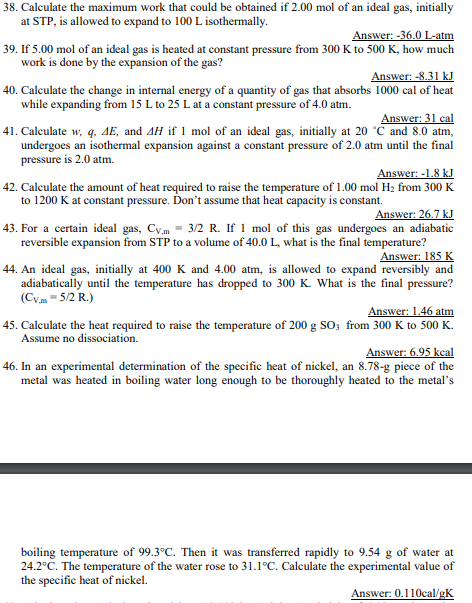
Homework Answers
38)
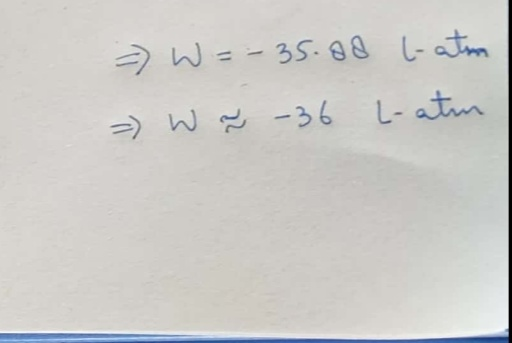
for isothermal process of an ideal gas, the formula for work is given by:
 ...........(1)
where, W = work done
n = number of moles
R = universal gas constant = 0.0821 (L atm)/ (mol K)
T = temperature
V2 and V1 = volume at state 2 and 1 respectively
P2 and P1 = pressure at state 2 and 1 respectively
first, we have to determine volume at state 1.

note:
as per HOMEWORKLIB RULES, first question of multiple questions has been solved.
Add Answer to:
The lesson is about First Law of Thermodynamic. The problems
have answers but i need solutions....
Can you please help me with these 5 problems!!! please and thank you Question 1 A...
Can you please help me with these 5 problems!!! please and thank you Question 1 A mass of 5 kilograms of carbon dioxide (CO2) in a piston-cylinder assembly undergoes two processes in series from an initial state where p1 = 2.4 MPa, T1 = 260°C: Process 1–2: Constant-temperature expansion until the volume is twice the initial volume. Process 2–3: Constant-volume heating until the pressure is again 2.4 MPa. Assuming ideal gas behavior, determine the overall work, in kJ. ____________________________________________________________ Nitrogen...
1. A) Argon contained in a closed, rigid tank, initially at 32.7°C, 1.5 bar, and a...
1. A) Argon contained in a closed, rigid tank, initially at 32.7°C, 1.5 bar, and a volume of 0.9 m3, is heated to a final pressure of 9.2 bar. Assuming the ideal gas model with k = 1.53 for the argon, determine the heat transfer, in kJ. B) Nitrogen (N2) contained in a piston–cylinder arrangement, initially at 8.6 bar and 422 K, undergoes an expansion to a final temperature of 300 K, during which the pressure–volume relationship is pV1.4 =...
1. A) Argon contained in a closed, rigid tank, initially at 36.3°C, 2.8 bar, and a...
1. A) Argon contained in a closed, rigid tank, initially at 36.3°C, 2.8 bar, and a volume of 1.4 m3, is heated to a final pressure of 9.9 bar. Assuming the ideal gas model with k = 1.53 for the argon, determine the heat transfer, in kJ. B) Nitrogen (N2) contained in a piston–cylinder arrangement, initially at 6 bar and 435 K, undergoes an expansion to a final temperature of 300 K, during which the pressure–volume relationship is pV1.5 =...
1.Water vapor contained in a piston–cylinder assembly undergoes an isothermal expansion at 277°C from a pressure...
1.Water vapor contained in a piston–cylinder assembly undergoes an isothermal expansion at 277°C from a pressure of 5.1 bar to a pressure of 2.7 bar. Evaluate the work, in kJ/kg. 2.Nitrogen (N2) contained in a piston–cylinder arrangement, initially at 9.3 bar and 437 K, undergoes an expansion to a final temperature of 300 K, during which the pressure–volume relationship is pV1.1 = constant. Assuming the ideal gas model for the N2, determine the heat transfer in kJ/kg. 3.Argon contained in...
1.Argon contained in a closed, rigid tank, initially at 62.3°C, 3.9 bar, and a volume of...
1.Argon contained in a closed, rigid tank, initially at 62.3°C, 3.9 bar, and a volume of 4.2 m3, is heated to a final pressure of 9.4 bar. Assuming the ideal gas model with k = 1.6 for the argon, determine the heat transfer, in kJ. 2.Water vapor contained in a piston–cylinder assembly undergoes an isothermal expansion at 223°C from a pressure of 5.4 bar to a pressure of 1.9 bar. Evaluate the work, in kJ/kg. 3.A mass of 4 kilograms...
i need help with the last four questions along with step by step he appropriate gas law to solve questions 1-6. Show work. (2 pts) A certain amount of a gas at a constant temperature has a pressur...
 i need help with the last four questions along with
step by step
he appropriate gas law to solve questions 1-6. Show work. (2 pts) A certain amount of a gas at a constant temperature has a pressure of 5.50 atm and a volume of 10.0 mL. If the volume is decreased to 125.0 mL, what is the resulting pressure of the gas? : 924 a4m 125 O P v (2 pts) If 0.722 L of a certain gas at...
i need help with the last four questions along with
step by step
he appropriate gas law to solve questions 1-6. Show work. (2 pts) A certain amount of a gas at a constant temperature has a pressure of 5.50 atm and a volume of 10.0 mL. If the volume is decreased to 125.0 mL, what is the resulting pressure of the gas? : 924 a4m 125 O P v (2 pts) If 0.722 L of a certain gas at...
4. An ideal gas of 5.0 mol CO2 is originally confined in 15 L at 300...
 4. An ideal gas of 5.0 mol CO2 is originally confined in 15 L at 300 K. Assume it undergoes isothermal expansion against a constant pressure of 1.0 atm until equilibrium is reached. Assume the heat capacity of CO2 at constant pressure, Cp.m is 37.11 J/mol K. Calculate the final volume, q, w,aU, and △H for the process. (15%) 5. Calculate the minimum work needed to freeze 250 g of water originally at 0°C standing in a room at 20°C....
1.5 mol of an ideal gas is initially at 0°C. It undergoes an isobaric expansion at...
1.5 mol of an ideal gas is initially at 0°C. It undergoes an isobaric expansion at p = 2.0 atm to three times its initial volume. Calculate the final temperature of the gas, Tf (in K). Calculate the work done on the gas during the expansion (in kJ). (Include the sign of the value in your answer.)
1. a 10 mol sample of ideal gas whose heat capacities are Cv= 20.8 J/K Mole...
1. a 10 mol sample of ideal gas whose heat capacities are Cv= 20.8 J/K Mole and Cv = 29.1 J/K Mole a. Undergoes a reversible constant volume cooking from 49.3 L, 300 K, and 5.00 atm to 150 K. Calculate q, w, and ΔU. b. the same gas then underwent a reversible constant pressure expansion from 150 K and 2.50 atm to 98.6 L. Calculate q , w, and ΔU. You'll need the ideal gas law to calculate T-final...
1.4 mol of an ideal gas is initially at 0°C. It undergoes an isobaric expansion at...
1.4 mol of an ideal gas is initially at 0°C. It undergoes an isobaric expansion at p = 1.8 atm to three times its initial volume. (a) Calculate the final temperature of the gas, Tf (in K). (b) Calculate the work done on the gas during the expansion (in kJ). (Include the sign of the value in your answer.)
 i need help with the last four questions along with
step by step
he appropriate gas law to solve questions 1-6. Show work. (2 pts) A certain amount of a gas at a constant temperature has a pressure of 5.50 atm and a volume of 10.0 mL. If the volume is decreased to 125.0 mL, what is the resulting pressure of the gas? : 924 a4m 125 O P v (2 pts) If 0.722 L of a certain gas at...
i need help with the last four questions along with
step by step
he appropriate gas law to solve questions 1-6. Show work. (2 pts) A certain amount of a gas at a constant temperature has a pressure of 5.50 atm and a volume of 10.0 mL. If the volume is decreased to 125.0 mL, what is the resulting pressure of the gas? : 924 a4m 125 O P v (2 pts) If 0.722 L of a certain gas at...
 4. An ideal gas of 5.0 mol CO2 is originally confined in 15 L at 300 K. Assume it undergoes isothermal expansion against a constant pressure of 1.0 atm until equilibrium is reached. Assume the heat capacity of CO2 at constant pressure, Cp.m is 37.11 J/mol K. Calculate the final volume, q, w,aU, and △H for the process. (15%) 5. Calculate the minimum work needed to freeze 250 g of water originally at 0°C standing in a room at 20°C....
Most questions answered within 3 hours.
-
Where is the error in this code sequence?
String s1 = "Hello";
String s2 = "ello";...
asked 11 months ago -
Financial data for Joel de Paris, Inc., for last year
follow:
Joel de Paris, Inc.
Balance...
asked 11 months ago -
Consider this reaction:
Al2(SO4)3 (aq)+ BaCl3
(aq) Al2Cl6 (aq)- +
3BaSO4(s) . What is the...
asked 11 months ago -
Suppose that Savneet is considering increasing her
recent random sample from 20 car rentals to 40...
asked 11 months ago -
Trucks arrive at an unloading terminal at an average rate of 120
per hour.
Trucks arrive...
asked 11 months ago -
Why are methanol and ethanol completely soluble in water while
octanol is not very little soluble....
asked 11 months ago -
A facilities manager at a university reads in a research report
that the mean amount of...
asked 11 months ago -
When the CuSO4 is rehydrated by adding water to the anhydrous
compound, is this an endothermic...
asked 11 months ago -
A ray of sunlight is passing from diamond into crown glass; the
angle of incidence is...
asked 11 months ago -
A block of mass 0.249 kg is placed on top of a light, vertical
spring of...
asked 11 months ago -
how do the kidneys compensate in the presences of acidosis
a) trigger hyperventilate
b) reserve acid...
asked 11 months ago -
Question 501 pts
The rental rate of capital to the firm increases. Which of the
following...
asked 11 months ago