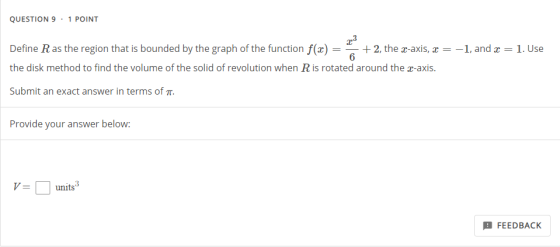
Define R as the region that is bounded by the graph of the function f(X)=x^3/6+2, the xaxis, x=-1, and x=1.
Homework Answers
![[ace !1+1) +ul141)+5.-!] *** 6 Griven function f(x)= x3 x=-1 and n=1 volume of the is volume region using disk x 3 1. +2 ) ²](http://img.homeworklib.com/questions/1c755d30-37fb-11eb-8436-7b0cc63524da.png?x-oss-process=image/resize,w_560)
Add Answer to:
Define R as the region that is bounded by the graph of the
function f(X)=x^3/6+2, the...
5. Define R as the region bounded by the graph of y=2x-r and by the x-axis...
 5. Define R as the region bounded by the graph of y=2x-r and by the x-axis over the interval [0,2]. Find the volume of the solid of revolution formed by revolving R around the y-axis. Hint: Use Shell Method s
Instructions: Show all your work for FULL credit. Calculators are NOL final answer. Neatness is highly appreciated. 1. A region R, bounded by y 2x, y 6-x, and x-axis, is rotated around the y-axis. Sk...
 Instructions: Show all your work for FULL credit. Calculators are NOL final answer. Neatness is highly appreciated. 1. A region R, bounded by y 2x, y 6-x, and x-axis, is rotated around the y-axis. Sketch the region R, in the box a) 15 strip/slice you will use to find the volume of the solid of revolution. b) Write the definite integral that gives a X the volume of the solid of revolution. (DO NOT evaluate the integral.) Find the circumference...
os. Define R as the region bounded by the graph of y2x-x' and by the axis...
 os. Define R as the region bounded by the graph of y2x-x' and by the axis over the interval [0.21 Find the volume of the solid of revolution formed by revolving Ruround the y-axis. Hint: Use Shell Method. 16 pts) 6. Find the average value, so of the function /(x) = cos x over the interval (0, 2) and find e such that f(e) equals the average value of the function over [0, 2x) 15 pts] 7. Express the limits...
6. [10 points] Consider the function f(x) = 2 + cose over the interval (1,6), where...
 6. [10 points] Consider the function f(x) = 2 + cose over the interval (1,6), where I is measured in radians. Let S be the region that is bounded above by the graph of f(x), below by the 2-axis, on the left by the line = 1, and on the right by the line = 6. This question concerns the process of approximating, and exactly calculating, the volume of the solid that is obtained when S is rotated around the...
24. The region bounded by f'(x) = -4sinx , x = 1 , x = 211...
 24. The region bounded by f'(x) = -4sinx , x = 1 , x = 211 , and y = 0 is rotated about the y-axis. Find the volume of the solid of revolution. Write the answer as an exact value (without decimals).
2) The region R in the first quadrant of the xy-plane is bounded by the curves...
2) The region R in the first quadrant of the xy-plane is bounded by the curves y=−3x^2+21x+54, x=0 and y=0. A solid S is formed by rotating R about the y-axis: the (exact) volume of S is = 3) The region R in the first quadrant of the xy-plane is bounded by the curves y=−2sin(x), x=π, x=2π and y=0. A solid S is formed by rotating R about the y-axis: the volume of S is = 4) The region bounded...
Math232 2 Consider the region in first quadrant area bounded by y x,x=6, and the x-axis....
 Math232 2 Consider the region in first quadrant area bounded by y x,x=6, and the x-axis. Revolve this bounded region about the x-axis a) Sketch this region and find the volume of the solid of revolution; use the disk method, and show an element of the volume. (15 marks) b) Find the coordinates of the centroid of the solid of revolution Find the moment of inertia of the solid of revolution with respect to the x-axis. d)
Math232 2 Consider...
Math232 2 Consider the region in first quadrant area bounded by y x,x=6, and the x-axis. Revolve this bounded region about the x-axis a) Sketch this region and find the volume of the solid of revolution; use the disk method, and show an element of the volume. (15 marks) b) Find the coordinates of the centroid of the solid of revolution Find the moment of inertia of the solid of revolution with respect to the x-axis. d)
Math232 2 Consider...
Math23 2 Consider the region in first quadrant area bounded by y x, x 6, and...
 Math23 2 Consider the region in first quadrant area bounded by y x, x 6, and the x-axis. Revolve this bounded region about the x-axis a) Sketch this region and find the volume of the solid of revolution; use the disk method and show an element of the volume. (15 marks) b) Find the coordinates of the centroid of the solid of revolution. c) Find the coordinates of the centroid of the plate; on the sketch above, show the vertical...
16pts. Use the Disk Method to find the volume of the solid of revolution bounded by...
 16pts. Use the Disk Method to find the volume of the solid of revolution bounded by the graphs of y=x+1 1. und 2, and rotated about the x-axis. 87 16 pts] 4. Use the Washer Method to find the volume of a solid of revolution formed by revolving the region bounded above by the graph of y = 2x and below by the graph of y = 2/x over the interval [1, 4) around the x-axis A
3. Consider the region R, bounded by the function f(x) and the x and y values...
 3. Consider the region R, bounded by the function f(x) and the x and y values shown. Write down an integral for the volume of the solid obtained by revolving R about the given line. Indicate what method you use in each case. 3 f(x) 2 R (Disk, Washer, or Shell) 1 You do not need to simplify but be sure to include the proper bounds on your integrals. a) The y-axis. Method: b) The line y =1. Method: c)...
 5. Define R as the region bounded by the graph of y=2x-r and by the x-axis over the interval [0,2]. Find the volume of the solid of revolution formed by revolving R around the y-axis. Hint: Use Shell Method s
 Instructions: Show all your work for FULL credit. Calculators are NOL final answer. Neatness is highly appreciated. 1. A region R, bounded by y 2x, y 6-x, and x-axis, is rotated around the y-axis. Sketch the region R, in the box a) 15 strip/slice you will use to find the volume of the solid of revolution. b) Write the definite integral that gives a X the volume of the solid of revolution. (DO NOT evaluate the integral.) Find the circumference...
 os. Define R as the region bounded by the graph of y2x-x' and by the axis over the interval [0.21 Find the volume of the solid of revolution formed by revolving Ruround the y-axis. Hint: Use Shell Method. 16 pts) 6. Find the average value, so of the function /(x) = cos x over the interval (0, 2) and find e such that f(e) equals the average value of the function over [0, 2x) 15 pts] 7. Express the limits...
 6. [10 points] Consider the function f(x) = 2 + cose over the interval (1,6), where I is measured in radians. Let S be the region that is bounded above by the graph of f(x), below by the 2-axis, on the left by the line = 1, and on the right by the line = 6. This question concerns the process of approximating, and exactly calculating, the volume of the solid that is obtained when S is rotated around the...
 24. The region bounded by f'(x) = -4sinx , x = 1 , x = 211 , and y = 0 is rotated about the y-axis. Find the volume of the solid of revolution. Write the answer as an exact value (without decimals).
 Math232 2 Consider the region in first quadrant area bounded by y x,x=6, and the x-axis. Revolve this bounded region about the x-axis a) Sketch this region and find the volume of the solid of revolution; use the disk method, and show an element of the volume. (15 marks) b) Find the coordinates of the centroid of the solid of revolution Find the moment of inertia of the solid of revolution with respect to the x-axis. d)
Math232 2 Consider...
Math232 2 Consider the region in first quadrant area bounded by y x,x=6, and the x-axis. Revolve this bounded region about the x-axis a) Sketch this region and find the volume of the solid of revolution; use the disk method, and show an element of the volume. (15 marks) b) Find the coordinates of the centroid of the solid of revolution Find the moment of inertia of the solid of revolution with respect to the x-axis. d)
Math232 2 Consider...
 Math23 2 Consider the region in first quadrant area bounded by y x, x 6, and the x-axis. Revolve this bounded region about the x-axis a) Sketch this region and find the volume of the solid of revolution; use the disk method and show an element of the volume. (15 marks) b) Find the coordinates of the centroid of the solid of revolution. c) Find the coordinates of the centroid of the plate; on the sketch above, show the vertical...
 16pts. Use the Disk Method to find the volume of the solid of revolution bounded by the graphs of y=x+1 1. und 2, and rotated about the x-axis. 87 16 pts] 4. Use the Washer Method to find the volume of a solid of revolution formed by revolving the region bounded above by the graph of y = 2x and below by the graph of y = 2/x over the interval [1, 4) around the x-axis A
 3. Consider the region R, bounded by the function f(x) and the x and y values shown. Write down an integral for the volume of the solid obtained by revolving R about the given line. Indicate what method you use in each case. 3 f(x) 2 R (Disk, Washer, or Shell) 1 You do not need to simplify but be sure to include the proper bounds on your integrals. a) The y-axis. Method: b) The line y =1. Method: c)...
Most questions answered within 3 hours.
-
Where is the error in this code sequence?
String s1 = "Hello";
String s2 = "ello";...
asked 10 months ago -
Financial data for Joel de Paris, Inc., for last year
follow:
Joel de Paris, Inc.
Balance...
asked 10 months ago -
Consider this reaction:
Al2(SO4)3 (aq)+ BaCl3
(aq) Al2Cl6 (aq)- +
3BaSO4(s) . What is the...
asked 10 months ago -
Suppose that Savneet is considering increasing her
recent random sample from 20 car rentals to 40...
asked 10 months ago -
Trucks arrive at an unloading terminal at an average rate of 120
per hour.
Trucks arrive...
asked 10 months ago -
Why are methanol and ethanol completely soluble in water while
octanol is not very little soluble....
asked 10 months ago -
A facilities manager at a university reads in a research report
that the mean amount of...
asked 10 months ago -
When the CuSO4 is rehydrated by adding water to the anhydrous
compound, is this an endothermic...
asked 10 months ago -
A ray of sunlight is passing from diamond into crown glass; the
angle of incidence is...
asked 10 months ago -
A block of mass 0.249 kg is placed on top of a light, vertical
spring of...
asked 10 months ago -
how do the kidneys compensate in the presences of acidosis
a) trigger hyperventilate
b) reserve acid...
asked 10 months ago -
Question 501 pts
The rental rate of capital to the firm increases. Which of the
following...
asked 10 months ago