Someone please help me on the second part to this question...
thanks in advance!
Homework Answers
Use the equation for diffraction of light and find the distance
between the two adjacent minima to find the width of the maxima as
shown below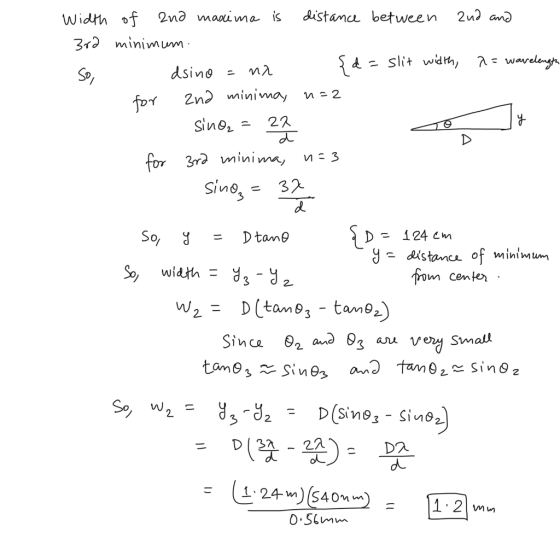
Add Answer to:
Someone please help me on the second part to this question...
thanks in advance!
A physicist...
1.) Which of the following statements is NOT true about a double-slit interference pattern? The bright...
1.) Which of the following statements is NOT true about a double-slit interference pattern? The bright fringes are longer than the dark fringes. Adjacent bright fringes have approximately equal brightness / intensity. The dark fringes are equally-spaced. The bright fringes are equally spaced. 2.) If you compare the single-slit pattern and the double-lit pattern, which of the following is correct? There are more bright fringes in the double-slit pattern compared to the single-slit pattern. There are more dark fringes in...
Consider double slit experiment with two slits are separated by d=0,715 mm
Consider double slit experiment with two slits are separated by d=0.715 mm and each slit width is 0.00321 mm. Screen is placed L=1.28 m away from the slits. a) Derive an algebraic equation to find linear distance of interference bright fringe on the screen from central bright (central maxima) fringe? b) Consider interference pattern due to light of unknown wavelength and linear separation between 2 and 5" bright fringes is 3.05 mm. Find the wavelength of the light? c) Now consider double slit...
Light of wavelength 700 nm falls on a 0.44 mm wide slit and forms a diffraction...
 Light of wavelength 700 nm falls on a 0.44 mm wide slit and forms a diffraction pattern on a screen 1.2 m wway. (a) Find the position of the first dark band on each side of the central maximum. mm (b) Find the width of the central maximum. 3. [-/10 Points] DETAILS SERCP7 24.P.031. MY NOTES PRACTICE ANOTHER Light of wavelength 587.9 nm illuminates a siit, of width 0.74 mm. (a) At what distance from the slit should a screen...
please show all work, include sketch, explanation. thank you! era un elence (o) at P, In...
 please show all work, include sketch, explanation. thank
you!
era un elence (o) at P, In radians, between these two waves: You might consider that the phase difference (what you want) is related to the path difference (what you are given) between the waves Determine the number of bright fringes inside the central diffraction envelope for a double-slit pattern if = 580 nm, d = 0.150 mm, and a = 25.0 um. What is the ratio of the intensity of...
please show all work, include sketch, explanation. thank
you!
era un elence (o) at P, In radians, between these two waves: You might consider that the phase difference (what you want) is related to the path difference (what you are given) between the waves Determine the number of bright fringes inside the central diffraction envelope for a double-slit pattern if = 580 nm, d = 0.150 mm, and a = 25.0 um. What is the ratio of the intensity of...
Round your final answers to three significant figures. The central bright fringe in a single-slit diffraction...
 Round your final answers to three significant figures. The central bright fringe in a single-slit diffraction pattern from light of wavelength 633 nm is 2.50 cm wide on a screen that is 1.050 m from the slit. (a) How wide is the slit? mm (b) How wide are the first two bright fringes on either side of the central bright fringe? (Define the width of a bright fringe as the linear distance from minimum to minimum) cm
A double slit aperture is illuminated by light of wavelength 530nm and the interference pattern is...
 A double slit aperture is illuminated by light of wavelength 530nm and the interference pattern is observed on a screen 5.00m away. The slits are 2.125fim width and are separated by 0.1mm. How far apart are the first and second bright fringes? How far apart are the first and second dark fringes? Determine the slit to screen distance required such that the width of the central peak of the diffraction pattern is 1 m. Why is the calculation from part...
ASAP PLEASE 2. Interference, 35 points 2.1, 25 points. A single slit is illuminated wit th...
 ASAP PLEASE
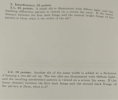
2. Interference, 35 points 2.1, 25 points. A single slit is illuminated wit th 500mm mm light, and the If the B resulting diffraction pattern is viewed on a sereen 3m awa distance betwen the irst dark fringe and the central bright fringe ofcl pattern is 15cm, what is the width of the slit? 2.2, 10 points. Another slit of the same width is added at a distance d forming a two-slit set up. The two slits are...
ASAP PLEASE
2. Interference, 35 points 2.1, 25 points. A single slit is illuminated wit th 500mm mm light, and the If the B resulting diffraction pattern is viewed on a sereen 3m awa distance betwen the irst dark fringe and the central bright fringe ofcl pattern is 15cm, what is the width of the slit? 2.2, 10 points. Another slit of the same width is added at a distance d forming a two-slit set up. The two slits are...
A beam of light of wavelength 600 nm from a distant source falls on a single...
A beam of light of wavelength 600 nm from a distant source falls on a single slit 1.00 mm wide and resulting diffraction pattern is observed on a screen 2 m away. The distance between the first dark fringes on either side of the central bright fringe is 1.2 cm 1.2 mm 6x10⁻⁴ m 2.4 mm
Light of wavelength 540 nanometer is incident on a slit of width 0.150 mm and a...
Light of wavelength 540 nanometer is incident on a slit of width 0.150 mm and a diffraction pattern is produced on a screen that is 2.00 m from the slit. If the dark images are very very thin, what is the width of the central bright fringe in cm ? (1nanometer = 1x 10⁻⁹ m) ( 10 pts ) 1.44 cm 0.720 cm 2.16 cm 1.76 cm
(5) Laser light of wavelength 632.8 nm illuminates a single slit with width 0.0250 mm. The...
 (5) Laser light of wavelength 632.8 nm illuminates a single slit with width 0.0250 mm. The transmitted light is viewed on a distant screen and the maximum intensity is 8.50 W/m² for the central bright fringe. (a) At what angle (in degrees) does the first minimum occur? (b) At what angle (in degrees) does the second minimum occur? (c) What is the intensity of the first secondary maxima? You may approximate its position as halfway between the first and second...
 Light of wavelength 700 nm falls on a 0.44 mm wide slit and forms a diffraction pattern on a screen 1.2 m wway. (a) Find the position of the first dark band on each side of the central maximum. mm (b) Find the width of the central maximum. 3. [-/10 Points] DETAILS SERCP7 24.P.031. MY NOTES PRACTICE ANOTHER Light of wavelength 587.9 nm illuminates a siit, of width 0.74 mm. (a) At what distance from the slit should a screen...
 please show all work, include sketch, explanation. thank
you!
era un elence (o) at P, In radians, between these two waves: You might consider that the phase difference (what you want) is related to the path difference (what you are given) between the waves Determine the number of bright fringes inside the central diffraction envelope for a double-slit pattern if = 580 nm, d = 0.150 mm, and a = 25.0 um. What is the ratio of the intensity of...
please show all work, include sketch, explanation. thank
you!
era un elence (o) at P, In radians, between these two waves: You might consider that the phase difference (what you want) is related to the path difference (what you are given) between the waves Determine the number of bright fringes inside the central diffraction envelope for a double-slit pattern if = 580 nm, d = 0.150 mm, and a = 25.0 um. What is the ratio of the intensity of...
 Round your final answers to three significant figures. The central bright fringe in a single-slit diffraction pattern from light of wavelength 633 nm is 2.50 cm wide on a screen that is 1.050 m from the slit. (a) How wide is the slit? mm (b) How wide are the first two bright fringes on either side of the central bright fringe? (Define the width of a bright fringe as the linear distance from minimum to minimum) cm
 A double slit aperture is illuminated by light of wavelength 530nm and the interference pattern is observed on a screen 5.00m away. The slits are 2.125fim width and are separated by 0.1mm. How far apart are the first and second bright fringes? How far apart are the first and second dark fringes? Determine the slit to screen distance required such that the width of the central peak of the diffraction pattern is 1 m. Why is the calculation from part...
 ASAP PLEASE
2. Interference, 35 points 2.1, 25 points. A single slit is illuminated wit th 500mm mm light, and the If the B resulting diffraction pattern is viewed on a sereen 3m awa distance betwen the irst dark fringe and the central bright fringe ofcl pattern is 15cm, what is the width of the slit? 2.2, 10 points. Another slit of the same width is added at a distance d forming a two-slit set up. The two slits are...
ASAP PLEASE
2. Interference, 35 points 2.1, 25 points. A single slit is illuminated wit th 500mm mm light, and the If the B resulting diffraction pattern is viewed on a sereen 3m awa distance betwen the irst dark fringe and the central bright fringe ofcl pattern is 15cm, what is the width of the slit? 2.2, 10 points. Another slit of the same width is added at a distance d forming a two-slit set up. The two slits are...
 (5) Laser light of wavelength 632.8 nm illuminates a single slit with width 0.0250 mm. The transmitted light is viewed on a distant screen and the maximum intensity is 8.50 W/m² for the central bright fringe. (a) At what angle (in degrees) does the first minimum occur? (b) At what angle (in degrees) does the second minimum occur? (c) What is the intensity of the first secondary maxima? You may approximate its position as halfway between the first and second...
Most questions answered within 3 hours.
-
Where is the error in this code sequence?
String s1 = "Hello";
String s2 = "ello";...
asked 10 months ago -
Financial data for Joel de Paris, Inc., for last year
follow:
Joel de Paris, Inc.
Balance...
asked 10 months ago -
Consider this reaction:
Al2(SO4)3 (aq)+ BaCl3
(aq) Al2Cl6 (aq)- +
3BaSO4(s) . What is the...
asked 10 months ago -
Suppose that Savneet is considering increasing her
recent random sample from 20 car rentals to 40...
asked 10 months ago -
Trucks arrive at an unloading terminal at an average rate of 120
per hour.
Trucks arrive...
asked 10 months ago -
Why are methanol and ethanol completely soluble in water while
octanol is not very little soluble....
asked 10 months ago -
A facilities manager at a university reads in a research report
that the mean amount of...
asked 10 months ago -
When the CuSO4 is rehydrated by adding water to the anhydrous
compound, is this an endothermic...
asked 10 months ago -
A ray of sunlight is passing from diamond into crown glass; the
angle of incidence is...
asked 10 months ago -
A block of mass 0.249 kg is placed on top of a light, vertical
spring of...
asked 10 months ago -
how do the kidneys compensate in the presences of acidosis
a) trigger hyperventilate
b) reserve acid...
asked 10 months ago -
Question 501 pts
The rental rate of capital to the firm increases. Which of the
following...
asked 10 months ago