

Homework Answers
Add Answer to:
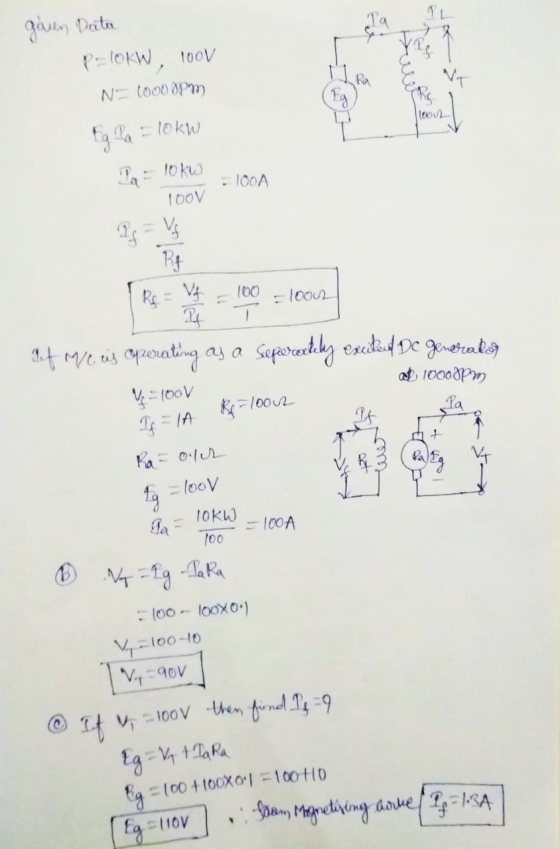
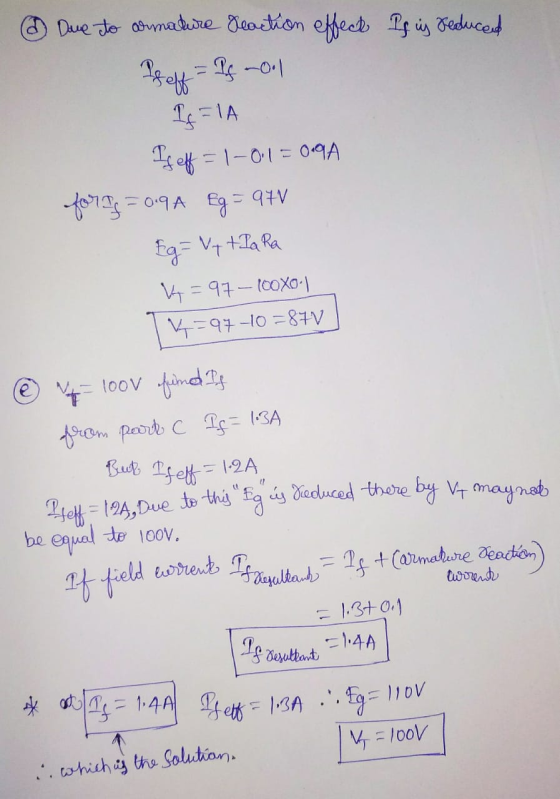
Q2. (10 points) A 10 kW, 100 V, 1000 rpm dc shunt generator has armature resistance...
part (b) Q5. The magnetization curve for a shunt DC generator is shown in Figure Q5-1.The...
 part (b)
Q5. The magnetization curve for a shunt DC generator is shown in Figure Q5-1.The generator is rated at 6 kW, 120 V, 50 A, and 1800 r/min and is shown in Figure Q5-2. Its field circuit is rated at 5A Figure Q5-1 The following data are known about the machine: 11r 0.180 120 V R, 24 Ω R.-0.18Ω -0 to 30 2 NF #1000 turns per pole v, Figure Q5-2 The shunt field resistor Radj is adjusted to...
part (b)
Q5. The magnetization curve for a shunt DC generator is shown in Figure Q5-1.The generator is rated at 6 kW, 120 V, 50 A, and 1800 r/min and is shown in Figure Q5-2. Its field circuit is rated at 5A Figure Q5-1 The following data are known about the machine: 11r 0.180 120 V R, 24 Ω R.-0.18Ω -0 to 30 2 NF #1000 turns per pole v, Figure Q5-2 The shunt field resistor Radj is adjusted to...
QUESTION 1 A) (10 marks) A 10 kW, 250 V DC self-excited shunt generator, with an...
 QUESTION 1 A) (10 marks) A 10 kW, 250 V DC self-excited shunt generator, with an armature resistance of 0.1 ohm, is delivering 80 % of rated power to the mains at rated voltage when being run at 1000 r.p.m. (revolutions per minute). The field circuit resistance is 220 ohms. The brush contact drop is 0.5 V and rotational (mechanical) losses are 750 W Calculate The induced voltage The electromagnetic torque developed The shaft torque The overall efficiency B) (15...
2. A dc machine (6 kW, 120 V, 1200 rpm, Ra = 0.2 Ω, Rf =...
2. A dc machine (6 kW, 120 V, 1200 rpm, Ra = 0.2 Ω, Rf = 100 Ω) has the following open circuit characteristics at 1200 rpm. If (A) 0 0.1 0.2 0.3 0.4 0.5 0.6 0.8 1.0 1.2 1.4 Ea (V) 5 20 40 60 79 93 102 114 120 125 130 It has a field control resistance whose value can be varied from 0 to 150 Ω. The machine is driven at 1200 rpm and separately excited from...
A 8250 w shunt DC motor has a terminal voltage of 300 V. A field resistance...
 A 8250 w shunt DC motor has a terminal voltage of 300 V. A field resistance Rf of 40 Ω, and an armature resistance Ra of 250 mm2. The field winding has 1500 turns. An adjustable resistance Rad is connected in series to the field winding. Rad is set at 20 Ω, but it can vary from 0 to 80 Ω. The magnetization curve is shown in Figure.1 and it is taken at a speed of 1200 rpm. (Armature reaction...
3. Each pole of a 100 kW, 250 V short-shunt flat-compound generator has a shunt field...
 3. Each pole of a 100 kW, 250 V short-shunt flat-compound generator has a shunt field of 2000 turns and a series field of 7 turns. If the series-field resistance is 0.01 and total shuntfield resistance is 100 2. Calculate the mmf when the machine operates at (a) no-load and (b) full-load Circuit Calculation(s) ha armature is connecte A permanent magnet dc motor tumsa source. Calculate the armature voltage requin (b) 1600 rpm. Neglect armature resistance. Circuit agnet de motor...
A 220 V DC shunt motor has an armature resistance, Re-0.1 S2, a field resistance, Ry=100...
 A 220 V DC shunt motor has an armature resistance, Re-0.1 S2, a field resistance, Ry=100 12, and negligible rotational losses. Under certain load conditions, the shunt motor runs at 1600 rpm while drawing a total current, I = 100 A. Determine: a. the output power of the motor; b. the output torque in N-m; and, c. the efficiency Without making any changes to the applied voltage or the field, the motor operates with a new M mechanical load that...
Q1: (30 points) A shunt DC generator, running at a constant speed of 1400 rpm, has...
 Q1: (30 points) A shunt DC generator, running at a constant speed of 1400 rpm, has a field resistance of 200 22 and armature resistance of 0.5 12. Ignore armature reaction and assume a 400 W rotational loss. a) [15] While supplying no load, the induced armature voltage is 280 V. Calculate the input power. b) [15] When the generator is loaded, the developed power is found to be 4.1 kW at the same magnetic flux of the field found...
A second separately excited DC generator has the same electrical parameters as the generator in part...
 A second separately excited DC generator has the same electrical
parameters as the generator in part (a) first but does not have
compensating windings. The full-load demagnetising armature
reaction is equivalent to 500 Ampere-turns. (i) With Radj = 63Ω and
the generator is driven at 1600rpm, what is the no-load terminal
voltage? (ii) What would be the output terminal voltage if 364A
were drawn from the armature at 1600rpm?
Q2. (a) Fig. Q20) shows a separately excited DC generator with...
A second separately excited DC generator has the same electrical
parameters as the generator in part (a) first but does not have
compensating windings. The full-load demagnetising armature
reaction is equivalent to 500 Ampere-turns. (i) With Radj = 63Ω and
the generator is driven at 1600rpm, what is the no-load terminal
voltage? (ii) What would be the output terminal voltage if 364A
were drawn from the armature at 1600rpm?
Q2. (a) Fig. Q20) shows a separately excited DC generator with...
As shown in the following figure, the speed of a 12 kW, 220 V, 1000 rpm...
 As shown in the following figure, the speed of a 12 kW, 220 V, 1000 rpm dc series motor is controlled using a single-phase full-wave half-controlled bridge converter (similar to that of Figure 3.48, page 102 of the textbook). The combined armature and field resistance is 0.2 S2. The supply voltage is 250 V (rms), 60 Hz. Assuming the motor is operating in the linear region of its magnetization curve (that is flux versus mmf curve) with constant KC 0.03...
A 3-phase 480V, 4-pole, 60Hz, Delta- connected synchronous generator with the OCC shown here has an armature resistance of RA-0015Ω and 400 synchronous reactance ofX, 0.1.2. At full load, the mac...
 A 3-phase 480V, 4-pole, 60Hz, Delta- connected synchronous generator with the OCC shown here has an armature resistance of RA-0015Ω and 400 synchronous reactance ofX, 0.1.2. At full load, the machine supplies 1200A at 0.8PF lagging. Under full-load conditions, the friction and windage losses are 40kW, and the core losses are 30kW. Ignore field 300 200 circuit losses. a) If the generator is operated at full load, how much field current is required to keep the terminal 100 voltage constant...
 part (b)
Q5. The magnetization curve for a shunt DC generator is shown in Figure Q5-1.The generator is rated at 6 kW, 120 V, 50 A, and 1800 r/min and is shown in Figure Q5-2. Its field circuit is rated at 5A Figure Q5-1 The following data are known about the machine: 11r 0.180 120 V R, 24 Ω R.-0.18Ω -0 to 30 2 NF #1000 turns per pole v, Figure Q5-2 The shunt field resistor Radj is adjusted to...
part (b)
Q5. The magnetization curve for a shunt DC generator is shown in Figure Q5-1.The generator is rated at 6 kW, 120 V, 50 A, and 1800 r/min and is shown in Figure Q5-2. Its field circuit is rated at 5A Figure Q5-1 The following data are known about the machine: 11r 0.180 120 V R, 24 Ω R.-0.18Ω -0 to 30 2 NF #1000 turns per pole v, Figure Q5-2 The shunt field resistor Radj is adjusted to...
 QUESTION 1 A) (10 marks) A 10 kW, 250 V DC self-excited shunt generator, with an armature resistance of 0.1 ohm, is delivering 80 % of rated power to the mains at rated voltage when being run at 1000 r.p.m. (revolutions per minute). The field circuit resistance is 220 ohms. The brush contact drop is 0.5 V and rotational (mechanical) losses are 750 W Calculate The induced voltage The electromagnetic torque developed The shaft torque The overall efficiency B) (15...
 A 8250 w shunt DC motor has a terminal voltage of 300 V. A field resistance Rf of 40 Ω, and an armature resistance Ra of 250 mm2. The field winding has 1500 turns. An adjustable resistance Rad is connected in series to the field winding. Rad is set at 20 Ω, but it can vary from 0 to 80 Ω. The magnetization curve is shown in Figure.1 and it is taken at a speed of 1200 rpm. (Armature reaction...
 3. Each pole of a 100 kW, 250 V short-shunt flat-compound generator has a shunt field of 2000 turns and a series field of 7 turns. If the series-field resistance is 0.01 and total shuntfield resistance is 100 2. Calculate the mmf when the machine operates at (a) no-load and (b) full-load Circuit Calculation(s) ha armature is connecte A permanent magnet dc motor tumsa source. Calculate the armature voltage requin (b) 1600 rpm. Neglect armature resistance. Circuit agnet de motor...
 A 220 V DC shunt motor has an armature resistance, Re-0.1 S2, a field resistance, Ry=100 12, and negligible rotational losses. Under certain load conditions, the shunt motor runs at 1600 rpm while drawing a total current, I = 100 A. Determine: a. the output power of the motor; b. the output torque in N-m; and, c. the efficiency Without making any changes to the applied voltage or the field, the motor operates with a new M mechanical load that...
 Q1: (30 points) A shunt DC generator, running at a constant speed of 1400 rpm, has a field resistance of 200 22 and armature resistance of 0.5 12. Ignore armature reaction and assume a 400 W rotational loss. a) [15] While supplying no load, the induced armature voltage is 280 V. Calculate the input power. b) [15] When the generator is loaded, the developed power is found to be 4.1 kW at the same magnetic flux of the field found...
 A second separately excited DC generator has the same electrical
parameters as the generator in part (a) first but does not have
compensating windings. The full-load demagnetising armature
reaction is equivalent to 500 Ampere-turns. (i) With Radj = 63Ω and
the generator is driven at 1600rpm, what is the no-load terminal
voltage? (ii) What would be the output terminal voltage if 364A
were drawn from the armature at 1600rpm?
Q2. (a) Fig. Q20) shows a separately excited DC generator with...
A second separately excited DC generator has the same electrical
parameters as the generator in part (a) first but does not have
compensating windings. The full-load demagnetising armature
reaction is equivalent to 500 Ampere-turns. (i) With Radj = 63Ω and
the generator is driven at 1600rpm, what is the no-load terminal
voltage? (ii) What would be the output terminal voltage if 364A
were drawn from the armature at 1600rpm?
Q2. (a) Fig. Q20) shows a separately excited DC generator with...
 As shown in the following figure, the speed of a 12 kW, 220 V, 1000 rpm dc series motor is controlled using a single-phase full-wave half-controlled bridge converter (similar to that of Figure 3.48, page 102 of the textbook). The combined armature and field resistance is 0.2 S2. The supply voltage is 250 V (rms), 60 Hz. Assuming the motor is operating in the linear region of its magnetization curve (that is flux versus mmf curve) with constant KC 0.03...
 A 3-phase 480V, 4-pole, 60Hz, Delta- connected synchronous generator with the OCC shown here has an armature resistance of RA-0015Ω and 400 synchronous reactance ofX, 0.1.2. At full load, the machine supplies 1200A at 0.8PF lagging. Under full-load conditions, the friction and windage losses are 40kW, and the core losses are 30kW. Ignore field 300 200 circuit losses. a) If the generator is operated at full load, how much field current is required to keep the terminal 100 voltage constant...
Most questions answered within 3 hours.
-
Where is the error in this code sequence?
String s1 = "Hello";
String s2 = "ello";...
asked 11 months ago -
Financial data for Joel de Paris, Inc., for last year
follow:
Joel de Paris, Inc.
Balance...
asked 11 months ago -
Consider this reaction:
Al2(SO4)3 (aq)+ BaCl3
(aq) Al2Cl6 (aq)- +
3BaSO4(s) . What is the...
asked 11 months ago -
Suppose that Savneet is considering increasing her
recent random sample from 20 car rentals to 40...
asked 11 months ago -
Trucks arrive at an unloading terminal at an average rate of 120
per hour.
Trucks arrive...
asked 11 months ago -
Why are methanol and ethanol completely soluble in water while
octanol is not very little soluble....
asked 11 months ago -
A facilities manager at a university reads in a research report
that the mean amount of...
asked 11 months ago -
When the CuSO4 is rehydrated by adding water to the anhydrous
compound, is this an endothermic...
asked 11 months ago -
A ray of sunlight is passing from diamond into crown glass; the
angle of incidence is...
asked 11 months ago -
A block of mass 0.249 kg is placed on top of a light, vertical
spring of...
asked 11 months ago -
how do the kidneys compensate in the presences of acidosis
a) trigger hyperventilate
b) reserve acid...
asked 11 months ago -
Question 501 pts
The rental rate of capital to the firm increases. Which of the
following...
asked 11 months ago